Thomas J. Norton

Kinergetics KBA-280 power amplifier
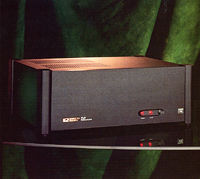
Kinergetics Research was a name to be reckoned with in the early days of CD, when they produced some of the earliest well-received, audiophile-grade CD players. They've branched out since then, producing amplifiers, preamps, subwoofers, and surround-sound processors. In fact, they're so busy with such products that they no longer build CD players! The last <I>Stereophile</I> review of a Kinergetics CD player appeared way back in 1993.
Continue Reading »

Mark Levinson No.37 CD transport & No.36S D/A converter

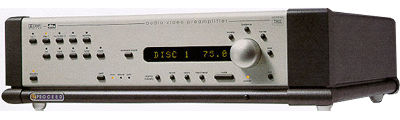
We are now well past the era in which every review of digital playback equipment had to begin with an apology for the medium. CD replay performance may, in fact, now be bumping up against a glass ceiling. But that doesn't discourage high-end audio manufacturers from trying to advance the art, and tempt audiophiles (at least those among us who are not hopeless digiphobes) out of our minds.

Continue Reading »

Vandersteen Cinema loudspeaker system (SGHT Review)

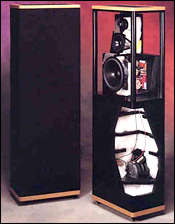
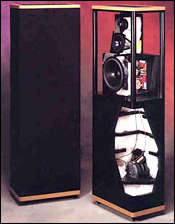
The Vandersteen 3A is a higher-end variation on the theme established by the company's first loudspeaker, the 2C. The latter is still available, though much updated into the current, highly popular 2Ce. A four-way design, the 3A has separate sub-enclosures for each drive unit; the whole affair is covered with a knit grille-cloth "sock" with wood trim end pieces. A rear-mounted metal brace allows the user to vary the tiltback&mdash;an important consideration for best performance with this loudspeaker.

Continue Reading »

KEF Reference Series Model Four loudspeaker

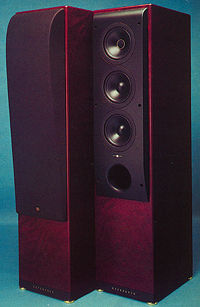
The Model Four is the largest model in KEF's current Reference series of loudspeakers, discounting the R107/2 Raymond Cooke Special-Edition (reviewed in a follow-up in October '95). It's also the largest KEF model that uses their Uni-Q&#174; loudspeaker configuration. When I visited the KEF factory last October with a group of audio journalists from the US, KEF emphasized the importance of Uni-Q technology to their future plans. They consider it proprietary, and intend to enforce the worldwide patents they hold on the design. One look at KEF's current line will be enough to tell you why they're so serious. Uni-Q drivers may be found not only in most of the Reference series, but in most of their other models as well. The most significant exceptions: the Raymond Cooke series, a few inexpensive models, and their THX-certified loudspeaker system.

Continue Reading »

Epos ES 14 loudspeaker

Americans might be forgiven if they haven't heard of Epos. A small, British specialist loudspeaker manufacturer, it was founded in 1983 by its designer, Robin Marshall—an ex-BBC engineer and a onetime consultant to Monitor Audio, according to Roy Hall of Epos's US importer, Music Hall. Their first model, the ES 20, didn't make it to the US, and was apparently a bit too pricey in the UK to make much of a splash there (about £700, $1300 at the current rate of exchange—a mint in a country with the patent on sub-$500/pair (UK prices!) two-ways). In 1986 or thereabouts, the new, smaller ES 14 was introduced, using updated versions of the same drivers in a smaller, ported cabinet. Music Hall only recently began importing the Epos into the US.
Continue Reading »

Energy Veritas v2.8 loudspeaker

If Canada has emerged as a hotbed of loudspeaker production in the past few years, the folks at Audio Products International must be positively sizzling. Of their three lines&mdash;Mirage, Energy, and Sound Dynamics&mdash;Mirage is perhaps the best known in the US, with Energy running a distant second. Mirage, at least in their flagship M series, features rather esoteric bipolar designs, while Energy sticks to the more conservative, forward-radiating approach. <I>Stereophile</I> has had extensive exposure to the various Mirages (a review of one of the M-series babies, the M-7si, is scheduled for a future issue); our exposure to Energy has been virtually nil, save for the odd Hi-Fi Show and CES. And thereby hangs a tale.

Continue Reading »

Vandersteen Audio 3A loudspeaker

High-end-audio manufacturers are both more and less adventurous than their more mainstream contemporaries. While mainstream-audio manufacturers will almost invariably change their models every year, the changes are more often than not cosmetic&mdash;at least in between successive models. High-end manufacturers, on the other hand, will keep the same model in the line for several years, but make cosmetically invisible refinements along the way.

Continue Reading »
Advertisement
Advertisement
Advertisement