John Atkinson

Audio Note Compels

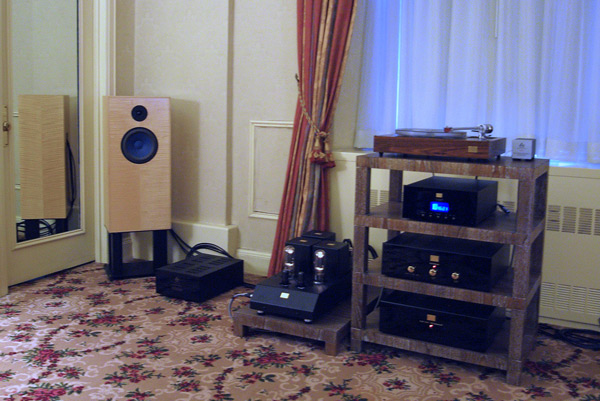
The corner placement required by Audio Note speakers always raises my eyebrows—there was even a mirror next to one of the speakers!—but the sound of Ivan Moravec performing Brahms late piano works, the Op.118 Intermezzi, on a secondhand Turnabout LP, was extraordinarily engaging on the Audio Note AN-E Lexus Signature loudspeakers. This was the last room I visited Saturday night and I didn’t feel the need to visit any more rooms for more music.
Continue Reading »
Audio Doctor presents Scaena speakers

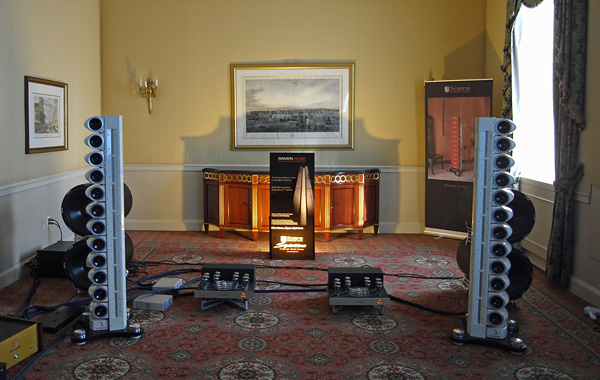
The Scaena Spiritus 3.4 loudspeaker system ($110,000), which uses separate tubular subwoofer modules to reinforce its line-source arrays of midrange units and Raven ribbon tweeters, sounded better than I had heard them at previous shows. As well as the C-J ART amplifiers mentioned by Art Dudley above, the system comprised a Kronos turntable with its contra-rotating platters, fitted with an SME V-12 tonearm and a Dynavector XV1S cartridge, an AMR tube phono preamp, and a fully loaded dCS Scarlatti digital front-end.
Continue Reading »

The Mighty YG Anat III Professional Signature speakers

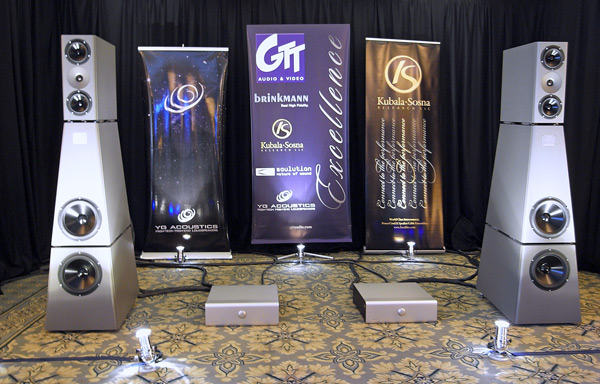
The YG Anat III Professional Signature speakers ($119,000/pair) in the GTT room had an attractive titanium finish. I thought a 45rpm test pressing of the Doors' "Riders on the Storm" sounding astonishing, especially John Densmore's drums, which, although recorded in mono in the right channel, had a combination of weight, realistic highs, and authority that I hadn't heard before from this over-familiar track.
Continue Reading »

Sightings #3: Checking out the Bricasti DAC

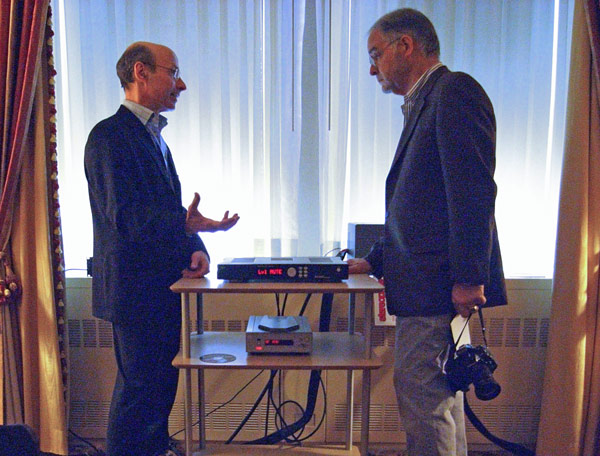
Audio Shows give industry professionals the chance to check out products they have read about in magazines. Here, Wilson's Peter McGrath (right) talks to Bricasti's Brian Zolner (The "Bri" in Bricasti) about the latter's M1 D/A processor that so impressed me in the February issue. Feeding data to the M1 was Rega's super- sexy Apollo CD player, which Sam Tellig will be reviewing in the July issue of Stereophile.
Continue Reading »

Lamm M1.2 Reference monoblock power amplifier

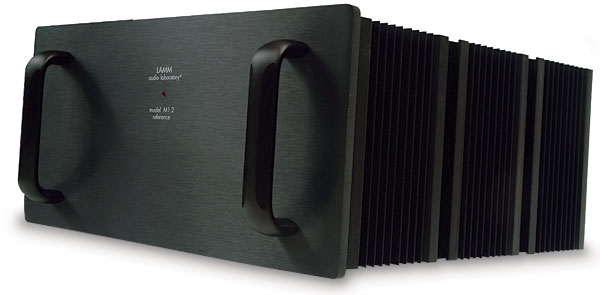
There is always a conflict between the needs of reviewers and the realities of the marketplace. Once a reviewer has invested his time and energy in a review, he would like that product to remain in production for all time, which would allow it to be used as a reliable recommendation forever. But whatever the product and whatever the category, sales of a product almost always follow the same triangular curve: a sharp rise at the product's introduction, a maximum reached sometime thereafter, and then a steady decline to a sustained but low plateau. Marketing-minded manufacturers therefore introduce a new model every three or four years, in hopes of turning that single triangle into a continuous sawtooth wave.
Continue Reading »

Sumo Samson subwoofer & Delilah crossover

Welcome back, Ladies and Gentlemen, to the continuing saga of the Englishman's Search for True Bass. In the previous episode (footnote 1), you witnessed Our Hero tussling with the problems of ported vs sealed-box woofer loading for full-range speaker systems. His conclusion? That ported designs may offer low-frequency quantity but it always seems to be at the expense of quality. If it's bass quality you want, you are better off with well-tuned sealed boxes, which explains why he is an unashamed fan of relatively small speakers with fast, tight upper bass. In this month's thrilling installment, JA—stiff upper lip thrust forward—wrestles with the problems of extending the bass response of his preferred speakers with a subwoofer from the Californian company of Sumo! Now read on . . .
Continue Reading »

Bricasti Design M1 D/A converter

Back in the late 1980s, it seemed a good idea: Separate a CD player's transport section from its D/A circuitry so that each could be optimally designed, and, as D/A technology improved, the sound of your CD player could be upgraded by replacing the outboard D/A processor. The catch was that the transport and D/A chassis needed to be connected with a serial data link: S/PDIF in optical or electrical flavors, or balanced AES/EBU. To minimize the number of cables required, the format of that link embedded the clock data within the audio data, which rendered the link sensitive to interface timing uncertainty, or jitter. (See "Bits Is Bits?," by Malcolm Hawksford and Chris Dunn.)
Continue Reading »

The Extreme MBL X-Treme

At the previous Shows where I had auditioned it, MBL's extravagantly excessive (or should that be excessively extravagant) X-Treme system had been set-up in inappropriate rooms, Finally, at the 2012 CES, this 4-enclosure system, which basically comprises two of the true omnidirectional upper-frequency modules of the Berlin-based company's 101E Mk.2 speaker (to be reviewed by Mikey Fremer in the April 2012 issue) with two man-sized powered subwoofers, each using six 12" drivers mounted three on each side to cancel mechanically induced vibrations, was set up in a room worthy of it. (The Venetian room was 31' by 22' with a 10' ceiling.) Bi-amped with four file-cabinet–sized MBL 9011 monoblocks—the total system cost was $565,000!—the X-Treme produced a big-bottomed sound that was indeed extreme when required but also delicate when appropriate. Oh my!
Continue Reading »
Advertisement
Advertisement
Advertisement