John Atkinson

Wilson's Watch Dog—New and Improved
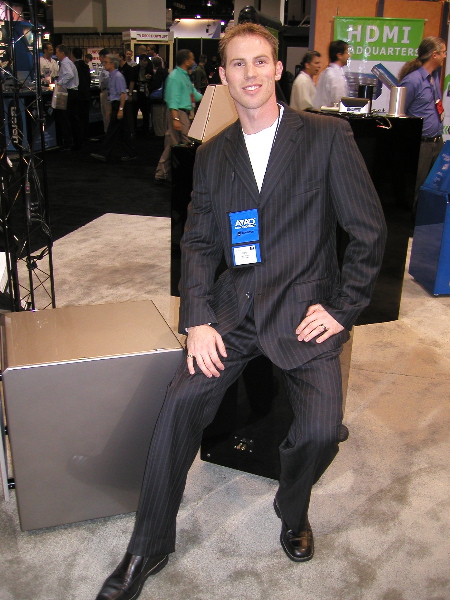
With David and Sheryl Lee Wilson in Europe for the Milan and London Shows, son Daryl demonstrated for me how the Utah company’s newly redesigned Watch Dog subwoofer doubles as designer seating. The sub is now a more manageable passive design, one third smaller than the original, and is stackable. The Passive Dog can be controlled either by a home theater system’s bass management or, in a music system, by the outboard Watch Controller. This has both balanced and single-ended inputs and outputs, and features versatile high- and low-pass filters.
Continue Reading »

Now That's Cute!

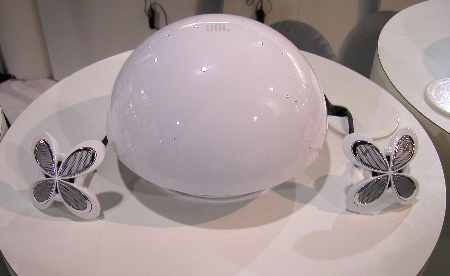
For $129.95, the JBL Spyro 2.1 system&mdash;available in black, fuschia, or retro blue with chrome highlights, as well as white&mdash; hooks up to your MP3 player and provides 6Wpc of neodymium-magnet Odyssey satellite power and 24W of Atlas woofer action. But don’t you just <I>love</I> the stylin’ styling! <I>Not</I> just for Spyro the Dragon gamers.

Continue Reading »

Slim Devices Squeezebox WiFi D/A processor

As readers of the <I>Stereophile</I> eNewsletter will be aware, the twin subjects of distributing music around my home and integrating my iTunes library of recordings into my high-end system have occupied much of my attention the past year. I bought an inexpensive Mac mini to use as a music server, using an <A HREF="http://www.stereophile.com/digitalprocessors/505apple">Airport Express</A> as a WiFi hub, which worked quite well, but my big step forward was getting a Squeezebox. I described this slim device in the <A HREF="http://www.stereophile.com/images/newsletter/306Bstph.html">mid-March</…; and <A HREF="http://www.stereophile.com/images/newsletter/406Bstph.html">mid-April</…; eNewsletters; I urge readers to read those reports to get the full background on this impressive device. In addition, the forums and Wiki pages on the <A HREF="http://www.slimdevices.com/dev_overview.html">Slim Devices website</A> offer a wealth of information on getting the most from a Squeezebox.

Continue Reading »

Meridian D600 digital active loudspeaker

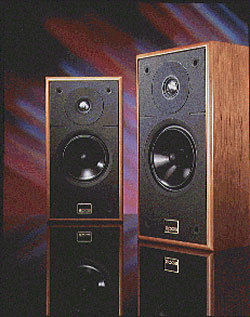
In audiophile circles, it is the "Stuart"&mdash;electronics designer Bob Stuart of the Boothroyd-Stuart collaboration&mdash;who has received most recognition. The contribution of industrial designer and stylist Allen Boothroyd has gone relatively unremarked. Yet as I unpacked Meridian's D600 "Digital Active" loudspeaker, I was struck by Boothroyd's ability to make the humdrum&mdash;a rectangular box loudspeaker&mdash;seem more than just that. The man has one hell of an eye for proportion. From the first Orpheus loudspeaker of 1975, through the Celestion SL6 and '<A HREF="http://www.stereophile.com/standloudspeakers/744">SL600</A&gt; (where AB did the industrial and package design), to this latest Meridian loudspeaker design, his brainchildren look "right," to the extent of making competing designs appear at minimum over-square and clumsy, if not downright ugly.

Continue Reading »

Classé cdp-202 CD/DVD player

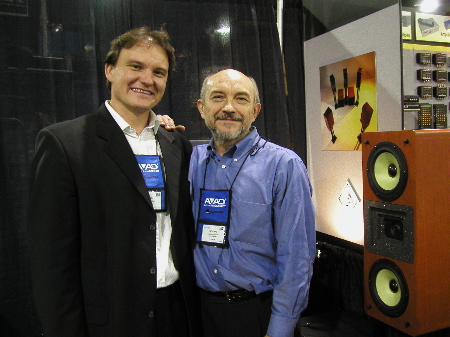
When, at the beginning of this century, the market profile of the high-end Mark Levinson brand took a dip due to the parent company's reorganization, one of the companies that took advantage of the opportunity was Class&#233; Audio. Founded in 1980 by engineer Dave Reich (now with Theta Digital) and run by engineer-entrepreneur Mike Viglas since the mid-1980s, the Canadian electronics manufacturer's Omega line of high-end <A HREF="http://www.stereophile.com/solidpoweramps/878">amplifiers</A&gt; and <A HREF="http://www.stereophile.com/solidpreamps/132">preamps</A&gt; had universally impressed <I>Stereophile</I>'s scribes, and its Omega SACD player (<A HREF="http://www.stereophile.com/hirezplayers/474">reviewed</A&gt; by Jonathan Scull in November 2001) was the first such product to come from a North American company.

Continue Reading »

Epos ES12 loudspeaker

Blind loudspeaker listening tests are hard work, not least because usually, most of the models being auditioned fail to light any musical sparks. But back in the spring of 1991, when a small group of <I>Stereophile</I> writers were doing blind tests for a group speaker review, one speaker did light up smiles on the listeners' faces, including my own. (We don't talk during our blind tests, but it's more difficult to keep body language in check.) Once the results were in, we learned that the speaker that got the music right in that test was the diminutive ES11 from Epos in England (footnote 1).

Continue Reading »

Rogers Studio 3 loudspeaker

Back in the early 1970s, the BBC needed a physically unobtrusive, nearfield monitor loudspeaker for use in outside-broadcast trucks. Accordingly, they instructed their design department, which at that time featured such luminaries as Dudley Harwood (the "father" of the polypropylene cone, who went on to found Harbeth) and the late Spencer Hughes (the "father" of the Bextrene cone, who went on to found Spendor), to produce such a model. Thus, not only was what was then probably the finest collection of British speaker-design talent involved in its development, there were no commercial constraints placed on the design. The only limitations were intended to be those arising from the necessarily small enclosure and the absence of the need for a wide dynamic range under close monitoring conditions.

Continue Reading »

David Inman

After I decided to <A HREF="http://www.stereophile.com/asweseeit/352">join <I>Stereophile</I></A> as its editor in the spring of 1986, I took a road trip through Europe. The ostensible reason for the trip was to attend a hi-fi show in Lucerne, Switzerland, but the reality was that, faced with the transatlantic dislocation, I wanted to touch base with places that had meant much to me over the preceding years. I took the train to Paris, where I spent a day taking what might have been my last look at the Impressionist paintings (then at the Jeu de Paume gallery, now at the Mus&#233;e d'Orsay), then drove the rest of the way to Lucerne with KEF's then marketing manager David Inman.

Continue Reading »

David Smith, 1951-2006

I was saddened to hear of the untimely death of David Smith, vice-president of audio engineering and R&D at Sony Music Studios in New York. David, who was 55, died Saturday June 17, at the home of his mother on Long Island.

Continue Reading »
Advertisement
Advertisement
Advertisement