AudioQuest Compares AC Cables
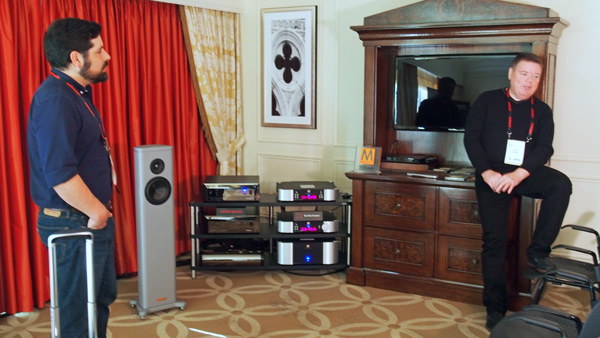
If there is one thing that raises the hackles of engineers, it is audiophiles' insistence that power cords affect sound quality. But at CES, AudioQuest's Garth Powell (right in photo, with AQ's Alex Brinkmann) was showing how changing just one cable in a system, the one connecting a Simaudio Moon CD player to a Niagara 700 power conditioner, could make or break the system's sound quality. Playing a track from Muddy Waters' Folk Singer, with Moon amplification and Magico S1 Mk.2 speakers, and without changing the volume, Garth compared AudioQuest's new Thunder cable ($700) with AC cables from other companies priced up to $18,000, culminating with the AudioQuest Dragon ($4000).
Continue Reading »



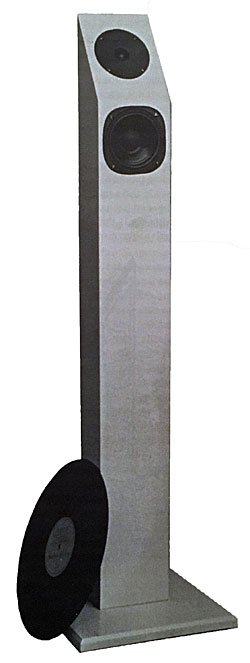 One of the joys of reviewing loudspeakers is that there are always intriguing aspects of any particular design. The problems involved in producing a speaker that has an even tonal balance, well-controlled directivity, good bass extension, and a smooth integration of the outputs from often widely disparate drive-units have what appears to be an infinite number of solutions. The result is often a speaker so different from the norm that it just cries out to be auditioned.