John Atkinson

Acapella High Violoncello II loudspeaker

Stereophile's founder, the late J. Gordon Holt, always had a thing for horn loudspeakers, feeling that these archaic beasts offered a "jump factor" that could never be rivaled by conventional, direct-radiating designs. A horn drastically increases the efficiency with which electrical power is converted into acoustic power, which means that for a given sound-pressure level, a smaller amplifier can be used compared with a direct-radiator, and that all distortions, both electrical and mechanical, can theoretically be much lower. Yet outside of a small circle of enthusiasts, horns never got much of a following in high-end audio, and as high amplifier power became plentiful and relatively cheap, horns largely disappeared from domestic audio use (except in Japan).
Continue Reading »

Pierre Lurne: Audiomeca's Turntable Designer

Someone, I forget who it was, once wrote a perceptive essay on how in any field of human endeavor, apparent perfection is attained only when that field is in the process of being superseded. The Palace at Versailles was built when the power of the French monarchy was well into decline; Wagner's "music of the future" was in fact the end of a particular line of development; the nuvistor was developed almost simultaneously with the silicon transistor which would render tubes almost obsolete; and six years after the commercial introduction of Compact Disc, with record shops increasingly filling up with silver discs, to the detriment of black, turntables exist which render LP playback pretty much on a level with CD technically (many audiophiles, of course, feel that the LP has <I>always</I> been musically ahead).

Continue Reading »

Image Concept 200 loudspeaker

I like reviewing loudspeakers. The more you become familiar with the art, the greater the sense of anticipation as you open up a pair of cartons. A visual inspection of the speaker always reveals a challenging mixture of the familiar and the new. The size of the cabinet is always the first clue&#151;has sensitivity been a design priority or was low-frequency extension uppermost in the designer's thoughts? You espy a known drive-unit&#151;has this tweeter's propensity for upper-presence sizzle been tamed? You find a reflex port on the rear panel&#151;has the temptation to go for a "commercial," under-damped bass alignment been successfully resisted? You spot factors which intuitively seem wrong for precise stereo&#151;a wide baffle lacking any kind of absorbent covering for diffraction control; a grille frame which puts acoustic obstacles in the way of the wavefront emerging from the tweeter.

Continue Reading »

Rich May of Sumo: An Audio Dynasty

Way back in the mists of time, around 1980 to be exact, the Marantz company in Europe introduces a range of ostensibly cost-no-object solid-state electronics under the "Esotec" banner. Manufactured in Japan, but apparently designed in the USA, these ruggedly constructed components are noteworthy in that the power amplifiers are capable of being operated with the output stages running under class-A bias as well as class-B. The relatively expensive Esotec amplifiers sell in small numbers in the UK&#151;remember that this is before the rebirth of the British high end&#151;and pass into the history books. I am reminded of them, however, when I visit my friend Ivor Humphreys of <I>Gramophone</I> magazine at Christmas 1987; he is using a pair of the 30W mono class-A Marantz amplifiers to drive <A HREF="http://www.stereophile.com/floorloudspeakers/550">KEF R107</A>s&#151;and making very nice sounds.

Continue Reading »

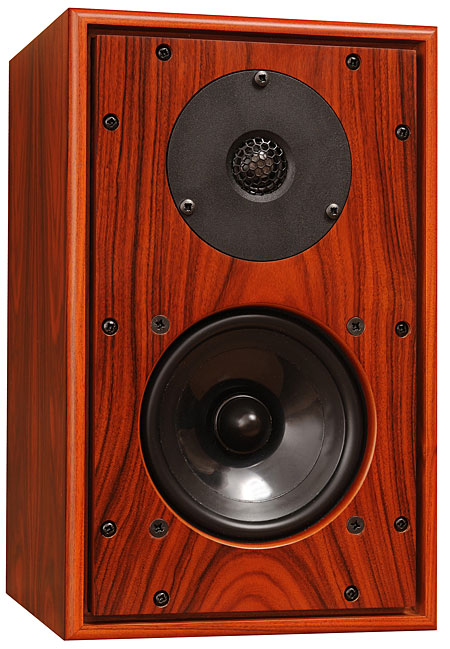
Harbeth P3ESR loudspeaker

Everyone wants something different from a loudspeaker. Some people value midrange neutrality above all, while others will sacrifice some of that accuracy to get extended lows or a speaker that will play immensely loud with only a few watts of power. Some want stereo imaging that is sufficiently delicate, stable, and accurate that the speakers open a transparent window on the recording's original performing space. Some will sacrifice all of the above to get a speaker whose "jump factor" can jerk zombies out of their stupor. And there are those who are prepared to lose just a little bit of everything in order to have a speaker that may not excel in any of these areas, but communicates what they want from their music in the most effective overall manner.

Continue Reading »

Polk RTA 11t loudspeaker

According to the conventional wisdom, companies selling consumer products fall into two categories: those whose sales are "marketing-led" and those whose sales are "product-led." Marketing-led companies tend to sell mature products into a mature market where there are no real differences between competing products&#151;soap powder, mass-market beer, or cigarettes, for example&#151;whereas product-led companies tend to sell new technologies, such as personal computers and high-end hi-fi components. In the audio separates market, conventional wisdom would have a hard time categorizing any individual company: no matter which you choose, it would be simplistic to say that it is either product- or marketing-led. No matter how good the product, without good marketing the manufacturer stands little chance of success; a poor product superbly marketed may make a company successful overnight, but that success will have hit the end stops by the following night. Nevertheless, for this review, I have chosen a model from a company renowned for its marketing strength: Polk Audio.

Continue Reading »

Focal Maestro Utopia III loudspeaker

Considering that the crates they're shipped in are each as large as a Manhattan studio apartment, once they'd been set up in my listening room, Focal's Maestro Utopia III speakers weren't as visually overpowering as I'd anticipated. The elegant dark-gloss front baffles, the gloss-gray side panels, and the fact that the speaker's three subenclosures are vertically arrayed so that the top, midrange section is angled down, significantly reduced their apparent size.

Continue Reading »

CEntrance DACport USB headphone amplifier

I have built up a large collection of CDs since the medium's launch more than a quarter century ago, along with a modest number of SACDs and a small number of DVD-As. But I find these days that, unless I'm getting down to some serious listening and can give the music my uninterrupted attention, I use iTunes to feed computer files to my high-end rig (footnote 1). I've mostly been using the superb-sounding combination of <A HREF="http://www.stereophile.com/hirezplayers/dcs_puccini_sacd_playback_syste… Puccini U-Clock and Puccini</A> player/DAC that I reviewed last December to take a USB feed from a Mac mini, but I've also been using the <A HREF="http://www.stereophile.com/digitalprocessors/bel_canto_usb_link_2496_us… Canto USB Link 24/96</A> and <A HREF="http://www.stereophile.com/digitalprocessors/lindemann_amp_stello_usb-s… U2</A> USB-S/PDIF converters, particularly for headphone listening, when I use one of those two format converters with a <A HREF="http://www.stereophile.com/digitalprocessors/886">Benchmark DAC1</A> D/A headphone amplifier.

Continue Reading »

iPad Daze

"Reviewed in the box!" is what <I>Stereophile</I>'s founder, the late <A HREF="http://www.stereophile.com/news/j_gordon_holt">J. Gordon Holt</A>, used to call it. You might think you're reading a review, but the realization slowly dawns that there's nothing in the text that could not have been gleaned from the manufacturer's brochure, nothing to indicate that the writer had even opened the box the product came in. When I read a review in another publication or online, I judge it by doing what I recommend <I>Stereophile</I>'s readers do when they read <I>this</I> magazine: I look for the nugget I <I>didn't</I> already know, the facet I <I>wasn't</I> expecting, the concluding jewel I <I>couldn't</I> have predicted without ever having tried the component myself. Sadly, all too often too many of what are promoted as "reviews" on the Web are merely descriptions.

Continue Reading »
Advertisement
Advertisement
Advertisement