John Atkinson

Quad Reference ESL-2805 loudspeaker

I gasped. An almost perfect 300Hz squarewave had appeared on the oscilloscope screen—something I had never before seen from a loudspeaker.

It was the spring of 1982. John Crabbe, then editor of the British magazine Hi-Fi News & Record Review, and I had driven up to Quad's factory in Huntingdon, England. The ESL-63 electrostatic loudspeaker had been launched the previous summer, and we were to interview its designer, Peter J. Walker, for an article that would appear in the July 1982 issue of HFN/RR. Peter set up a pair of ESL-63s on wooden kitchen chairs, fed one of them a 300Hz squarewave, casually placed a mike before it, and showed us the result on the 'scope. "Of course, why should a speaker being able to reproduce a squarewave matter at all, hmmm?" he rhetorically asked us.
Continue Reading »

"If it sounds good..."

"...and measures bad, then you're measuring the wrong thing!" If one motto could sum up this magazine's philosophy, this would be it. Too many times we have discovered components that sounded musically fabulous while offering measured performance that was, at best, merely competent. Yet recently, I'm starting to lose confidence in that old saw.

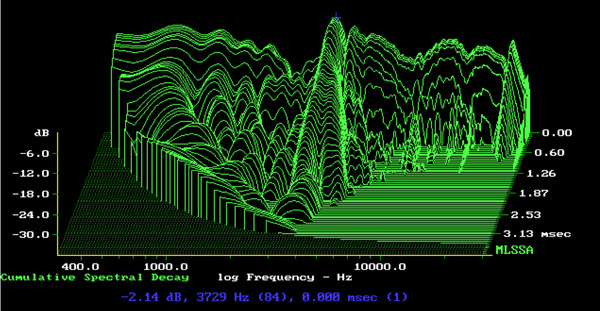
On a number of occasions, I or another of Stereophile's reviewing team has heard a product sounding flawed in ways later revealed by measurements. A closed story, you might think—but consider the NEAR-50M loudspeaker reviewed by Dick Olsher in this issue. Despite hearing many good things in the speaker's sound, Dick was bothered by a tonal-balance problem in the low treble. He was also disturbed by a lack of integration between the tweeter and midrange unit. When I measured the '50M, my response graphs (footnote 1) pretty much explained why Dick heard what he heard. Nevertheless, other reviews of this loudspeaker have been ecstatic in their praise, one even stating that it was "one of the most transparent and balanced dynamic loudspeakers available at any price" (my italics).

Continue Reading »

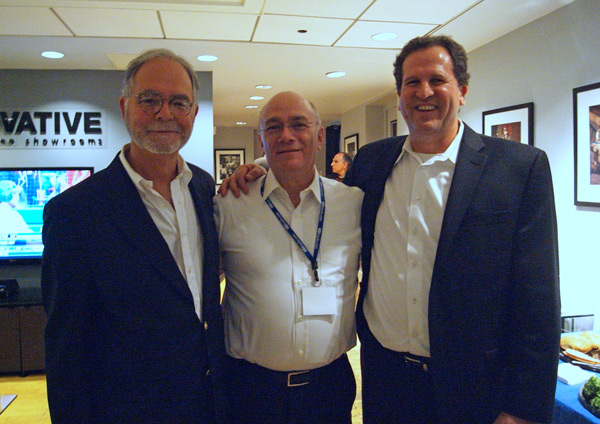
Innovative Innovative Audio

Innovative's Elliot Fishkin (center) flanked by Wilson Audio Specialties' Peter McGrath (left) and VTL's Luke Manley (right).

As we reported below, Manhattan retailers Lyric and Stereo Exchange decided not to participate in the New York Audio & AV Show, instead holding standalone events at their stores. There are valid reasons for this decision, not the least of which is that the manufacturers are spared the crapshoot of setting up their systems in rooms with unknowable acoustics. By contrast, every dem room at a retailer is, or should be, an optimized machine for making audio components sound at their best, which surely is the point. However, if every retailer decided to do this, there would be insufficient support for the main show to take place. There would thus be no shows at all, an example of what has been called the "Tragedy of the Commons."

Props, therefore, to Innovative Audio, who both participated in the NY Audio & AV Show with passive and active rooms, but who also invited Showgoers to their premises after the Show closed Friday and Saturday evenings to take a listen under more controlled conditions.

Continue Reading »

Gradient Conquers Room Acoustics

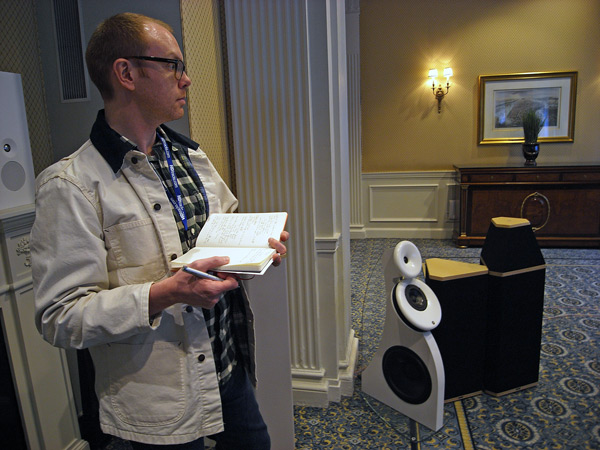
The dipolar Gradient speakers from Finland being demmed in the SimpliFi suite had an advantage over conventional speakers at the NY Show, in that they better coped with the Waldorf=Astoria's often-problematic room acoustics. Partnered with Bladelius electronics and DNM cabling, the Revolution speakers (right) were paired with the matching Radiant subwoofer (center), which features two 12" drivers to produce uncolored, full-range low frequencies. Stephen Mejias was sufficiently impressed to look up from his notebook. The white speaker is Gradient's Helsinki 1.5, which Art Dudley reviewed in August 2010
Continue Reading »

The 384k Da Vinci DAC

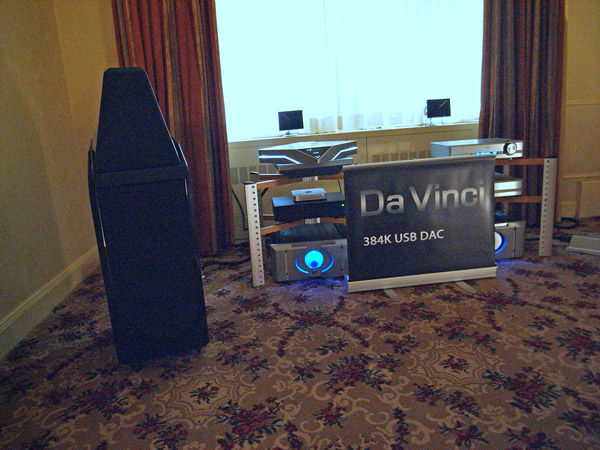
I had seen and heard a prototype of the Light Harmonic's Da Vinci DAC at the 2011 Axpona Show, but the 2012 NY Show saw the debut of the production version of this unique $20,000 DAC, which handle data with sample rates up to 384kHz over an asynchronous USB 2.0 link. Demmed in a system comprising Wilson Sasha W/P speakers, driven by a Pass Labs X100.5 amplifier and XP20 preamp, with all-MIT cabling, wit data sourced from an iPad-controlled Mac mini, the Da Vinci produced a sound that thrilled. A 384k-sampled recording of voice and acoustic guitar by Cookie Marenco sounded palpably real. I am planning on reviewing the Da Vinci in the late fall.
Continue Reading »

The Tweak Studio & Burmester & Walker

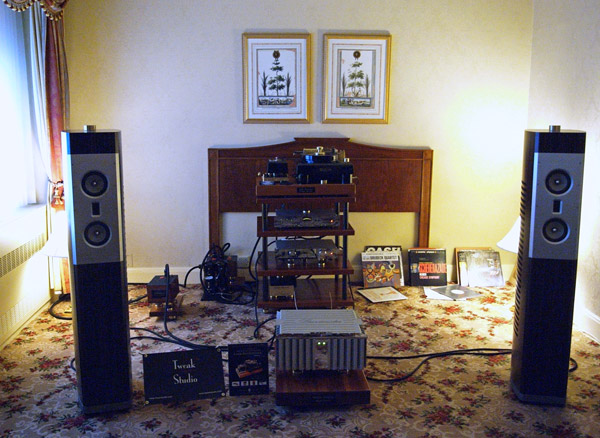
As well as providing the sound for the seminar room, which was where a recorded music concert, titled "Euphoria at the Waldorf," was presented Friday and Saturday evenings, The Tweak Studio's exhibit room also featured components from the premium German manufacturer Burmester: a pair of 380 Mk.2 speakers driven by a 911 power amplifier and an 088 preamp. Source was a Walker turntable and arm fitted with a Soundsmith Sussuro Hyperion cartridge. There was much to admire in this system's reproduction of Louis Armstrong singing "St. James Infirmary," but as was the case with so many of the rooms at the Waldorf, the presentation was marred by over-ripe room acoustics.
Continue Reading »

MBL Rocks Peter Gabriel

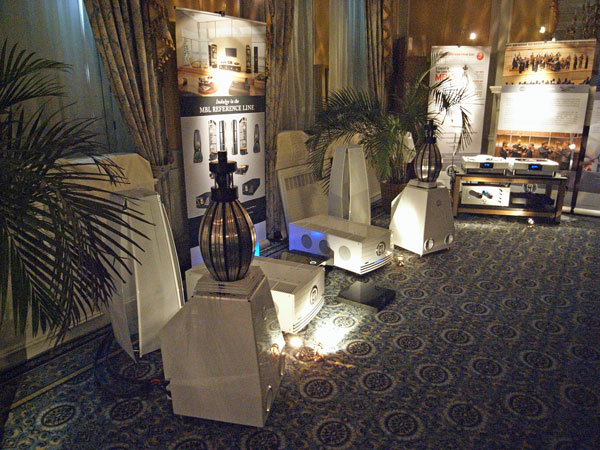
The MBL room was the last room I visited at the NY Audio & AV Show. I sat down in the sweet spot, on the couch midway between the MBL 101E Mk.2 "radialstrahler" speakers, each driven by a 9011 monoblock; Jeremy Bryan cued up a hi-rez file of Peter Gabriel singing "Wallflower," from his New Blood album; and OMG. This was true virtual reality! Then Jeremy explained what he had to do to tame the room's acoustics—see Ariel Bitran's blog following this one. All I can say is that it was worth the effort!
Continue Reading »

Legacy's Focus SE speaker

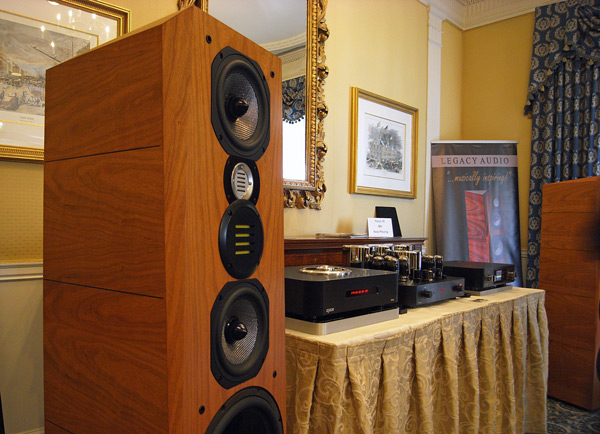
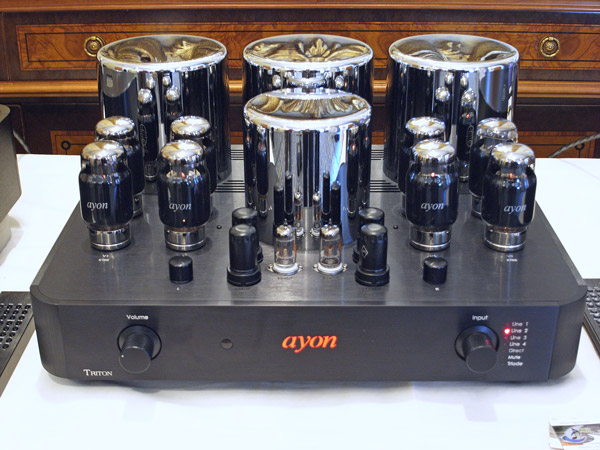
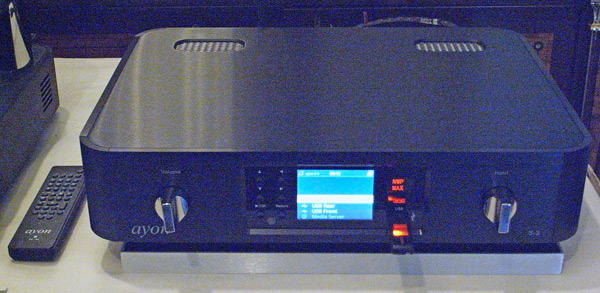
I had visited the Legacy room at the NY Show hoping to hear the Whisper XD, which had been one of my best sounds at the 2010 Axpona Show. Though I have auditioned this speaker at other shows since then, they had never been set up in rooms that did them justice. However, when I visited the Legacy room, the relatively affordable Focus SE speakers ($8750–$9250/pair, depending on finish), set up at the other end of the room from the Whispers, were playing. Driven by Ayon tube amplification, this speaker, which combines a 1" Kapton ribbon tweeter with a 3" Kapton-ribbon midrange unit, two Rohacell-reinforced graphite-cone woofers, and two 12" aluminum-cone subwoofers sounded pleasant enough, but the listening conditions were not sufficiently ideal for me to make a more confident judgment of the speaker's quality.
Continue Reading »
Advertisement
Advertisement
Advertisement