John Atkinson, Paul Messenger

William Zane Johnson 1926–2011
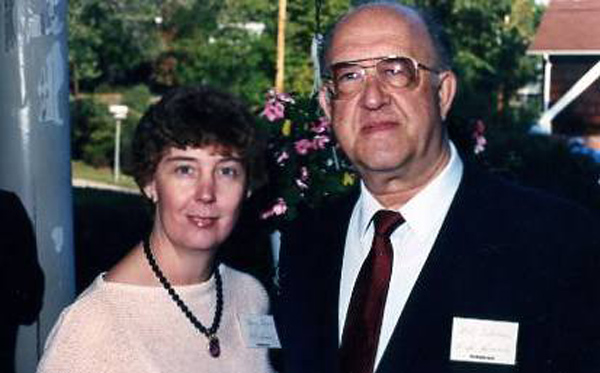
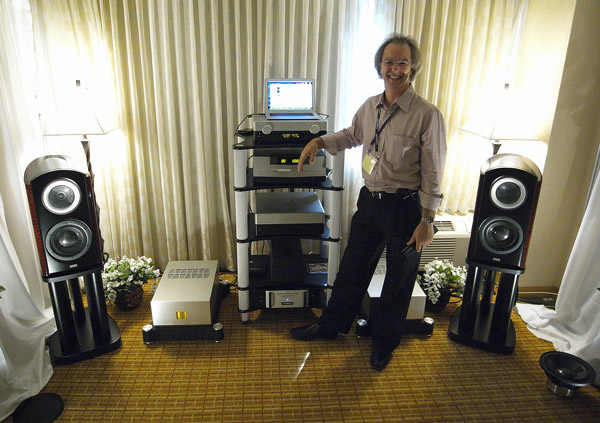
We were saddened to hear of the passing, on December 10,of Audio Research founder William "Bill" Zane Johnson. Bill, who founded Audio Research in 1970 and became its Chairman Emeritus in 2008, is survived by his wife Nancy (left in photo) and family. We are preparing a tribute to Bill, to be published in the March 2012 issue of Stereophile, but meanwhile, we are reprinting here an interview Paul Messenger and I conducted with Bill that was originally published in the June 1983 issue of Hi-Fi News. (My thanks to HFN editor Paul Miller for permission. Stereophile's 1994 interview with Bill can be found here.)—John Atkinson
Continue Reading »
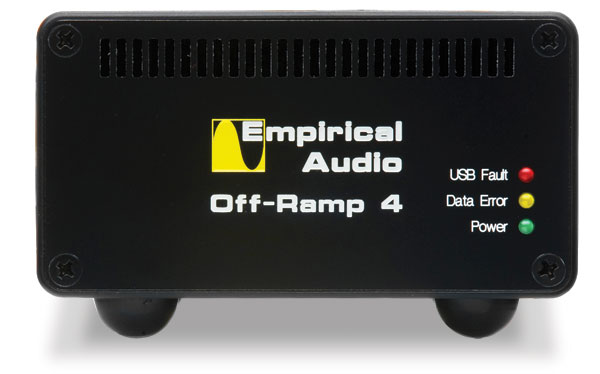
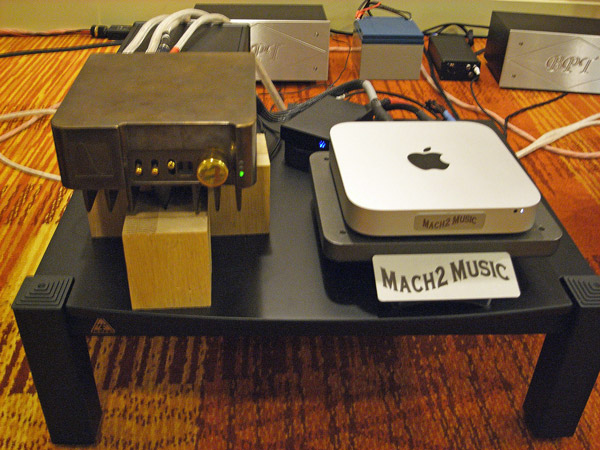
Empirical Audio Off-Ramp 4 USB format converter

If an audiophile visiting an audio show in 1991 were to have been transported two decades into the future, at first he would not be aware of any difference: A two-channel system would be playing in a hotel room. But on closer inspection, he would notice that the CD player, the ubiquitous source 20 years ago, would be conspicuous by its absence. Yes, there might be a turntable—"Good to see that people are playing LPs in the future," he would think—but why is there a PC in the room?
Continue Reading »

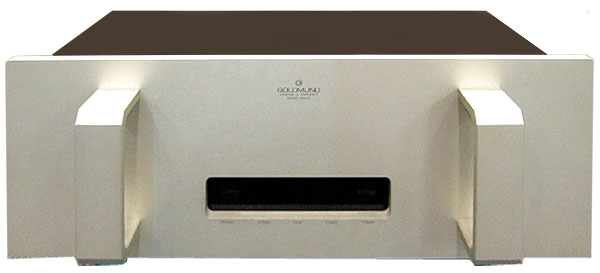
Goldmund Mimesis 8 power amplifier

To judge from the $6400 Mimesis 8, Goldmund walks its own way when it comes to power amplifier design. High-end solid-state amplifiers from US companies like Krell, Mark Levinson, Threshold, and the Jeff Rowland Design Group marry massive power supplies to large numbers of output devices (these often heavily biased to run in class-A), built on chassis of such nonmagnetic materials as aluminum. By contrast, the Mimesis 8 has a magnetic (steel) chassis, and uses a relatively modest power supply, that for each channel based on two main 4700µF reservoir capacitors. The 8 offers just two pairs per channel of complementary output MOSFETs (Hitachi K134/J49). These carry a modest bias current of around 80mA total.
Continue Reading »

That was the 2011 RMAF, that was!

The eighth Rocky Mountain Audio Fest, held October 14–16 at the Denver Tech Center Marriott, with Analogue Productions' Pink Floyd presentation at the Hyatt a couple of blocks down the road, was the largest yet, with an estimated 180 brands on show. We haven't yet seen the official attendance figures, though I wouldn't be surprised if they were a little down from last year, the corridors being more comfortable. But Show organizer Marjorie Baumert, seen here obviously having fun despite the pressure, is to be congratulated for making the RMAF a fun place to spend a weekend and a superb venue to see, but more importantly, to hear the best of what high-end audio has to offer music lovers. Thank you, Marjorie—we will see you in 2012.
Continue Reading »

The Magico Q1

Magico's Alon Wolf shows off his new Q1 stand-mounted speaker ($24,950/pair), which marries the beryllium-dome tweeter from the Q3 and Q5 floorstanders with a 7" Nano-Tec–cone woofer. The sealed, hard-anodized aluminum enclosure is braced and damped to minimize resonances. Despite its relatively diminutive size—it measures 14.2" H by 9" W by 14.2" D—the Q1 weighs 60 lbs.

Driven in Chicago retailer Musical Artisans' room by by BAlabo amplification, a Zanden phono stage, a Clearaudio turntable, and a Bottlehead-modded Nagra open-reel deck to play Tape Project tapes, the Q1s produced a full-range sound that flattered female vocals without sounding mellow or lacking in transparency.

Continue Reading »

Don Keele & the Constant-Directivity CRT36 Speaker

Speaker engineer Don Keele almost wrote the book on measuring speakers. so when I bumped into him at RMAF and he told me he had a new speaker on show, I went straight to his room. There, I saw and heard the CBT36, which as you can see, is very unusual in both appearance and design. CBT stands for Constant Beamwidth Transducer and is based on unclassified military underwater sound beam-forming research. There are 72 0.75" tweeters crossed over to 18 3.5" Dayton Audio midrange units, arranged in groups that, with the 36° arc of the 5'-tall array, gives sound that doesn't change its balance as the listener sits or stands. And as you can see from the mirror that Don has slipped in front of the speaker in my photo, the ground-plane reflection of the array effectively doubles its height.
Continue Reading »

TAD's Compact Reference. . .

. . . stand-mounted speaker is hardly compact but it is a reference. TAD's Andrew Jones was showing off the speaker, which combines a hi-tech coaxial tweeter/midrange array with a port-loaded, high-excursion woofer, with all-TAD electronics, including an asynchronous USB DAC and 600W-into-4 ohms solid-state monoblocks. What did I think of the sound? Well, for that all I will say is that it echoed what I will be writing in my January 2012 review.

On passive show were TAD's new entry-level E1 floorstanding speaker. Scheduled to cost $27,000/pair, the E1 uses a beryllium-dome tweeter and is a more refined development of the Pioneer S1-EX that so impressed Kal Rubinson a few years ago.

Continue Reading »

Peachtree's Grand Pre

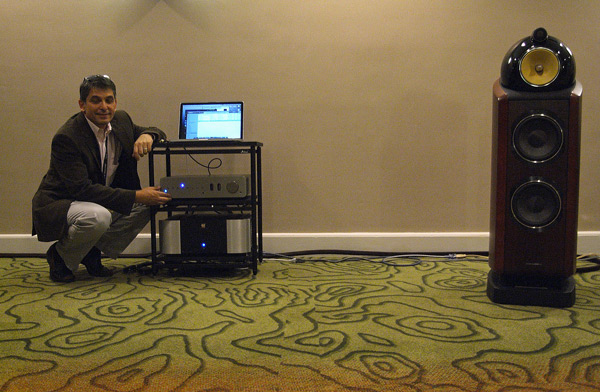
It's the perfect name for a preamp, I thought. Grand Pre, if not Grand Prix, has a certain ring to it. The first upmarket product from the company that has made a name for itself with its high-performance iDecco, iNova, and iDac, the Grand Pre will be priced at $3000. It combines the high-resolution ESS 9018 DAC chip with a buffer stage based on 12AX7 tubes, and offers both analog and digital inputs, including a 24/192k-capable USB input. Peachtree's David Solomon, shown in my photo,was demming the Grand Pre with a Simaudio Moon amplifier driving B&W 802 Diamond speakers, using Pure Music on his laptop to send it USB data.
Continue Reading »

Dan D'Agostino Momentum Preamplifier

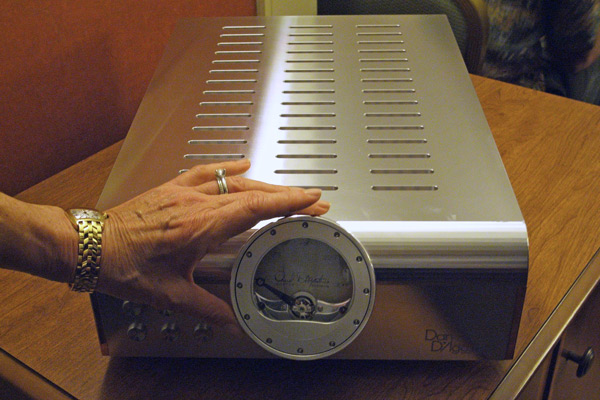
Stephen Mejias has already reported on the sound in the room shared by Wilson, Transparent, and Dan D'Agostino. I was equally impressed, agreeing with Millennia Media's John La Grou that one of Peter McGrath's classical recordings, Mahler's Symphony 5 performed by the New World Symphony under Michael Tilson-Thomas and captured with Joe Grado's omnidirectional microphones, was as good as it can get when it comes to two-channel representations of an orchestra. (John manufactures the very-low-noise mike preamps I use for my Stereophile recordings.) But I really just wanted to show another picture of the forthcoming Dan D'Agostino Momentum line preamplifier, with Dan's wife Petra lending me her hand for scale, as she rotates the volume control ring around the meter.
Continue Reading »

Empirical Audio Bronze DAC

I review Empirical Audio's pricey Off-Ramp 4 asynchronous USB–AES/EBU converter with its Monolith 1 battery supply in the forthcoming December issue and was impressed by the quality of its engineering as well as by its sound quality. At RMAF, Empirical's Steve Nugent showed me the Overdrive Ultra D/A converter ($10,000–$15,000), housed in a bronze case, which is well-damped. The DAC uses the Off-Ramp 4 circuit as its USB front-end and features just one analog stage following the I/V converter. Unusually, this uses a bipolar emitter follower instead of the common FET buffer. The digital circuitry is powered from the Monolith, feeding 12 Hynes-type regulators, though Steve Nugent feels that the analog stage sounds better when powered from a conventional AC-derived supply. The volume control in the DAC is elegant in that it reduces the reference voltage to the DAC chip, thus maintaining full digital resolution. There are two choices for full-scale output voltage.
Continue Reading »
Advertisement
Advertisement
Advertisement