John Atkinson

Enzo Natali R.I.P.

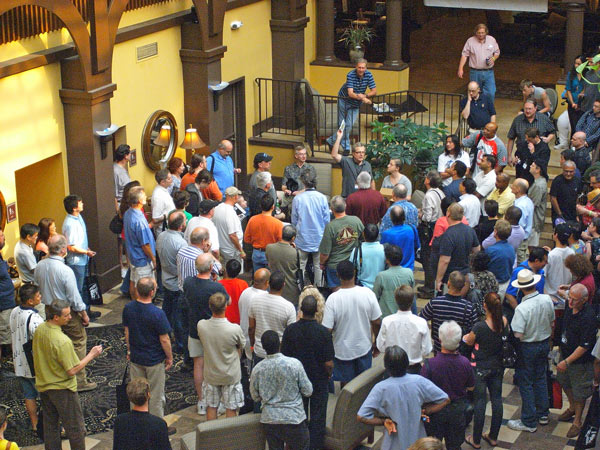
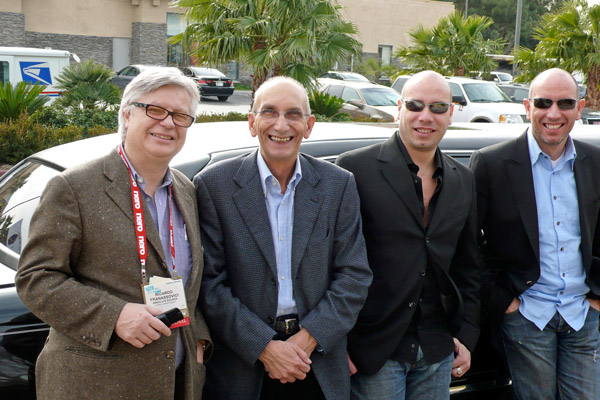
Just a brief comment to note the passing on Saturday August 11 of Italian audio distributor Enzo Natali, pictured at the 2012 CES second from left above with UK distributor Ricardo Franassovici (left) and Enzo's two sons Luca and Marco (right and far right). (My thanks to Ricardo for allowing me to publish both this picture and the one below.)
Continue Reading »
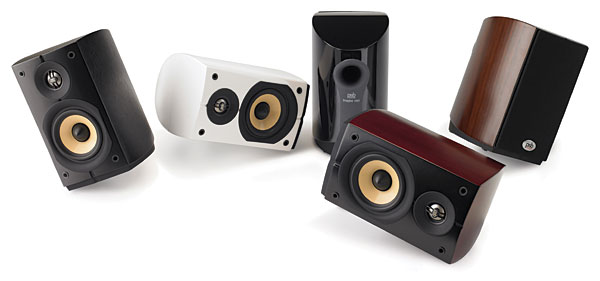
PSB Imagine Mini loudspeaker

The first loudspeaker I heard from the Canadian company PSB was the Stratus, an affordably priced ($1400/pair), two-way tower with a soft-dome tweeter and an 8" woofer. The Stratus had benefited from designer Paul Barton's being able to use the anechoic chamber at the Canadian government's National Research Center, in Ottawa. The Stratus was reviewed for Stereophile by J. Gordon Holt in our May 1988 issue; he described the speaker as "eminently listenable," though Gordon also felt that it was "a little lacking in guts and liveliness." I had sat in on some of his listening sessions and had been impressed by what I heard.
Continue Reading »

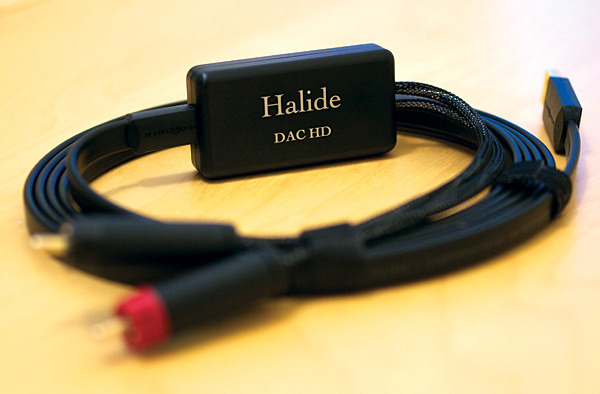
Halide Design DAC HD D/A converter

When it comes to getting audio from a PC via its USB port, the buzzword du jour is asynchronous. This cryptic term refers to which device has control over the timing of the audio data being streamed from the computer: the computer itself, or the device receiving the data. It might seem logical to have the computer control the timing, but this is not so. When digital audio data are converted to analog by a D/A converter, control over exactly when each dataword is converted is critical for the best quality of sound. Any uncertainty in that timing manifests itself as analog distortion, aka jitter.
Continue Reading »

Capital Audiofest 2012—Summing Up the Show

I said in my first story from this year’s Capital Audiofest, the third overall and the second to be held at the Crowne Plaza Hotel in Rockville, MD July 13–16, that this wasn’t like other audio shows. On the positive side, CAF had a great atmosphere, friendly and collegial, with great organization from Gary Gill and his team. The hotel had a goodly number of rooms with manageable acoustics, and the hotel staff was friendly and supportive. The live music was superb. Every showgoer I spoke with said that they were having a great time at CAF, that the Metro Washington DC area really does need a show like this, and it was great to hear so many products. And the nightly raffle—my photo shows Gary Gill holding up one of the prizes at the Saturday evening event—was an excellent draw, with the big prize a Benchmark DAC 1 D/A headphone amplifier.
Continue Reading »

Capital Audiofest—Day Two Early Afternoon

Lunch and live music both over, it was time to head back to the exhibits. First stop on the third floor was one of the rooms from Metro Washington DC retailer Command AV, featuring DeVore Fidelity’s Orangutan/96 speakers ($12,000/pair). Combining the unorthodox coupling of a 1” silk-dome tweeter with a 10” paper-cone woofer in a stunningly finished, wider-than-it-is deep enclosure, the O/96 offers a equally stunningly high sensitivity of 96dB/W/m. I had heard the O/96s at Artie Dudley’s a couple of weeks back and was impressed by how the O/96 matched the midrange magic of vintage speakers while adding things I deem essential, like highs and lows. The speakers sounded as good at CAF as they had in upstate NY, both speakers and room stepping out of the way of the music on the Ray Brown/Duke Ellington duo LP This One’s For Blanton.
Continue Reading »

Capital Audiofest—Day Two Lunch

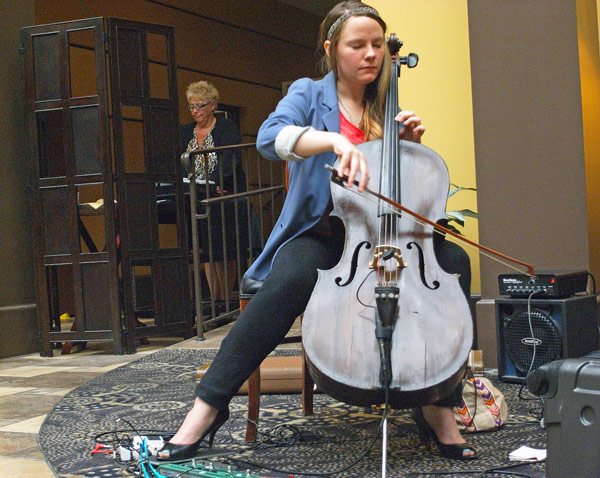
Back in the atrium, I set myself up with a Newkie Brown and a surprisingly good bowl of gumbo and sat back to listen to the set from Janel Leppin and Anthony Pirog, on electrified cello and electric guitar. Anthony, of course, has the 21st Century guitarist's usual battery of delay pedals, loop units, fuzz boxes, swell pedals, of course but so did Janel! She alternated long, lyrical melodic lines with strummed and pizzicato accompaniments, the two players creating ambient soundscapes reminiscent of what Robert Fripp was doing 20 years ago but with the cello adding a more human element. After the set, I picked up a copy of their album Where is Home? (CD or LP, Cuneiform Records), but the recorded sound, while conventionally good, is a shadow of what the duo create live.
Continue Reading »

Capital Audiofest—Day Two Morning

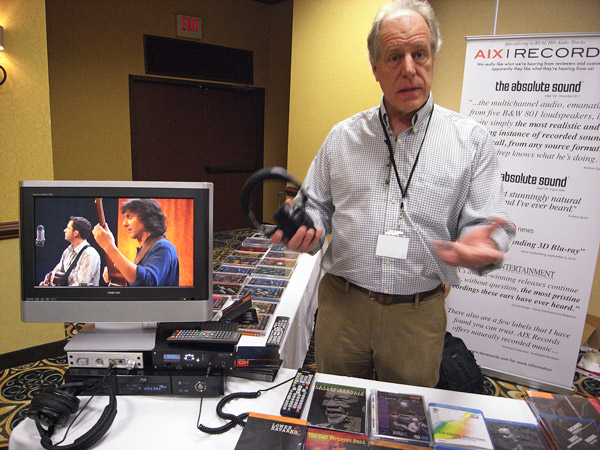
I started off Saturday morning at the Capital Audiofest by revisiting Salon II in the Crowne Plaza’s atrium, where I chatted with AIX Records’ Mark Waldrep. Recently the subject of a fascinating interview on AudioStream.com, Mark has been a voluble and ubiquitous advocate of high-resolution surround-sound recordings. At CAF, however, he was using headphones to demonstrate his AIX recordings. But with a difference—to the left of my photo you can see a Smyth Realiser, which allows full surround-sound to be experienced on headphones (see “Music in the Round,” November 2010). On the DVD-R versions of AIX releases, Mark has included full-resolution 2-channel FLAC files prepared with the Smyth Realiser from playback of the original multichannel recordings on his reference system. I tried one of these files, called “Headphones [xi],” and was impressed. The soundfield extended well outside my head, with good localization of the rear-channel information. In effect, I was transported via headphones to Mark’s listening room.
Continue Reading »

Capital Audiofest—Day One

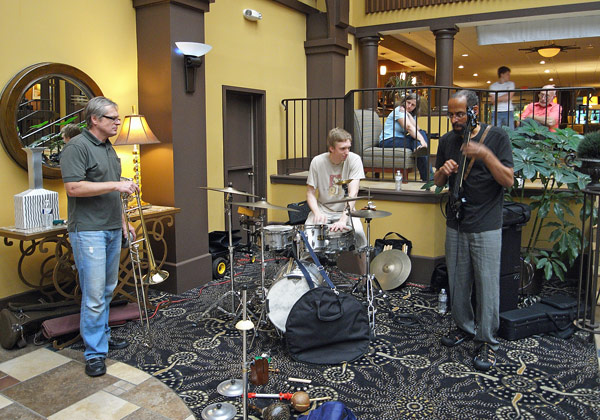
The Capital Audiofest is not like other shows, which was emphasized when I finally walked into the atrium of Rockville, MD’s Crowne Plaza Hotel. There was show organizer Gary Gill wailing on trombone in a set of free jazz with drummer Kirk Kubicek Jr. and bass player Harry Walker. Walker was playing/stroking/tapping a fretless Ashbory Bass, which makes up for its short 18” scale length by having very thick, heavy silicone-rubber strings. Despite the unstructured nature of the music, the trio created fascinating and compelling soundscapes, rivaled only by those created in a later set by headlining act Janel Leppin and Anthony Pirog, on electrified cello and electric guitar, respectively.
Continue Reading »

Lansche Audio 5.1 loudspeaker

The phenomenon of the "singing flame" has been known since the 19th century. Place electrodes either side of a flame and, if you apply a high enough audio-modulated voltage to those electrodes, the ionized particles in the flame will cause it to emit sound. (Search YouTube for "singing flame" and you'll find many examples.) This principle was developed into a practical loudspeaker in 1946 by a French inventor, Siegfried Klein, who confined an RF-modulated arc to a small quartz tube, coupled it to a horn, and called the resulting speaker the Ionophone. An intense radio-frequency electrical field ionizes the air between inner and outer electrodes to produce a distinctive, violet-tinged yellow flame in the quartz combustion chamber. When the RF field is modulated by the audio signal, this causes the almost massless ionized flame to expand and contract in what should be a perfectly pistonic manner.
Continue Reading »
Advertisement
Advertisement
Advertisement