John Atkinson

Meridian's Room-Friendly M6 Speaker
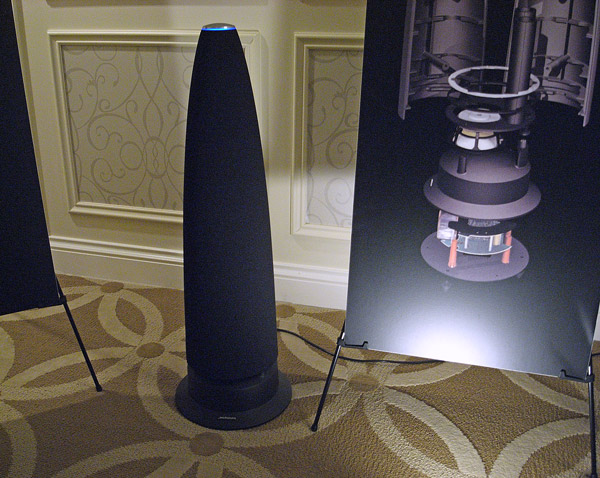
Other than the soft ring of blue light at the top, Meridian's new M6 powered loudspeaker ($9000/pair) looks unprepossessing but hides a wealth of high technology within its black enclosure. The entire range from 200Hz to 25kHz—two decades!—is handled by a single front-firing 3" driver at the top of the cabinet. This is a development of the drive-unit Meridian designed for the F80 music system and is coupled to a downward-firing woofer, which can be seen in the exploded diagram next to the speaker. The M6 has a digital input and the use of DSP for its crossover and equalization means it can be placed near room boundaries, maximizing its Spouse-Acceptance Factor. I listened to the Sheffield Drum Record from Bob Stuart's Sooloos server, controlled with the new iPad app, followed by Dire Straits, the pizzicato movement from Ravel's String Quartet. and the 2L hi-rez recording of Britten's Simple Symphony, and the M6 demonstrated surprising dynamics and clarity, coupled with an overall ease to its presentation. Yes, the lows were a bit too rich, but this is a fit'n'forget speaker system that non-audiophile music lovers will go ga-ga over.
Continue Reading »
40 Years of Meridian

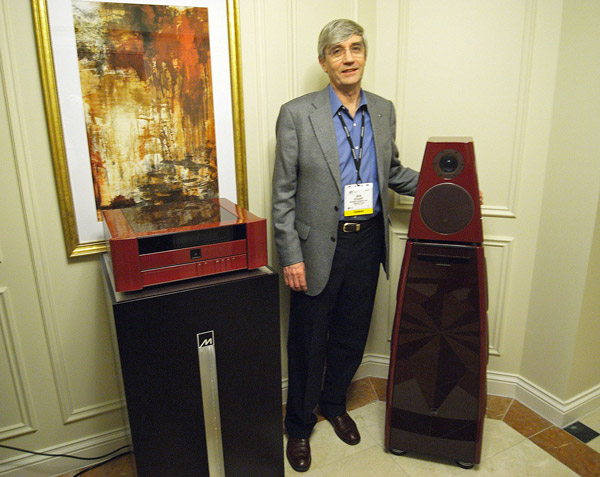
2011 witnessed the 40th anniversary of the founding of English manufacturer Meridian and the partnership between electronics engineer Bob Stuart and industrial designer Allen Boothroyd. To celebrate Stuart and Boothroyd created anniversary editions of the DSP-8000 active speaker and 808 Signature Reference CD Player, of which only 40 of each model will be made. Bob Stuart looks suitably proud of the models, which are finished in exclusive “Ruby” finish—not available on other products in the range—even the drivers are treated with a new, polished bezel. Each system is signed by Stuart and Boothroyd, comes with a book illustrating Meridian’s history, and will be set-up in the customer's home by a Meridian engineer.
Continue Reading »

The Mårten Django

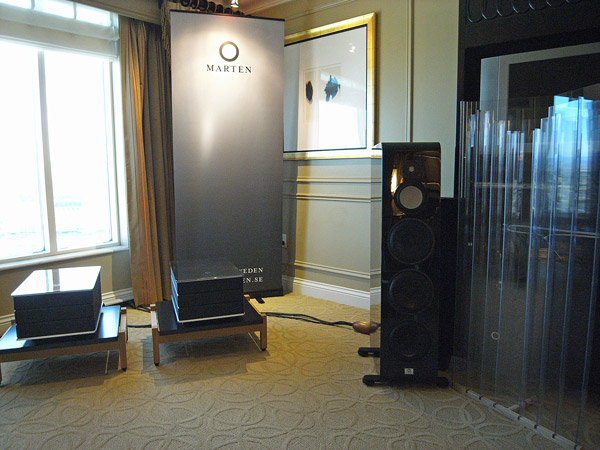
The Mårten Django represented a new direction for the Swedish speaker manufacturer, in that at $15,000/pair, it is considerably more affordable than the Mårten Coltrane speakers shown at earlier Shows. It still uses a ceramic tweeter and a ceramic-cone midrange unit, with three aluminum-cone 8" woofers, but in a less complex enclosure than the more expensive speakers. Downward-firing posts reflex-load the woofers. Set up across the room's diagonal, and flanked by Swedish SMT acoustic panels, the Jacques Loussier Trio performing an arrangement of an Eric Satie Gymnopedie was reproduced with superb low-frequency weight and definition. Amplification was Mårten's own M-Amp, with an MSB digital source. The Djangos were also being used in US importer Dan Meinwald's room, where they were being driven by EAR tube amps and a prototype EAR SACD player to great effect.
Continue Reading »

The Return of Franco Serblin

Sonus Faber co-founder Franco Serblin has started a new, eponymous company and two of his speakers, the floorstanding Ktema ($39,995/pair) and bookshelf Accordo ($12,995/pair) were being demonstrated in one of the Axiss Audio rooms in the Venetian. Amplification was all-Air Tight—ATM-3011 monoblocks, ATC-2 preamplifier, ATE-2 phono preamplifier, ATH-2A transformer—with the source a Transrotor Fat Bob S turntable fitted with an Audiocraft AC-3300 tonearm and an Air Tight PC-1 Supreme cartridge. The laidback sound of Norah Jones matched the superb looks of the speakers and the bass was full and warm—which impressed me the more when I realized I was listening to the stand-mounted Accordos, not the larger Ktemas.
Continue Reading »

Perfect8's Point Mk.II

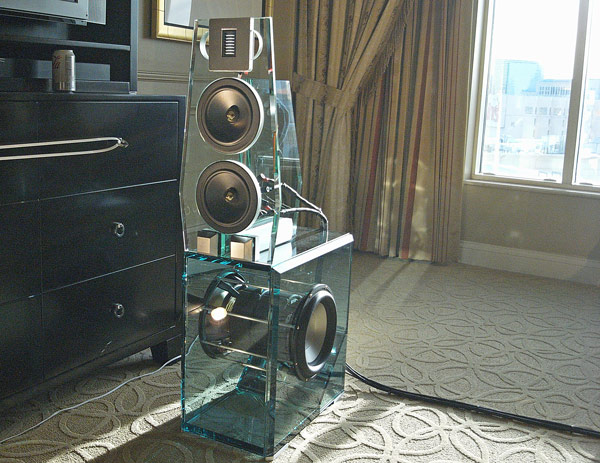
At the 2011 CES, Swedish company Perfect8 concentrated on their Force flagship speaker. For the 2012 Show, they brought their Point Mk.II ($115,000/pair with subwoofer modules), which, like its big sister, uses an enclosure fabricated from glass—or rather, from what Perfect8 calls "Super Silent Glass," joined without solvent-based adhesives. The upper-frequency module is a dipole, allowed to roll off naturally to integrate with the subwoofer module below it, which uses two 10" drive-units mounted on its sides to cancel mechanical reaction forces. The woofer's low-pass filter is set at 86Hz and realized in DSP; the module includes a class-D amplifier housed in the triangular section at the rear. Despite my reservations about glass as an enclosure material, both Diana Krall and Rimsky-Korsakov sounded uncolored and natural.
Continue Reading »

High-Efficiency Non-Switching Amp from THX

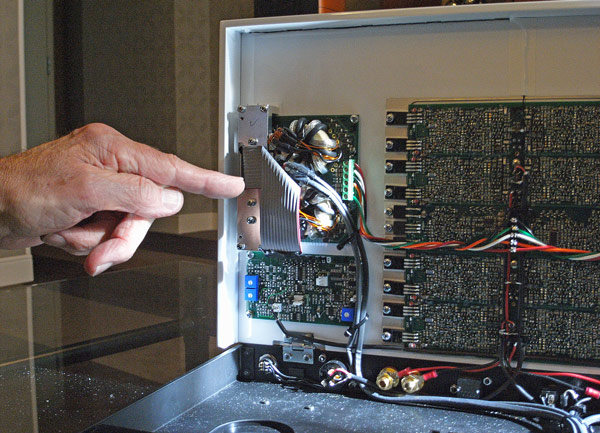
When I gave my Richard Heyser Memorial Lecture at last October's AES Convention, THX's Laurie Fincham was sitting in the audience. Afterwards, Laurie whetted my appetite for what the company would be presenting at CES: a patented non-switching power amplifier topology that would be as efficient as a class-D amplifier but without the side-effects that afflict such designs, high levels of radiated RF, for example. In the photo, Laurie is pointing to the power supply of the amplifier. DC is fed to two oscillators running at 25kHz, one generating a sinewave, the other a cosinewave, ie 90° out of phase with the sinewave. Each wave feeds a transconductance amplifier in the primary of a small transformer; the output of each secondary is rectified and summed to produce a high DC voltage which is then used to power the amplifier circuit. There are no storage capacitors in the circuit—it looks as if almost all the energy entering the supply is available as the final DC voltage! The new topology was developed by Fincham, Owen Jones (the twin brother of TAD's Andrew Jones) and Andrew Mason.
Continue Reading »

Crystal's Arabesque Mini

Crystal Cable's first loudspeaker, the Arabesque, used a complex-shaped enclosure fabricated from glass panels. Three years later, the Dutch company showed the new Arabesque Mini ($25,000/pair plus $1000/pair for matching stands), which uses a small aluminum cabinet with the same "comma" cross-section as the glass speaker, a shape that confers advantages when it comes to controlling the inevitable air-space resonances. A beryllium-dome tweeter is coupled to a long-throw, 1" maximum excursion (presumably peak–peak) 6" woofer. Crystal specifies distortion as being <0.5% from 120Hz to 20kHz, though no spl is given for this specification.
Continue Reading »

The Mighty YG Anat III Signature

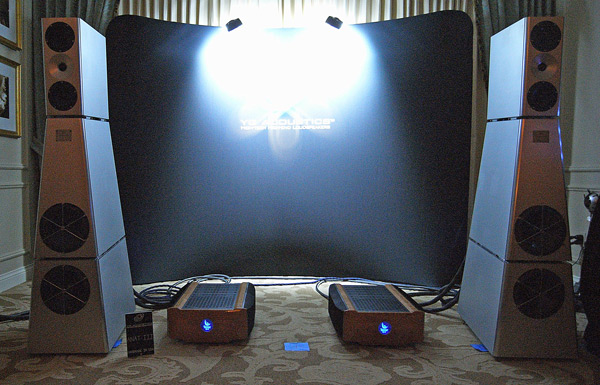
For the past few years, Colorado company YG Acoustics has been exhibiting in a large "air-wall" space in the Sands Convention Center. Their reason for doing so was that it was a great place for a new company to get foot traffic, but the downside was that it took heroic efforts to get sound quality that would indicate what YG speakers were capable of. For the 2012 Show, they had moved to a large suite in the Venetian Tower, and finally they were showing what their $119,000/pair flagship, the Anat III Signature, was capable of.
Continue Reading »

YG Acoustics–Vitus

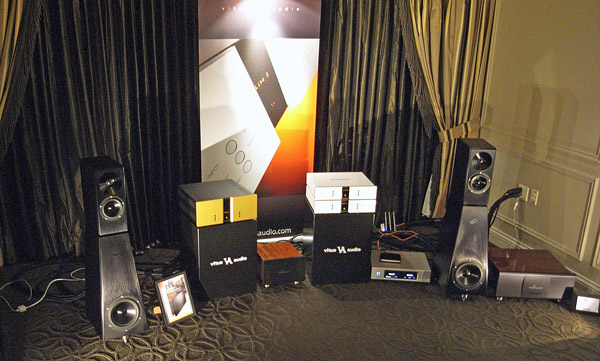
The second room in which I auditioned YG speakers was the Vitus Audio room, where the Kipod II Signatures ($49,000/pair) were doing their very musical thing. The Kipod uses the same materials and technologies as YG's top-model Anat III and now uses the BilletCore midrange unit and woofer, where the diaphragm is machined from a solid slab of aircraft-grade aluminum. First-generation Kipods can be upgraded to II status.
Continue Reading »

Hansen by Hansen

"These speakers get the scale of the sound right," I scribbled in my notebook as I was listening to the Hansen Emperor E speakers ($68,000 Canadian) playing a big band recording. The leather-covered, 61" tall speakers were being driven by Tenor 350M monoblocks, a Tenor Line 1/Power 1 preamplifier, and Phono 1 phono stage, hooked up with Kubala-Sosna Elation series cables. The front-end components were supported on a Critical Mass Systems Maxxum integrated rack and filter system.
Continue Reading »
Advertisement
Advertisement
Advertisement