John Atkinson, Robert Harley

Plateau Camber 3.5 loudspeaker

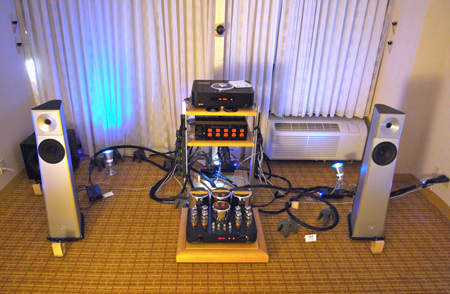
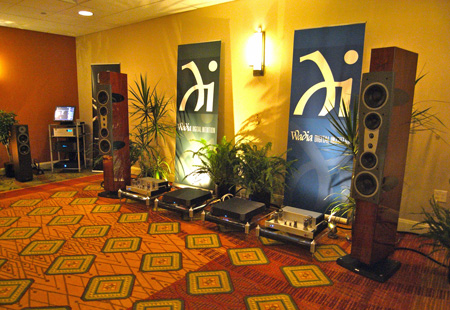
The loudspeaker coming under the microscope this month emanates from north of the border. The Canadian loudspeaker industry has benefited enormously in the last few years from having the measurement, testing, and listening facilities of Canada's National Research Council in Ottawa made available to it on a commercial basis. Unlike the US or even the UK, where a new speaker designer has pretty much to rely on his own resources, having to invent his own test procedure as well as design the product, the Canadian equivalent can have his loudspeaker tested under standard conditions, quickly indicating whether he is on the right track or not. (He still, of course, has to rely on his own talent to get on the right track in the first place or to get back on it if it appears that something is amiss.)
Continue Reading »

Plateau Camber 3.5 loudspeaker RH's 1990 System

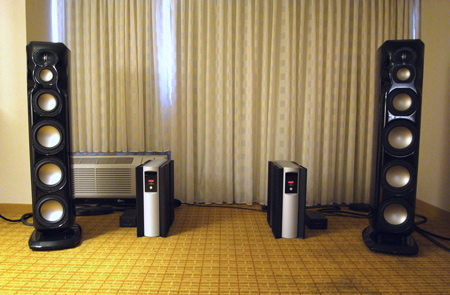
The loudspeaker coming under the microscope this month emanates from north of the border. The Canadian loudspeaker industry has benefited enormously in the last few years from having the measurement, testing, and listening facilities of Canada's National Research Council in Ottawa made available to it on a commercial basis. Unlike the US or even the UK, where a new speaker designer has pretty much to rely on his own resources, having to invent his own test procedure as well as design the product, the Canadian equivalent can have his loudspeaker tested under standard conditions, quickly indicating whether he is on the right track or not. (He still, of course, has to rely on his own talent to get on the right track in the first place or to get back on it if it appears that something is amiss.)
Continue Reading »

Synergistic's Black ART

When I reported in our report from the 2009 RMAF that I perceived a degradation when Ted Denney of cable manufacturer Synergistic Research removed his tiny ART devices from the room, it triggered a debate that raged not just in the comments following that report but also in our website forum right up to today. The fact is that these small metal bowls are too small to have a significant effect on the acoustics of a room at frequencies below 10kHz or so, yet they seem to improve the accuracy and stability of stereo imaging and even tighten up the sounds of bass instruments. It is a mystery, therefore, how these devices can work. I have conjectured that perhaps they have an effect on the listener’s state of mind rather than the acoustics, but if so, then I don’t comprehend how that effect can be both repeatable and demonstrable. Whatever they do—if they do anything, that is—therefore, I wasn’t sure what to expect when I went into my final room at the 2010 RMAF, the Synergistic room.
Continue Reading »

Dynaudio - Wadia - Octave

Perhaps the best sound I heard at RMAF was in the large room on the mezzanine shared by Dynaudio, XLO, and Wadia. The Dynaudio Confidence C4s ($20,900/pair), which I first <A HREF="http://www.stereophile.com/floorloudspeakers/794/">reviewed in March 2003</A>, were sounding as good as I remember them sounding in my own room, perhaps even better. The rest of the system was obviously high-class: a Wadia 971 CD transport ($17,950) fed Wadia's Series 9 Decoding computer ($33,450, comprising the 931 controller and dual-mono 922 DACs), which in turn fed Octave MRE130 tubed monoblocks from Germany ($16,000/pair) sitting on Grand Prix amp stands. Cabling was all by XLO. The 130W Octave amplifiers use two pairs of KT88s in push-pull and the wideband output transformer has a single tap. The amp can also use 6550s or EL34s, and an accessory "black box" increases the B+ storage capacity.

Continue Reading »

Revel & Mark Levinson

One of my two best sounds at RMAF was from Revel's Ultima Salon2 speakers ($22,000/pair), which have been favorites of mine since <A HREF="http://www.stereophile.com/floorloudspeakers/608revel">Larry Greenhill's review</A> appeared in the June 2008 issue of <I>Stereophile</I>. At RMAF, the Revels were being driven by Mark Levinson No.53 monoblocks ($25,000/pair), which in turn were being fed straight from the variable output of a Mark Levinson No.512 SACD player ($15,000). Cabling was all-Transparent. The superbly stable soundstaging extended beyond the physical positions of the speakers, the tonal balance was one of the most neutral I heard at the Show, and the bass was both extended and defined. I would have stayed listening for longer, but the Show only had 30 minutes more to run and I had two more rooms to visit.

Continue Reading »

Audio Design from Jan Didden & Bob Cordell

DIY hi-fi used to be an important aspect of audio magazine content 30 and more years ago, but these days it has migrated almost completely to the Internet, with just Ed Dell's <I>AudioXpress</I> magazine still waving the roll-your-own flag in print. Sharing a stand at RMAF were two of the Internet's most notable DIY engineers, Jan Didden from Holland (left) and Bob Cordell from New Jersey (right), and both were venturing into the print medium. Bob had advance copies of his new tome <I>Designing Audio Power Amplifiers</I> for sale, which I will be reviewing in <I>Stereophile</I> early in the New Year. Jan had the first volume of his new bookzine <I><A HREF="http://www.linearaudio.net">Linear Audio</A></I>, which has articles on audio design from Bob, as well as Doug Self, Joachim Gerhardt, Nelson Pass, Siegfried Linkwitz, and many others. But if you have any interest at all in the nuts and bolts of audio design, don't wait for my reviews of these books; check them out for yourself. There's audiophile gold within their pages!

Continue Reading »

The Peachtree iDAC

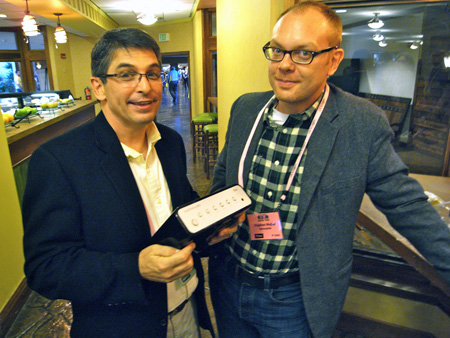
Peachtree's David Solomon, seen here accosting <I>Stereophile</I>'s Stephen Mejias (right) in the hotel's coffee bar, was in ebullient mode. He's holding Peachtree Audio's new idAC ($999), which combines the usual 24/192kHz S/PDIF inputs with a 24/96-capable USB input and an iPod dock that, like the Peachtree iDecco amplifier that is favorably reviewed by Art Dudley in our December 2010 issue, takes the audio data from the iPod in digital form. The iDAC uses the latest version of ESS's 32-bit Sabre<SUP>32</SUP> D/A chip.

Continue Reading »

Avalon Transcendent

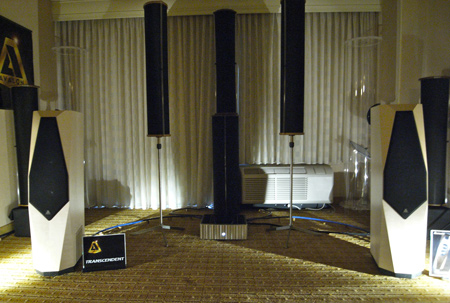
Boulder-based retailer Blu Note Design had a passive display in the Marriott's loby, but its active room on the second floor of the Tower was debuting the Avalon Transcendent speaker ($15,000/pair). One of my best sounds at the Show, the 2-way, 3-driver speakers were being driven by a Jeff Rowland Design Group 625 amplifier, a Jeff Rowland Corus preamp, an Ayre C-5XEmp disc player and QB-9 DAC, with Cardas Clear cabling.
Continue Reading »

Nola & Audio Research

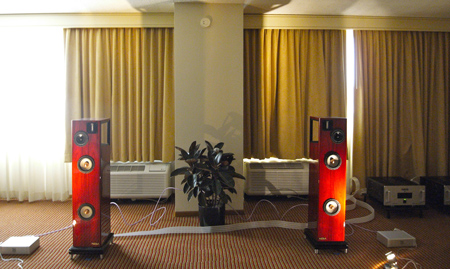
New York-based Nola was showing its Metro Grand Reference speakers at RMAF ($25,000/pair). Combining a Raven ribbon tweeter and a 4" midrange, both mounted on an open baffle, with two 6.5" reflex-loaded woofers, this slim tower, driven by an Audio Research Reference 210 power amplfier, Reference 5 preamplifier, and CD8 CD player via Nordost cabling, produced more bass than I thought possible, given its modest drive-unit array. The response is specified as being 6dB down at a low 26Hz. This was one of several systems at RMAF using the Quantum QX4 AC treatment device from Nordost.

Continue Reading »

Open-Reel Tape

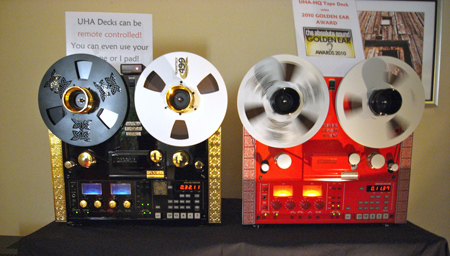
Source material in the Nola room was a pair of open-reel recorders from United Home Audio, but on the one piece I listened to, Mussorgsky's <I>Pictures at an Exhibition</I>, it sounded like a dub from LP. Not that there's anything wrong with that!

Continue Reading »
Advertisement
Advertisement
Advertisement