Ludwig van Beethoven's 32 Piano Sonatas
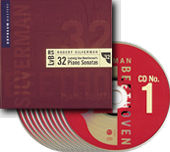
<I>"All</I> of them?!"


<I>"All</I> of them?!"

<B>Little Feat: <I>Hotcakes & Outtakes: 30 Years of Little Feat</I></B><BR> Warner Archives/Rhino R2 79912 (4 CDs). 1970-2000. Russ Titelman, Ted Templeman, Lowell George, Van Dyke Parks, Erik Jacobsen, George Massenburg, Bill Payne, Paul Barrère, Bill Wray, Ed Cherney, Frank Zappa, Michael O'Bryant, Richard Moore, orig. prods.; Gary Peterson, Bill Payne, Paul Barrère, reissue prods.; Bill Inglot, reissue sound. AAD. TT: 5:13:48<BR> Performance <B>*****</B><BR> Sonics <B>****</B>
Charles Hansen said it best, in a recent e-mail: "People have been holding back from criticizing this technology because they weren't certain that some new discovery hadn't been made." Ayre Acoustics' main man was talking about "upsampling," whereby conventional "Red Book" CD data, sampled at 44.1kHz, are converted to a datastream with a higher sample rate. (Because of its association with DVD-Audio, 96kHz is often chosen as the new rate.)
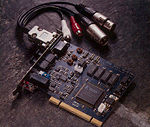
In the early days of digital audio, I remember talking with Dr. Tom Stockham, the developer of the groundbreaking Soundstream system used then by Telarc. As well as using a 50kHz sample rate, the excellent-sounding Soundstream stored its 16-bit data on large drum-shaped Winchester drives connected to a minicomputer. Twenty years later, the advent of ultra-high-density magnetic storage media and fast microprocessor chips has put high-resolution digital audio manipulation and storage within reach of anyone with a modern PC or Mac. And facilitating the transformation of the PC into a high-quality DAW has been a new generation of soundcards, such as the <A HREF="http://www.stereophile.com//digitalsourcereviews/280/">Digital Audio Labs CardDeluxe</A> I reviewed in September 2000 and the subject of this review, the German RME Digi96/8 Pro.
In his very English way, Sony's then managing director for the UK, Tim Steele, was getting a touch, er, desperate. His oh-so-cultured voice rose a smidgen as he resorted to a direct selling of the benefits of what he was talking about. "Look, you're all sitting on riches," was his fundamental pitch. "You can sell music-lovers your entire back catalog all over again—at a higher price!"
A much-touted benefit of DVD-Audio and Super Audio CD is that these new media can store digital audio data extending one or more octaves higher in frequency response than the capabilities of the CD. In the August issue's "Industry Update" (pp.27-29), Paul Messenger reported on an add-on supertweeter from English manufacturer Tannoy that would extend the ultrasonic response of loudspeakers so they can reproduce this new information. Putting to one side for now the issue of whether a loudspeaker really needs to be able to reproduce frequencies that no one can hear, the subject of how much ultrasonic content is present in real musical signals is still a contentious one.
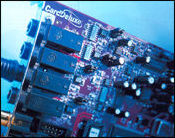
Convergence. There, I've said it. I swore I wasn't going to use the "C" word, but when you're faced with writing about a product that smashes the boundaries between component categories as completely as the CardDeluxe does, you have little choice.
I left you last month 104 miles from Santa Fe, New Mexico, heading east on I-40 accompanied by a dog and two cats, with 1946 miles to go to reach <I>Stereophile</I>'s new editorial home, New York City. To cut a long story short, I did arrive in New York (covered in dog and cat hair). After a nerve-wracking delay, so did our furniture. We will be living out of boxes for a while <I>chez</I> Atkinson, but that's a mere inconvenience compared with the Great Adventure of setting up a new listening room.