John Atkinson

Vivid Impresses Web Monkey
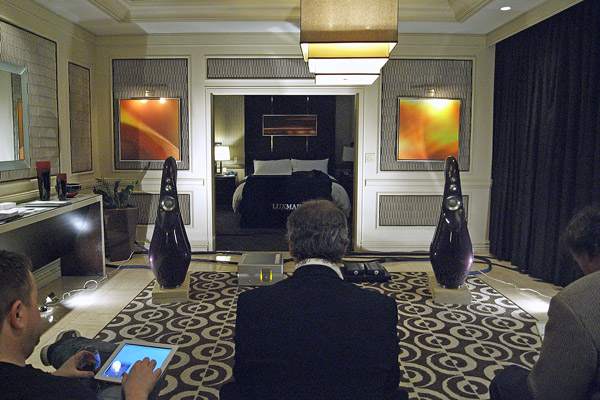
Source Interlink Media's Home-Tech Group's self-styled "Web Monkey" Jon Iverson (center) focuses his attention on the new Vivid G3Giya loudspeaker ($40,000/pair), which is scheduled to start shipping in April. Driven by a Luxman amplifier and hooked up with Kubala-Sosna Emotion cables, the G3Giya is a 2/3 scale version of the G1Giya that so impressed Wes Phillips in July 2010, with twin aluminum-cone 7.5" woofers loaded by the same proprietary ported transmission line, this time curled over more severely because of the speaker's reduced height. (The G1Giya used 11" woofers.)
Continue Reading »
Vivid's G3Giya Encore

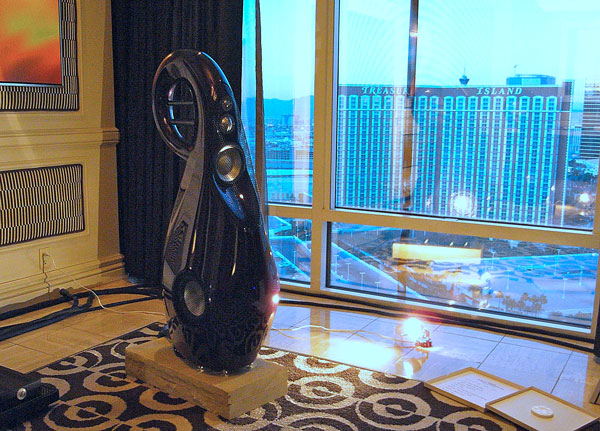
Here's a closer "glamor shot" of the new G3Giya loudspeaker, though it doesn't do justice to the deep gloss maroon finish of the speaker. Note how the fact that the tweeter and upper-midrange unit have to be mounted higher up the curve of the "tail" means that the transmission lines loading these drive-units have become a styling feature rather than buried within the enclosure.
Continue Reading »

The Mighty Magico Q7

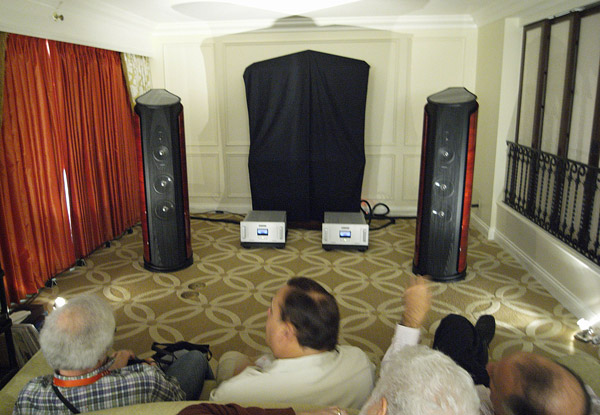
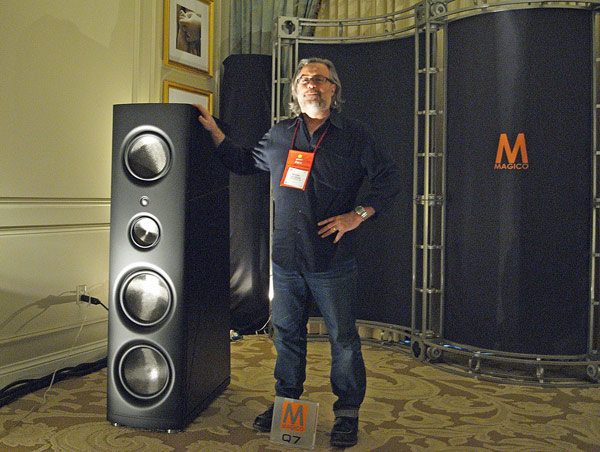
Costing $165,000/pair, Magico's new Q7—shown here with AudioStream.com editor Michael Lavorgna for scale—embodies everything the Californian company knows about speaker design: a proprietary beryllium-dome tweeter, nano-fiber–sandwich-cone midrange unit and woofers, housed in a sealed all-aluminum enclosure weighing 750 lbs! With the prototype Audeeva music server, Pacific Microsonics DAC, a Spectral preamp, MIT cables, and unidentified amplifiers hidden behind a curtain, the Q7s threw an enormous soundstage on a 176.4kHz/24-bit file of a Reference Recordings orchestral recording, with bass-drum blows that pressurized the room without obscuring a low-level bassoon that was playing at the same time—macro and micro-dynamics.
Continue Reading »

Magico S5 Loudspeaker

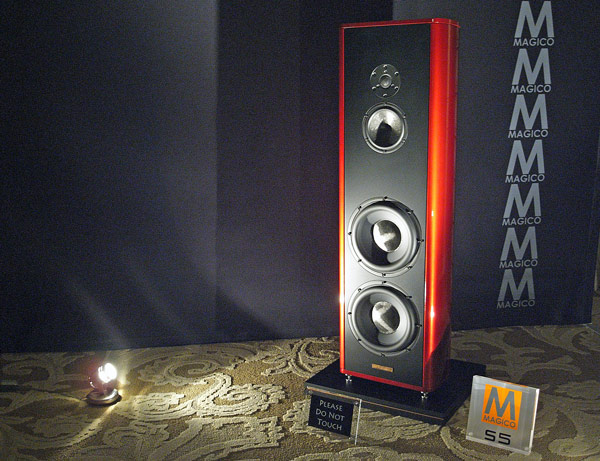
While Magico's recent high-performance speakers are notable for their all-aluminum cabinet construction, including the Q5 that was our 2011 "Loudspeaker of the Year," the new S5 ($28,600/pair) uses a more conventional enclosure to bring its price within reach of more than just the 1%. While it still uses a beryllium-dome tweeter, this is not made in house.
Continue Reading »

Evolution's MMMicroOne

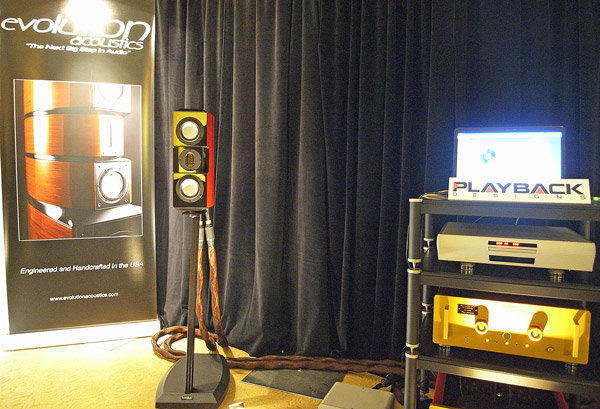
I missed this tiny jewel of a speaker when it made its debut at the 2011 T.H.E.Show, but it's now in production. As I sat down to listen to it at this year's show, I asked what it cost.

"25."

Okay, $25,000/pair is not unheard of for high-performance minimonitors; the Sonus Faber, Magico, and Franco Serblin stand-mount speakers are even more expensive.

"No, 25 hundred per pair. With the stands.

Continue Reading »

The Sonus Faber Aida

The New York debut of Sonus Faber's stunning-looking Aida ($120,000/pair) was compromised by sub-optimal room acoustics and too much noise from outside the dem area. But the speaker, powered by Audio Research's new Reference 250 monoblocks ($25,900/pair) lived up to the promise in Las Vegas. But as I had found in New York, the true magic of the Aida was only to be found if you sat exactly in the sweet spot, when the speakers disappeared and the end of the room dissolved into the recorded acoustic. Certainly the team from WhatsBestForum.com sitting in front of my camera—Hi, Steve!—were enjoying what the Aidas' were doing.

The rest of the system comprised an SME Model 20/3 turntable/tonearm ($17,000) with a Palos Presentation cartridge ($3995), an Audio Research CD8 ($9995) and DAC8 ($4995), Reference Phono 2SE ($12,995) and Reference 5SE linestage ($12,995), all connected with Shunyata cables. Racks were the ubiquitous Harmonic Resolution Systems SXRs and power conditioning was also by Shunyata.

Continue Reading »

TAD E1 Speaker

All-new from TAD at the 2012 CES was a more affordable line of components than the 600 series and electronics and Reference loudspeakers. The Evolution Series E1 speaker ($29,800/pair, right) still uses a concentric tweeter and midrange unit, like its more expensive Reference One sibling (left), but while the tweeter dome is still beryllium, the midrange diaphragm is now magnesium rather than beryllium and the unit is built on a 5" rather than a 6" chassis. Twin 7" woofers are used, but still with the highly linear corrugated surrounds and with a 2.5: voice-coil. Bass extension is specified into the low 30s, anechoic. I auditioned so much music on this system, I thought I was outstaying my welcome, but the sound of the E1 system, at $76,800 including the new M2500 500Wpc power amplification and the C2000 D/A preamp driven by asynchronous USB from a MacBook Air and all sitting on a Finite Elemente rack was open, natural, and uncolored, with superb low-frequency definition and weight. I couldn't imagine how the sound of a a 176.4kHz/24-bit transfer of Rebecca Pidgeon singing "Spanish Harlem" could be bettered—until TAD's Andrew Jones switched to the TAD Reference system (see next story).
Continue Reading »

TAD C600 Preamplifier

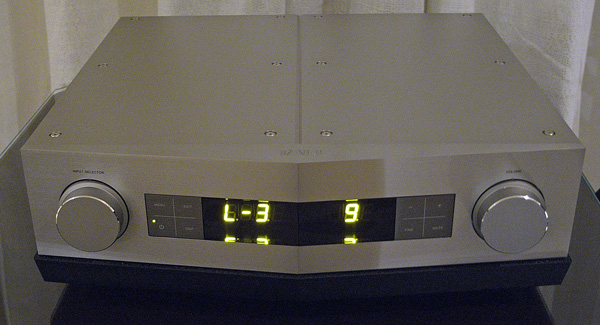
It costs $42,000 but TAD's new C600 solid-state line preamplifier features dual-mono construction, an all-discrete signal path, a separate power supply, and fastidious attention paid to detail in both its design and construction. The amber LED display for example, is DC-powered rather than from the usual multiplexed supply, to eliminate EMI interference. And the sound, in conjunction with the D600 SACD player, M600 monoblocks, Reference One floor-standing speakers, and HRS rack to give a system price of $214,500? I'll leave it to Stephen Mejias to describe in his show wrap. Personally, it was a highlight of the 2012 CES.
Continue Reading »

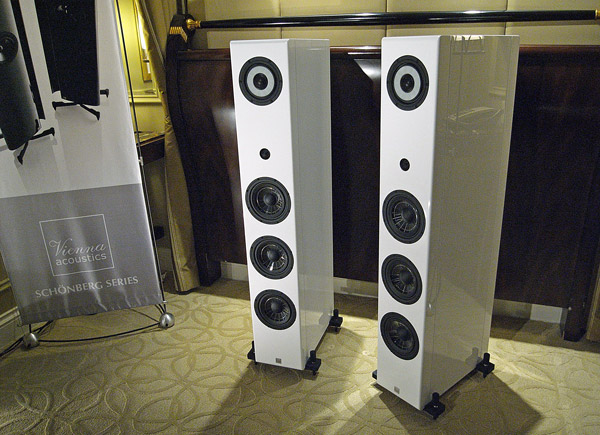
Vienna Acoustics Imperial Grand Speaker

Scheduled for a summer 2012 launch with a projected priced of $9000–$10,000/pair, the Vienna Acoustics Beethoven Imperial Grand speaker uses a smaller flat, concentric tweeter/midrange drive-unit developed from that used in the Austrian company's top models, The Kiss and The Music. But like them, it uses a supertweeter to cover the range above 17kHz. The cabinet is sourced from Italy and the speakers are assembled in Vienna. And the name? Well, the Bösendorfer company is also based in Vienna and their flagship piano is also called the Imperial Grand.
Continue Reading »
Advertisement
Advertisement
Advertisement