David Lander

Richard Sequerra: Tuning In

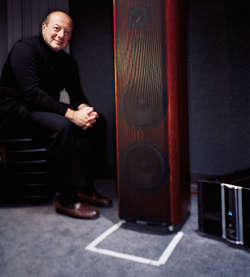
Richard Sequerra was born in 1929 and raised in various parts of the US by his mother, who worked for the Department of State. By the time he was 20, he had launched a freelance career that has since spanned a wide range of technologies. During a stint at Marantz in the 1960s, he worked with Sidney Smith on that firm's famed Marantz 10B tuner, which was sold from 1964 through 1970. Subsequent products have included the Sequerra 1 tuner and the Metronome 7 loudspeaker, originally produced by Sequerra's firm Pyramid and now hand-assembled by its creator, who offers the most recent version via his <A HREF="http://www.sequerra.com">website</A&gt;, for less than half what it cost through retail channels when Sam Tellig praised it in the July 2007 <I>Stereophile</I>. Sequerra's newest transducers&#151;a self-amplified nearfield speaker and matching subwoofer designed for Internet music listening&#151;remain in prototype form; he hopes to sell or license the designs rather than manufacture and market them himself.
Continue Reading »

Sandy Berlin

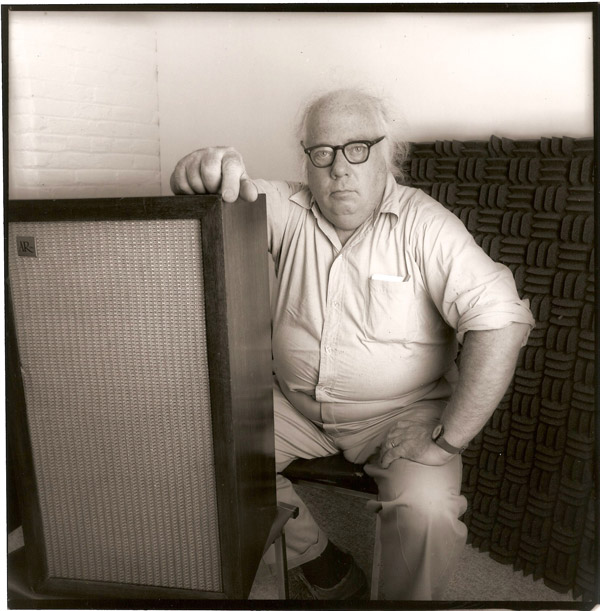
Sanford "Sandy" Berlin died on March 11 at his home in Santa Monica, California. He was 80 and had suffered from cancer. Born in 1927, he would have been 81 on April 10. During a long and highly successful career in audio management, Berlin held top positions at companies ranging from Harman/Kardon and JBL to Madrigal and Revel. He entered the industry in the 1960s, after brokering Harman/Kardon, then owned by General Instruments, back to its founder, Sidney Harman, who subsequently hired him and put him in charge of H/K. When Harman's firm, then called Jervis Corporation, acquired JBL in 1969, Berlin moved to Los Angeles to reshape it. He later set up German and French distribution units for Harman-group products and, after negotiating Harman's purchase of Tannoy, moved to England to serve as Tannoy's chairman. When Harman set out to create a new speaker brand, Bolivar, Berlin took the reins of that Tennessee-based operation (which ultimately proved unsuccessful).

Continue Reading »

A Glorious Time: AR's Edgar Villchur and Roy Allison

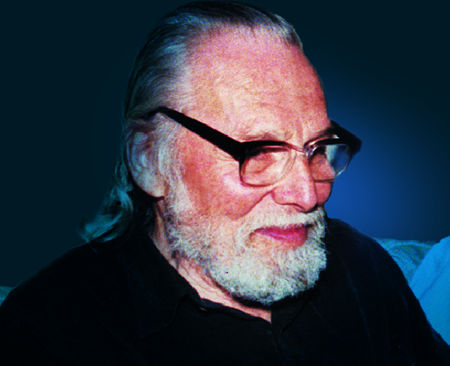
<I><B>Editor's Note: </B>In 1954, a New York writer and teacher reinvented the world of audio with the modest-looking Acoustic Research AR-1 loudspeaker. A small fraction of the size of the behemoths that were then </I>de rigeur<I> for the reproduction of bass frequencies, Edgar Villchur's loudspeaker went as low with less distortion. Perhaps more importantly, the AR-1 pioneered both the science of speaker design and the idea that a low-frequency drive-unit could not be successfully engineered without the properties of the enclosure being taken into account.</I>

Continue Reading »

Tom Jung of DMP: Making Musical Sense

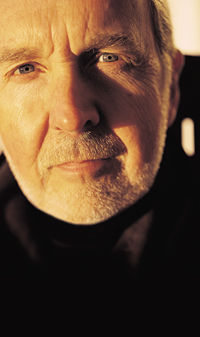
Tom Jung's career has been dotted with numbers. In 1969, he and a partner founded Sound 80, a Minneapolis recording studio named by an advertising wizard who had previously conjured up the appellation Cure 81 for a Hormel ham, supposedly while sipping Vat 69 scotch. Some years later, engineers from another Midwestern company with a numeral in its name, 3M, stopped by with an experimental tape recorder that also employed digits. Those zeros and ones proved critical to the recordings Jung went on to engineer and produce at his next company, Digital Music Products, better known as DMP.

Continue Reading »

Jim Winey: Maggies Man

<I>The Pennsylvania Gazette</I> documented an early connection between music and an American named Winey when, in 1759, it listed for sale as part of an estate "a middle sized organ, having eight stops." Interested parties were directed to one Jacob Winey, a Philadelphia merchant.

Continue Reading »

Dan D'Agostino of Krell: Power Is As Power Does

Maybe Dan D'Agostino was destined to develop and build a line of products distinguished by their sheer might. After all, he grew up just blocks from a natural phenomenon synonymous with power: Niagara Falls. Even today, when the 56-year-old D'Agostino returns to his boyhood home to visit his parents, he enjoys pulling on a pair of shorts and going for a long run in the adjacent park, which resounds with the Falls' unrelenting thunder.

Continue Reading »

Ikonoklast: Linn's Ivor Tiefenbrun

In July 1877, Thomas Edison wrote that he was sure he would "be able to store up & reproduce at any future time the human voice perfectly," and the word phonograph soon began showing up in his lab notes. By the time Ivor Tiefenbrun stepped onto the audio industry soundstage, nearly a century had passed, and even discriminating listeners took the record player for granted. But Tiefenbrun had discerned sonic differences among players, and he knew that his LP12—he had built a prototype for personal use—was a superior performer. When people told him that turntables do no more than go 'round and 'round, he would rebut them by pointing out that speakers merely go in and out.
Continue Reading »
Advertisement
Advertisement
Advertisement