Elite Speakers
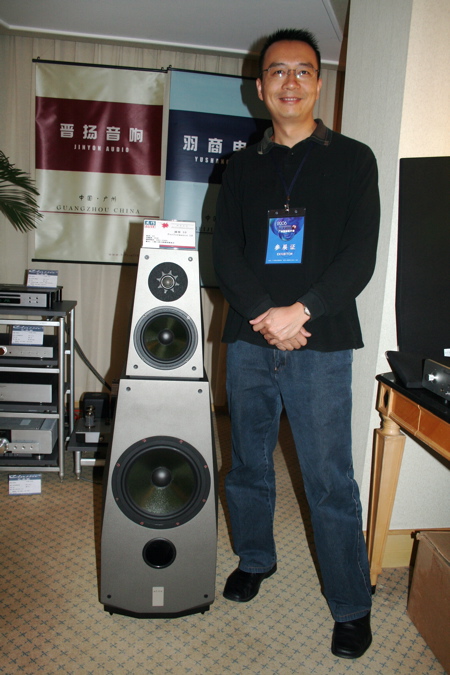
After my first few days wandering through the show, I began to wonder where all the Chinese speakers were—the relatively normal ones, I mean.


After my first few days wandering through the show, I began to wonder where all the Chinese speakers were—the relatively normal ones, I mean.
I'm currently attending GuangZhou Hi-Fi 2006 in GuangZhou, China (you can read my <A HREF="http://blog.stereophile.com/china2006//index.html">China Hi-Fi Tour 2006 blog</A>). The show is a fantastic audio event and everywhere I look, I see products I want—some very similar to mainstream US brands and some exceedingly strange and different. But the <I>audiophiles</I> are familiar: Show me a guy who lights up in the glow of a 300B and I'll show you one of <I>my</I> chosen people.

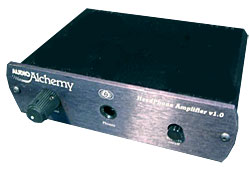
It's hard to know what to call the SHA-Gold. It <I>is</I> a superb headphone amplifier—maybe even the target all future headphone amps need to shoot at—but it's also a full-function preamplifier. At two grand, it's not exactly a unit you'd add to your current system just to get a headphone connection...<I>Wait a minute!</I> What am I saying? I'm sure that there are folks out there who would add this to their existing reference systems as casually as I'd buy the <A HREF="http://www.stereophile.com/headphones/796alchemy">Audio Alchemy headphone amplifier</A>—but they'd be missing out on a great line stage.
For headphone listeners, this is truly a golden age—we have multiple choices at many different price levels. During the course of this review, I had as many as five headphone amplifiers (and, in several cases, multiple power supplies) set up for comparison. Yet many people don't understand why we might want a headphone amp in the first place.
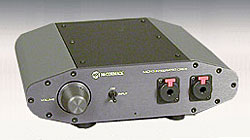
<I>What,</I> I hear you asking, <I>is an integrated drive?</I> The MID is part of McCormack's much lauded "Micro" series (see my review of their Micro Line Drive in Vol.18 No.6), which are designed to offer the same dedication to quality as McCormack's full-size components, but at a lower price (and in a smaller package). The MID was initially the Micro Headphone Drive, sporting two ½" stereo phone-jacks on the front panel, a two-position input switch, and a volume control. The rear boasted two inputs and an output (controlled by the volume pot). It was designed to be a high-quality headphone amp and a minimalist preamp. In this configuration, I ran into it at the 1995 WCES where—almost as a gag—Steve McCormack had made up a few ½" stereo phone-plug to 5-way binding post connectors. He could, he explained, run small speakers from the headphone outputs. There was a serious purpose behind the joke, of course. Showing that the MHD could drive speakers spoke volumes for its ability to drive headphones.

I was cruising at 36,000 feet, totally relaxed, listening to Richard Thompson. Looking down at my lap, I caught sight of a little box with a glowing green light. Switching off this light was like turning on the noise—the 767 was roaring like a locomotive and the ambient sound hit me like a fist. Thompson's crisp Celtic chordings turned mushy, undetailed, and dull. I felt weary. <I>Whoa, I wouldn't do that again if I were you, laddie!</I> I fumbled for the switch and reactivated the NoiseGuard circuitry on my Sennheiser HDC 451 noise-canceling headsets. Thompson's guitar rang out clearly, the airplane quieted to sound like an S-class Benz, and I relaxed into a calm reverie with only one worry clouding my contentment. But I patted my pocket: yup, still two cognacs left. Everything would be all right.

Barque & Consonance's Opera Consonance M15 mates a 15" woofer with a unique multicell horn tweeter. Sensitivity is 98dB (!) and frequency range is rate at 30Hz–20kHz. The tweeter handles everything above 500Hz. Price would be around $10,000/pair USD, not including distribution costs.
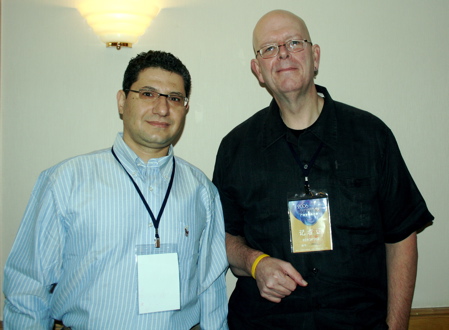
I was listening to Barque & Consonance's Opera Audio Consonance M-15 loudspeakers when Lino Faragi introduced himself. "I'm that crazy European guy who opened up a hi-fi shop in China—the first non-Asian to do high-end here," he said, handing me a card for Sound & Vision in Shanghai. "We do things a little differently. Come see us."
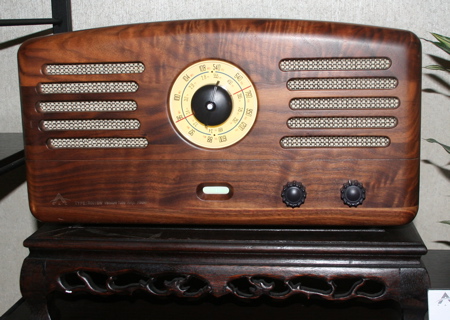
I bought the Classic Radio R601P on the spot. Beautiful walnut cabinet, warm tube sound, and that lovely magic tuning tube below the dial—all for under $500.
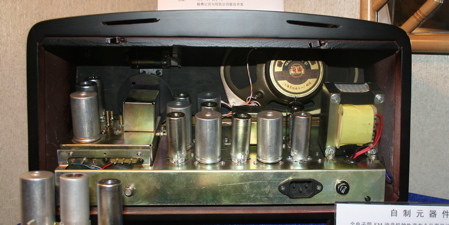
The Classic Radio JR-455 from the other side. Kids, this is how they used to make 'em back when radios were built like cathedrals.