Michael Fremer

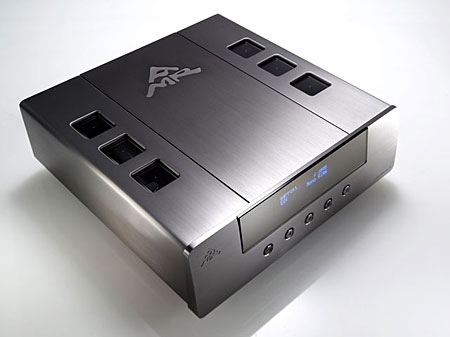
dCS Debussy D/A processor

Don't have $80,000 to drop on dCS's four-component Scarlatti SACD stack that I reviewed in August 2009, or $17,999 for their Puccini SACD/CD player that John Atkinson raved about in December 2009? Even if you do, the new Debussy D/A processor ($10,999) might be a better fit for your 21st-century audio system. Sure, you don't get an SACD transport—or any kind of disc play, for that matter—but the odds today are that you already have a player you like that's got an S/PDIF output that can feed the Debussy.
Continue Reading »
Oracle Delphi Mk.VI turntable

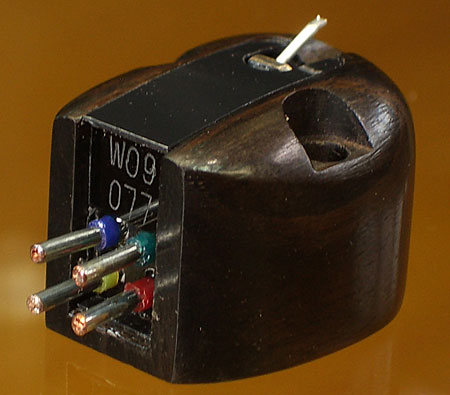
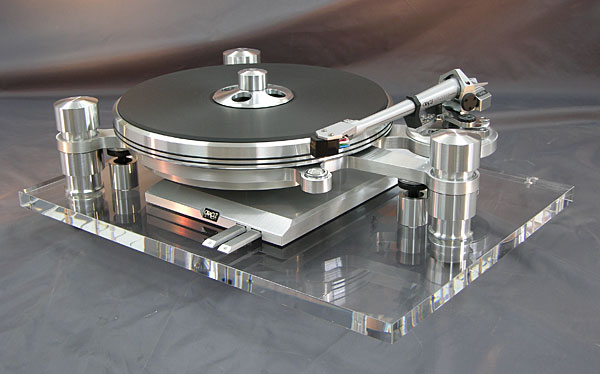
Thirty years have not diminished the beauty and elegance of Oracle's Delphi turntable. In my opinion, it still ranks among the best-looking turntables ever made. I bought an original Mk.I, used, in 1982, and very positively reviewed the Delphi Mk.V in the December 1997 Stereophile.

In its three decades the Delphi has undergone many upgrades both technical and aesthetic. Not surprisingly, so has the price. The Mk.II Delphi sold for $1250 in 1986; the Delphi Mk.VI with Turbo power supply and dedicated power cord now sells for $8500, which, in today's market, I think is reasonable for what you get. The review sample came with an Oracle/SME 345 tonearm ($3100) and a Benz-Micro Thalia high-output MC cartridge ($1700), for a total cost of $13,300—or $11,600 for just 'table and arm.

Continue Reading »

Sutherland Engineering Timeline record weight

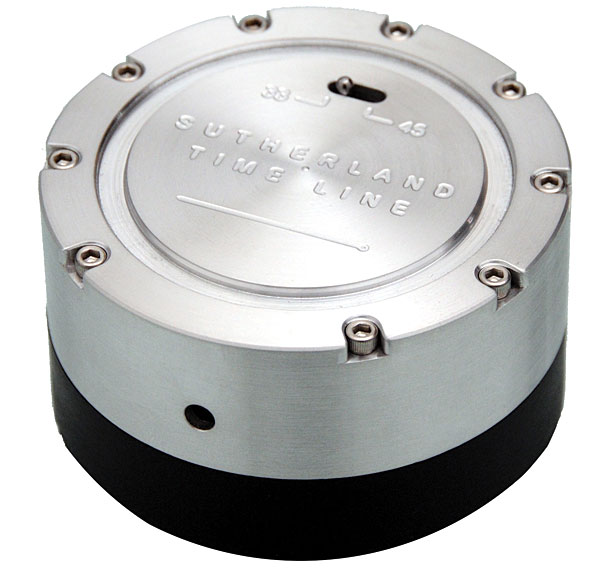
Ron Sutherland has devised the Timeline, a device for testing the 33.33 and 45rpm speeds of turntables. It's housed in a disc of aluminum and Delrin that fits over the platter spindle. Turn it on, and an LED shoots a red dash of light at the wall (if there is one) behind your turntable. If the dash doesn't move, the speed is correct. If it drifts to left or right, you'll need to adjust the 'table's speed. Unless your wall has hash marks, there's a bit of subjectivity involved, and at $399 the Timeline isn't cheap, but Sutherland says he's not making much money at that price, and that it will take a lot of sales to recoup the R&D he's put into designing something as precise as he claims the Timeline is.—Michael Fremer
Continue Reading »

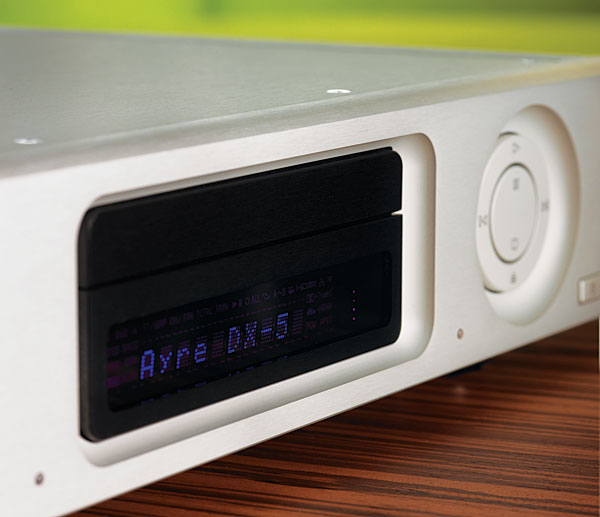
Ayre Acoustics DX-5 universal disc player

The old Saab slogan, "Find Your Own Road," was so good that the old General Motors, which once owned Saab, had to kill it—just as the newly revived GM tried, in a "Call It Chevrolet" memo, to kill "Chevy." GM did a U-turn on that one the very next day, but "Find Your Own Road" never returned, and is available for Ayre Acoustics to use. I can't think of a better slogan for a company that I admire almost as much as I do Saab.

Consider this: While Ayre calls its new DX-5 ($10,000) a "universal A/V engine," the disc player doesn't have a coaxial or a TosLink S/PDIF input. That appears crazy to me, but to Ayre, no. They've found their own road.

Continue Reading »

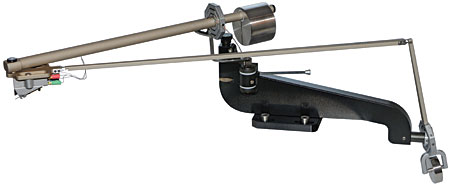
HiFiction Thales AV tonearm

Ideally, LPs should be played with the pickup stylus remaining tangential (<I>ie</I>, at a 90&#176; angle) to the groove&#151;just as the lacquer from which the LP was ultimately stamped was cut in the first place. Over the years, many attempts have been made to accomplish this. Back in 1877, Thomas A. Edison's original machines tangentially tracked his cylinders, but Emil Berliner's invention of the flat disc put an end to cylinders altogether. In the 1950s, a number of companies marketed so-called "tangential" trackers that used dual arms, based on conventional pivoting arrangements, to change the angle at which the headshell was mounted as it moved across the LP side. In 1963, Marantz introduced the SLT-12, which used a plastic pantograph to move the stylus across the record surface. Garrard's Zero 100 pivoting arm controlled its independently pivoting headshell with a bar that extended from the main bearing of the tonearm.

Continue Reading »
Advertisement
Advertisement
Advertisement