Michael Fremer

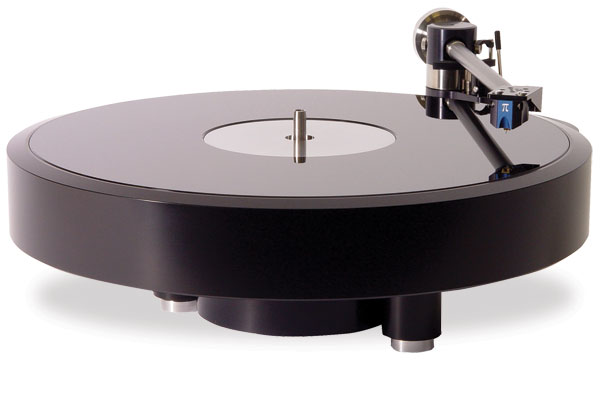
VPI Classic 3 turntable & Classic-JMW tonearm

Trends in turntable design shift back and forth over time, each "advance" turning out to be a mostly sideways move. Over its long history, VPI's founder and designer, Harry Weisfeld, has moved the analog goalposts back and forth as he's refined his thinking. His early turntables were mostly standard spring-suspension designs of normal size. By the time Weisfeld produced his fully tricked-out TNT model, which was originally designed to stably hold the heavy moving mass of Eminent Technology's ET2 air-bearing arm, he'd moved to a massive, oversized, sandwiched plinth with isolating feet at the corners. He first used springs and, later, air bladders originally designed to cushion a tractor-trailer's load, and which he'd found in a trucker's supply catalog. Via an O-ring, the TNT's outboard motor drove one of three pulleys that protruded from holes in the plinth, and attached to a T-shaped subchassis that, in turn, drove the other two pulleys via two additional O-rings.
Continue Reading »
Kuzma 4Point tonearm

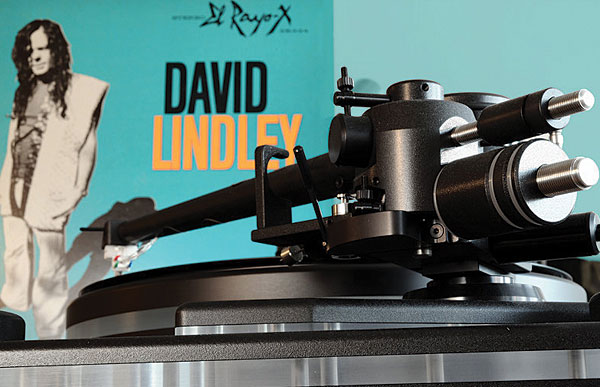
No one has ever accused Franc Kuzma of designing glamorous audio jewelry. His turntables and tonearms are industrial-strength examples of engineering know-how and machining excellence. But to those who appreciate such things, his products are truly beautiful, even if they're not adorned with chrome, wood, and sleekly polished surfaces. And if looking at the 4Point tonearm ($6500) in pebbly Darth Vader black doesn't get your analog juices flowing, perhaps its innovative design will. But first, this message:
Continue Reading »

Ypsilon PST-100 Mk.II line preamplifier

Though essentially a two-man operation based in Athens, Greece, Ypsilon Electronics has been, since 1995, turning ears and eyes throughout the audiophile world with purist, hand-crafted electronics whose sound seems to defy characterization. Even under audio-show conditions in difficult hotel rooms, and often driving unfamiliar loudspeakers, the sound of Ypsilon electronics seems to evaporate in ways that few products manage, leaving behind less residue and more music.
Continue Reading »

Clearaudio Concept record player

Enticing more music lovers to try vinyl requires a foolproof, plug'n'play solution. Asking a member of the digital generation to install a cartridge in a tonearm and then set up the VTA, SRA, VTF, etc. is asking too much. It's easier to make such a request of someone already bitten by the analog bug, but with turntables, wishing someone beginner's luck will not guarantee success.
Continue Reading »

Brinkmann Pi phono cartridge

The Brinkmann Pi cartridge's Benz-Micro heritage was obvious from the get-go. The motor is built to Brinkmann's specifications by Benz-Micro and includes a Micro-Ridge stylus. The cantilever material is not specified. The Pi's output is approximately 0.25mV, and its compliance is moderate at 15µm/mN. Recommended are a tracking force of 1.8–2gm, a VTA of 23°, and a resistive load of 600 ohms.

Helmut Brinkmann says he tweaked the Pi's design for a year and a half before he achieved the results he desired, including making the tiny set screws out of various materials. The Pi, with a body of machined aluminum designed to control the dissipation of resonant energy, weighs a hefty 14gm. Brinkmann supplies aluminum screws and titanium washers, which, he claims, in combination with special damping between the cartridge body and headshell, have been "sonically tuned to create a unique musical instrument."

Continue Reading »

Brinkmann 9.6 tonearm

Brinkmann's 9.6 tonearm ($3990) resembles the German company's longer, more expensive 10.5 and 12.1 arms, which in turn resemble the legendary Breuer. The new arm includes the same headshell, armtube, mounting socket, and cueing device used in the other arms. The bearing system differs, though the Swiss-made ball bearings are identical.
While the more expensive arms use traditional fixed-gimbal bearings, the 9.6 has a unipivot-like construction for the horizontal bearing. The weighted arm housing sits on a small ball that rests on a pivot, also as in a typical unipivot design. A second ball at the bottom of the housing prevents "arm lean," but since the arm's weight rests on the top ball, the lower one isn't critical, and I could feel some play when I handled the arm. Vertical arm motion is effected via a second pair of captured bearings. This arrangement allowed the use of less costly parts and kept the price down, Brinkmann says. The arm's effective length is 248mm (231.5 from pivot to spindle, plus 16.5mm of overhang), while its effective mass, referenced to the center position of the headshell slot, is 12gm.

Continue Reading »

Brinkmann Audio Bardo turntable

I won't debate here how to make a turntable's platter go around. Choose your favorite: belt vs direct drive, idler wheel vs belt, spring-windup vs wind power, whatever. As far as I'm concerned, there's nothing to debate. Each of these technologies has its pluses and minuses, but none can produce CD's accuracy of speed and inherent freedom from wow and flutter.
Continue Reading »

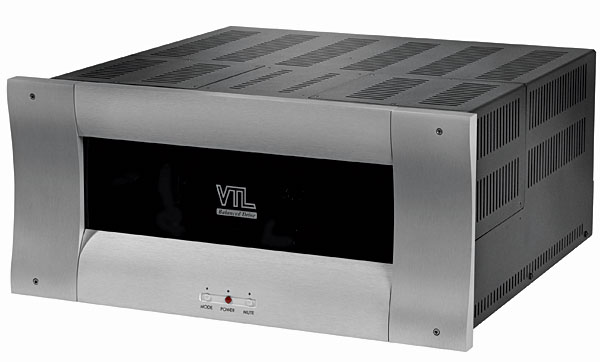
VTL MB-450 Series III Signature monoblock power amplifier

The VTL MB-450 series began life in the late 1980s as the Deluxe 300, a pair of which I once owned. Over the years the basic design has been improved and modified, in the forms of the MB-450 (1996) and the MB-450 Series II (which I reviewed in January 2008). The tube complement remains the same: eight 6550s in the push-pull output stage, a 12AT7 input tube, and a 12BH7 driver. Into a 5 ohm load, the MB-450 III is claimed to produce 425W in tetrode mode or 225W in triode, from 20Hz to 20kHz.
Continue Reading »

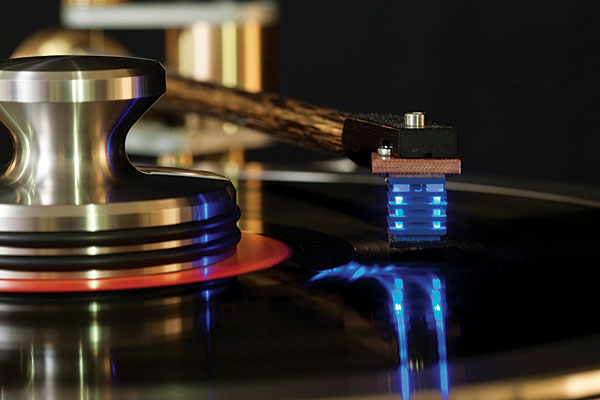
Soundsmith Strain Gauge SG-200 phono cartridge system

Strain-gauge phono cartridges are rarely made and seldom heard; for most vinyl fans, they are more myth than fact. Panasonic once made one, as did Sao Win, but those were decades ago. I've heard about those two models for years but have never seen, much less heard one.

As if he's not got enough to do building his extensive lines of moving-iron cartridges, preamplifiers, amplifiers, and speakers, Soundsmith's Peter Ledermann also makes a full line of strain-gauge cartridge systems available with a choice of six user-replaceable stylus profiles. I believe the Soundsmith is the only strain-gauge cartridge currently made anywhere in the world. Ledermann says it takes him a full day to build one.

Continue Reading »
Advertisement
Advertisement
Advertisement