Being a metallurgical engineer, I've always been intrigued by audio cables—their construction, the materials they're made of, how they're produced, and, of course, how all of that relates to their sound. Over the years, I've auditioned a wide range of cables, from Nordost's round conductors in a flat cable, to Alpha-Core's flat cables in a round conductor, to MIT's complex termination systems. I've even got a closet full of cables—some quite good—from companies that no longer exist. But one thing I'd not done in the 25 years since I began both making my own interconnects and experimenting with the original Polk, Fulton, and Monster Cable speaker wires, was audition cables from AudioQuest. I'd always been intrigued by their exotic constructions and materials, and by how it seemed as if they were way ahead of everyone else in understanding cable performance. But for one reason or another, it never happened until now. So Mr. AudioQuest—Bill Low—and his brain trust geared me up with their $1250/meter Anaconda interconnects and $850/10' Gibraltar speaker cables. System and Setup
I used the AudioQuest cables off and on over about a year, but did most of my serious listening in two stints. The first, just prior to Trish's and my move last summer, used Magnepan MG3.6/R speakers driven by my VTL Ichibans or a GamuT D-200. The second session, later in the fall and winter, after we'd moved into our new house, used a system built around either the Classé Omega monoblocks and Audiophysic Virgo III speakers, or the Kirksaeter Silverline 60s driven by Mark Levinson No.20.6s. In both setups, the remainder of the system consisted of my VPI TNT/JMW 12.5/Benz-Micro L04 analog front-end, the Simaudio Moon Eclipse CD player, and my VAC CPA-1 Mk.III preamp. I did use other gear at times—the GamuT CD-1 CD player, my VAC Renaissance 70/70, and the GamuT preamp all saw duty—but the bulk of my notes are from one of the two setups above. In all cases, I compared the AudioQuests to my three current reference cables—Nirvana's S-X Ltd., Nordost's Valhalla, and Audience's Au24—to establish a context.
AudioQuest Anaconda interconnect
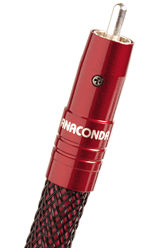
AudioQuest describes its Anaconda interconnect as a "triple balanced" design, meaning that it contains three identical pairs of conductors, one for each leg of a balanced connection, or two for ground and one for hot in an unbalanced configuration. Each pair consists of 24 AWG and 20 AWG conductors, the former in a Teflon tube, the latter in a polyethylene (PE) tube. Both conductors are solid, ultra-pure copper, and the insulating tubes are much larger than the conductor—resulting in a (mostly) air dielectric. The use of two insulating materials and the relative sizes of the conductors are selected to balance the attributes of the materials and, theoretically, get the best of both while minimizing the audible effects of their drawbacks. The conductors are then completely covered with a shield of solid silver foil, which is tied to ground at one end of the cable and drained by four drain wires of 26 AWG, silver-plated, long-grain copper. The whole assembly is then encased in red PVC, covered with a sexy black mesh, and terminated with AQ's heavily silver-plated copper plugs—RCAs in my case—via a resistance-welding process. Use and Listening: The first question in reviewing any cable is "How easy is it to use—to wind, wedge, suspend, and bend to a system's configuration?" In the case of the Anaconda, the answer was "Very easy." Although it's the standard ½" or so in diameter, the Anaconda is reasonably flexible. What's more, once bent, it kind of retains its shape, making it dead simple to dress cables in even the most crowded equipment rack. If I had to describe the Anaconda's sound in one word, it would be "bold." If I had a few more, I'd throw in "big, expansive, dynamic, powerful, fast..." You get the idea. Letting rip with a clean, open, well-recorded rock album was what did the trick. Trish and the kids were at Tai Kwon Do one evening, so I pulled out AC/DC's Back in Black (LP, Atlantic 16018), cued up "You Shook Me All Night Long," and was absolutely blown away. The warm, natural analog sound I expected was there in spades, but it was as if I'd turned the volume up a couple of clicks. In audio lingo, I'd say that the system's dynamic transients were noticeably larger with the Anacondas. In terms of the music, I'd say that Phil Ruud's drums had a power and impact that felt as if they were pressurizing the room, taking my breath away, and pushing me back in my chair. And the Young brothers' dueling guitar riffs a few seconds later exploded out of a dead-silent background, going from zero to way too many decibels in the blink of an eye.
I used the AudioQuest cables off and on over about a year, but did most of my serious listening in two stints. The first, just prior to Trish's and my move last summer, used Magnepan MG3.6/R speakers driven by my VTL Ichibans or a GamuT D-200. The second session, later in the fall and winter, after we'd moved into our new house, used a system built around either the Classé Omega monoblocks and Audiophysic Virgo III speakers, or the Kirksaeter Silverline 60s driven by Mark Levinson No.20.6s. In both setups, the remainder of the system consisted of my VPI TNT/JMW 12.5/Benz-Micro L04 analog front-end, the Simaudio Moon Eclipse CD player, and my VAC CPA-1 Mk.III preamp. I did use other gear at times—the GamuT CD-1 CD player, my VAC Renaissance 70/70, and the GamuT preamp all saw duty—but the bulk of my notes are from one of the two setups above. In all cases, I compared the AudioQuests to my three current reference cables—Nirvana's S-X Ltd., Nordost's Valhalla, and Audience's Au24—to establish a context.
AudioQuest describes its Anaconda interconnect as a "triple balanced" design, meaning that it contains three identical pairs of conductors, one for each leg of a balanced connection, or two for ground and one for hot in an unbalanced configuration. Each pair consists of 24 AWG and 20 AWG conductors, the former in a Teflon tube, the latter in a polyethylene (PE) tube. Both conductors are solid, ultra-pure copper, and the insulating tubes are much larger than the conductor—resulting in a (mostly) air dielectric. The use of two insulating materials and the relative sizes of the conductors are selected to balance the attributes of the materials and, theoretically, get the best of both while minimizing the audible effects of their drawbacks.
The conductors are then completely covered with a shield of solid silver foil, which is tied to ground at one end of the cable and drained by four drain wires of 26 AWG, silver-plated, long-grain copper. The whole assembly is then encased in red PVC, covered with a sexy black mesh, and terminated with AQ's heavily silver-plated copper plugs—RCAs in my case—via a resistance-welding process. Use and Listening: The first question in reviewing any cable is "How easy is it to use—to wind, wedge, suspend, and bend to a system's configuration?" In the case of the Anaconda, the answer was "Very easy." Although it's the standard ½" or so in diameter, the Anaconda is reasonably flexible. What's more, once bent, it kind of retains its shape, making it dead simple to dress cables in even the most crowded equipment rack. If I had to describe the Anaconda's sound in one word, it would be "bold." If I had a few more, I'd throw in "big, expansive, dynamic, powerful, fast..." You get the idea. Letting rip with a clean, open, well-recorded rock album was what did the trick. Trish and the kids were at Tai Kwon Do one evening, so I pulled out AC/DC's Back in Black (LP, Atlantic 16018), cued up "You Shook Me All Night Long," and was absolutely blown away. The warm, natural analog sound I expected was there in spades, but it was as if I'd turned the volume up a couple of clicks. In audio lingo, I'd say that the system's dynamic transients were noticeably larger with the Anacondas. In terms of the music, I'd say that Phil Ruud's drums had a power and impact that felt as if they were pressurizing the room, taking my breath away, and pushing me back in my chair. And the Young brothers' dueling guitar riffs a few seconds later exploded out of a dead-silent background, going from zero to way too many decibels in the blink of an eye.