Audacious Audio

Sort By:  Post Date TitlePublish Date

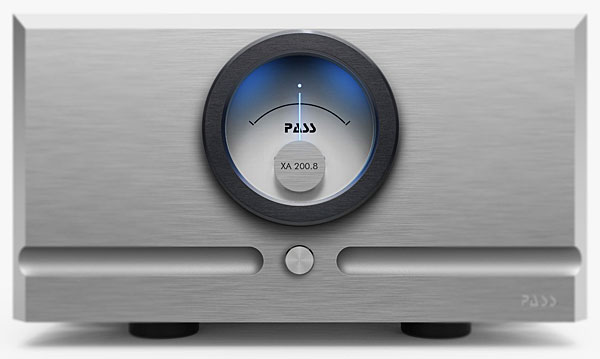
Pass Laboratories XA200.8 monoblock power amplifier

It was almost seven years ago that Nelson Pass, whose talks and exhibits I'd covered at many a Bay Area Burning Amp DIY event and audio show, surprised me with a loan of two Pass Laboratories' XA 160.5 class-A monoblock amplifiers. Ten months later, after I'd commented that my system had challenged the XA 160.5s in the bass department, he sent me a pair of XA200.5 monos. I connected those bigger babies to Wilson Audio Sophia 3 loudspeakers and some now-discontinued digital components with Nordost Odin 1 interconnects and speaker cables. Then came my way, toward the end of 2016, the XA200.8 monoblocks ($42,000/pair).

Ypsilon Electronics Hyperion monoblock power amplifier

Designers of hybrid amplifiers can use solid-state devices in an amp's input stage and tubes in its driver and output stages, as Music Reference's Roger Modjeski did in his RM-200 Mk.II—or they can use tubes in the input and transistors in the output, as Ypsilon Electronics' Demetris Baklavas prefers.

The advantage of solid-state at the input stage can be lower noise. In the RM-200 Mk.II's fully balanced design, carefully matched input devices result in high common-mode rejection and low-noise operation close to the levels achieved with the best input transformers. The RM-200 Mk.II's signal/noise ratio measured a healthy 95.4dB.

Jadis JA200 Mk.II monoblock power amplifier

"How natural the sound," wrote Jonathan Scull in March 1994, in his Follow-Up on the original Jadis JA 200 monoblock amplifier, which then cost $18,990/pair. "How easy it was to follow the musical line and fall into the music. How deep, controlled, tight, and satisfying the bass. How magnifique the midrange—the traditional strength of the Jadis presentation. How full and satisfying the lower midrange. How open, airy, how right the highs—not at all hard, but very extended and natural. How involving their presentation. How full, how harmonically correct, how wonderfully compelling. How magical."

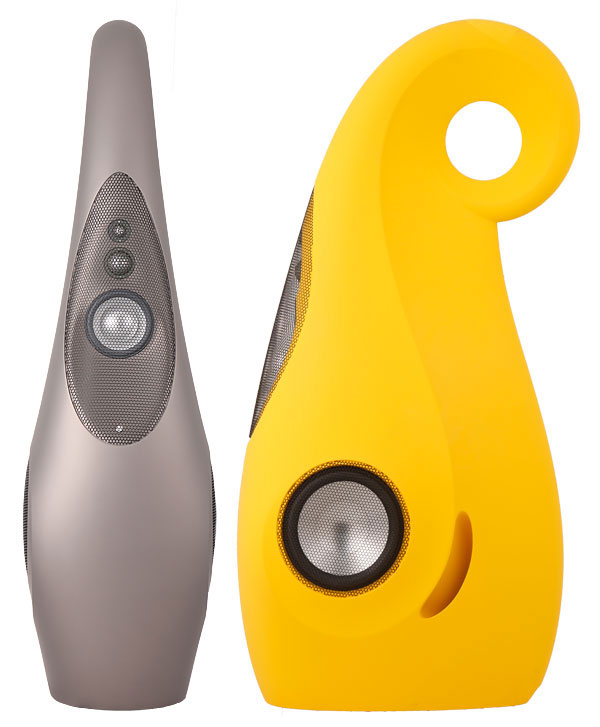
Vivid Audio Giya G1 Spirit loudspeaker

It's been more than seven years since the late Wes Phillips reviewed Vivid Audio's top-of-the-line loudspeaker, the Giya G1, for Stereophile, and since then the speaker has been seriously revised. At first glance you still notice the sui generis form; closer inspection reveals fundamental changes that make it, in most respects, an entirely new speaker.

Gramophone Dreams #19: HiFi Man Susvara headphones

I spend my days comparing cartridges and speaker stands, arguing about imaging and microphone placement, speculating about DAC filters, and lately, sometimes, very secretly listening to headphones connected not to commercially available headphone amplifiers but directly to the outputs of basic tubed and solid-state power amplifiers. No person in his right mind would or should try this—it's too easy to destroy a pair of delicate, expensive headphones. But for me, it's been worth the risk.

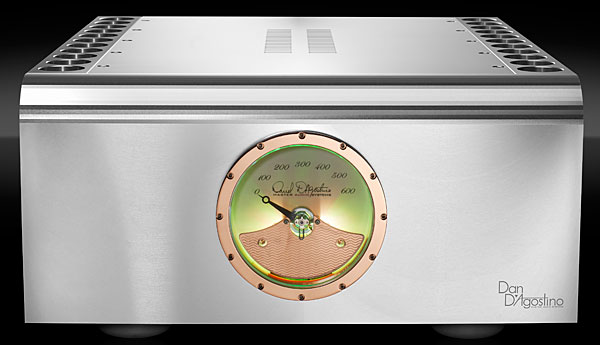
Dan D'Agostino Progression Mono monoblock power amplifier

For as long as I've known about high-end audio, I've put Dan D'Agostino, co-founder of Krell, on the same pedestal reserved for the likes of Frank McIntosh, Saul Marantz, Avery Fisher, H.H. Scott, and Sidney Harman. The reason is simple: Dan's the man whose achievements at Krell led me from the harsh sound of my first high-end amp into another dimension, one of truly musical sound reproduction.

Brinkmann Audio Nyquist D/A processor

What? Johnny-come-lately turntable manufacturer Brinkmann Audio now makes a DAC? Are they desperate? What sampling rates does it support—162/3, 331/3, 45, and 78? I guess the vinyl resurgence is over! Why else would Brinkmann make a DAC?

If that's what you're thinking, consider that Helmut Brinkmann began designing, manufacturing, and marketing electronics well before he made the first of the turntables for which his company is best known in the US.

Rockport Technologies Avior II loudspeaker

Following my review of the floorstanding Magico S5 Mk.II last February, I spent some time with two-way stand-mounted speakers from Aerial Acoustics, Bowers & Wilkins, and Dynaudio. As much as I appreciated the small speakers' virtues, I found myself missing the big Magico's bass extension and ability to play loud; my next loudspeaker review, therefore, would be of another floorstander.

It's been a while since we published a review of a Rockport Technologies loudspeaker.

Lamm Industries L2.1 Reference preamplifier

"As the original L2 circuitry was virtually flawless, it was the emergence of new electronic components that opened up a possibility of [even better performance] . . ."

So begins one of two booklets—one a collection of specifications and interior photos, the other a distinctly thorough user's manual—included with the new L2.1 Reference line-level preamplifier from Brooklyn's Lamm Industries, earlier products from which have impressed me as among the best available. Indeed, coming from almost anyone else, the above quote would strike me as trivial boasting—but I know from experience that there's nothing trivial about designer and company head Vladimir Lamm.

Zesto Audio Andros Téssera phono preamplifier

Maybe you've seen the widely circulated New Yorker cartoon: Two guys stand in front of a nicely drawn, tubed audio system, under which are shelves full of LPs. One guy says, "The two things that really drew me to vinyl were the expense and the inconvenience."

If you can't laugh at that, you've lost your sense of humor—even acknowledging that, oddly, convenience is the raison d'etre of some recent phono preamplifiers—including Dan D'Agostino Audio's Momentum and the CH Precision P1, both of which offer multiple, switchable, configurable inputs saved in memory. Today's well-heeled vinyl enthusiast might have two or more tonearms mounted on a single turntable—or even two turntables, each with two arms. Zesto Audio's new Andros Téssera tubed phono preamplifier takes aim at that market segment.

Advertisement
Advertisement
Advertisement