Audacious Audio

Sort By:  Post Date TitlePublish Date

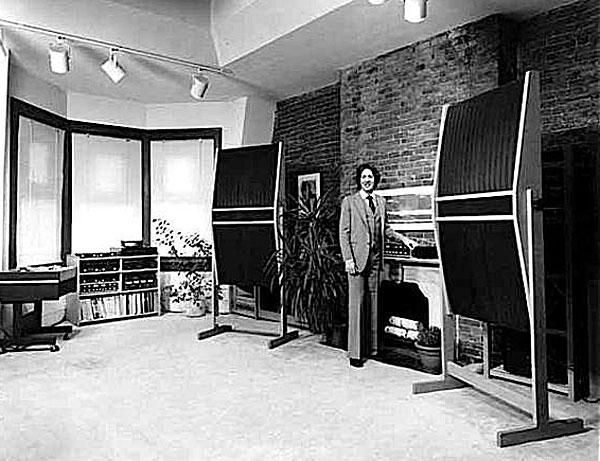
Wilson Audio Modular Monitor (WAMM) loudpeaker system

No, we made no typos in the specifications sidebar. The weight of the Wilson Audio Modular Monitor (WAMM) speaker system is enough to make you consult a structural engineer before dropping it on your living room floor—fragile, 300-year old New England frame houses are probably out. And the recent price increase from $32,000 to $35,000 is enough by itself to buy a pair of Quad ESL-63s—which is not a bad speaker system. The WAMM represents an all-out assault on both the state of the art in speaker systems and on the limits to which wealthy audiophiles will go in order to have the best.

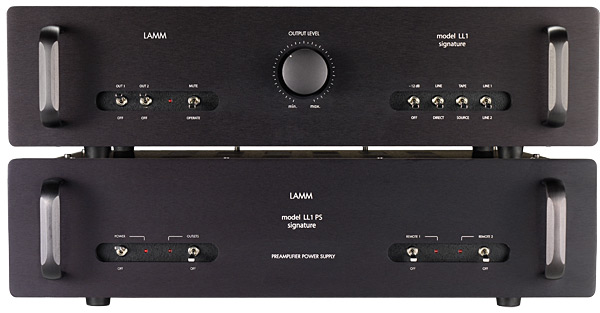
Dan D'Agostino Master Audio Systems Momentum line preamplifier

A preamplifier is the port of entry through which you gain access to the sources you've so carefully assembled. It's also the gate through which all of your music passes. So while its sonic performance is obviously critical, you'd also better assess how it feels, how it looks, and how it operates—you're going to be in an intimate relationship with it for a long time. Before choosing a preamplifier, therefore, take some time to drive it around the block, or at least shake hands with it. Use your imagination as much as your ears.

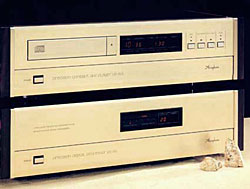
Accuphase DP-80L CD player & DC-81L digital processor

389accu.promo.jpg$13,000! You could buy two Hyundai Excels for that kind of money. Or one 5-liter Ford Mustang. Or two-thirds of a Saab 900 Turbo. How could the purchase of this Accuphase two-box CD player be justified on any rational grounds? What if it did offer state-of-the-art sound quality? Would it really be 50 times better than a humble Magnavox? Would it even be 4.3 times better than the California Audio Labs Tempest II CD player? And would it approach the sound quality routinely offered from LP by the similarly priced Versa Dynamics 2.0 turntable?

Hill Plasmatronics Type 1 loudspeaker

Dr. Alan Hill, president of Plasmatronics Inc., was previously employed by the US Government in laser research. His assignment: To increase the efficiency of lasers so that they could do something more impressive than produce holograms, mend leaky retinal blood vessels, and punch pinholes in steel blocks. Dr. Hill earned his keep, thus advancing laser technology a giant step closer to Star Wars, and then retired from government service to design. . . a loudspeaker?!!!?

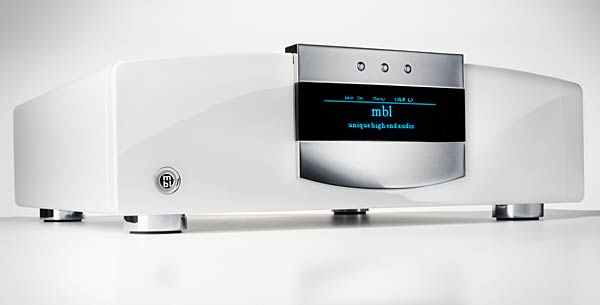
MBL Corona C15 monoblock power amplifier

A year or so ago, in my review of the Pass Labs XP-30 preamplifier, I wrote that the heart of an audio system is the preamplifier, in that it sets the overall quality of the system's sound. But it is the power amplifier that is responsible for determining the character of the system's sound, because it is the amplifier that must directly interface with the loudspeakers. The relationship between amplifier and loudspeaker is complex, and the nature of that relationship literally sets the tone of the sound quality.

Analog Corner #226: VPI Classic Direct Drive Signature turntable

VPI Industries' Harry Weisfeld has tried, built, and marketed almost every known way of spinning a platter. He began in the early 1980s, before many recent turntable enthusiasts were born, with the belt-driven HW-19, and since then has produced rim-driven models, and 'tables with motors outboard or inboard, one or three pulleys, one or three belts, and platters of acrylic or aluminum alloy. But while Weisfeld has owned quite a few direct-drive 'tables, he'd never come up with his own—until now.

VTL Siegfried Series II Reference monoblock power amplifier

Big tube amplifiers were once scary monsters reserved for those who didn't mind heavy maintenance, careful tweaking, and the occasional explosion. Blown tubes required replacing, preferably with pricey matched pairs, then biasing with a voltmeter. Optimal sonic performance required regular bias monitoring and adjusting, and because of current surges on startup, you had to choose between leaving the heat-producing monoliths on, or turning them on and off for each listening session, thus shortening the life of the tubes.

Counterpoint Clearfield Metropolitan loudspeaker

893count.250.jpgWhile Clearfield Audio may be a new name to many of you, it represents the marriage of two well-established members of the high-end community: Counterpoint and designer Albert Von Schweikert. Counterpoint had been working to add speakers to its product lineup for some time. The partnership with Von Schweikert, whom Stereophile readers will remember as the designer of the Vortex Screen favorably reviewed by Robert Harley in July 1989, fills out Counterpoint's high-end product line from source—the company showed a CD transport at the June 1993 CES—to speaker.

The Metropolitan
The developmental history of Vortex speakers provides a meaningful framework for the design of the Clearfield offerings, especially the Metropolitans, or Mets. Like the Vortex designs, the Mets are three-ways with transmission-loaded bass. Like the Kevlar Reference Screen (reviewed by Robert Greene in The Abso!ute Sound's "double-issue" 83/84, December '92), the Mets use Kevlar-coned midrange units from Focal that cover a broad range from 125Hz to 2kHz. What's dramatically different is the overall driver layout.

Advertisement
Advertisement
Advertisement