Audacious Audio

Sort By:  Post Date TitlePublish Date

Revel Ultima Rhythm2 powered subwoofer

Powerful, massive, and expensive, Revel's Ultima Rhythm2 subwoofer ($10,000) swept me off my feet when I first saw it in Harman International's suite at the 2013 Consumer Electronics Show. It outsizes, by 49 lbs and 2.6 cubic feet, Revel's previous flagship model, the Ultima Sub30, which I reviewed in the November 2004 issue. Its specs read like no other sub's: 196 lbs; 18" cast-frame woofer; dual 4" voice-coils; 4kW peak power from twin internal amplifiers that generate 1kW RMS; 115dB peak acoustic output; a fully configurable, high-resolution, 10-band parametric equalizer (PEQ); an internal crossover with high- and low-pass outputs; and PC-based setup via USB. The Rhythm2's patent-pending design is said to let just enough air move in and out of the cabinet to prevent any distortion-inducing pressure due to heating of the voice-coils. And its veneer, shape, beveled top edges, and bottom plinth exude the quality found in Revel's top-of-the-line floorstanding speaker, the Ultima Salon2, with which I was familiar.

Astell&Kern AK240 portable media player

Do you travel? Commute, perhaps? Just like to listen to music privately around the house? No matter—the Astell&Kern AK240 is the luxury choice in high-resolution portable music players (footnote 1). It even comes with a lovely leather case that beautifully cradles its angular beauty. The AK240 can play all of your PCM files, up to a resolution of 24-bit/192kHz, as well as DXD and single- and double-rate DSD, natively, and can do so from its internal storage, from a microSD card, or from your computer via WiFi or a wired connection. It can also function as a DAC or USB-to-TosLink converter. I'm not so sure there's much left wanting.

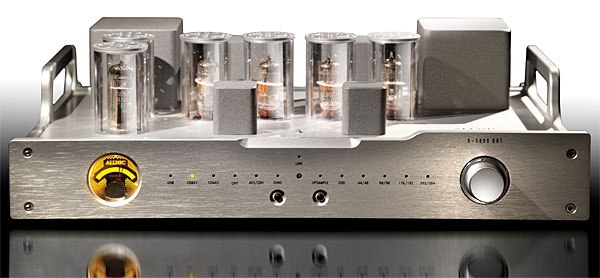
Allnic D-5000 DHT D/A processor

There may have been a time when vacuum tubes and microprocessors seemed strange bedfellows. But nowadays—given the countless digital processors with tubed output stages, and an even greater number of tubed amps and preamps whose insides are crawling with the latest solid-state devices—we're more or less used to the idea. Here as elsewhere, hybrids are no big deal.

Ayre Acoustics KX-R Twenty line preamplifier

The experience left me doubting my ears. After I'd performed all the measurements of Ayre Acoustics' KX-R preamplifier ($18,500) to accompany Wes Phillips's review in our November 2008 issue, I spent a weekend listening to it. To my astonishment, the sound of my system with a Transporter D/A processor feeding the preamplifier was better than when the DAC fed the power amplifier directly. Through the KX-R, images sounded more tangible, and the sound was better focused, despite the signal's having been passed through not just another set of interconnects but also through the preamp's input and output socketry, switches, a volume control, printed circuit-board traces, and active and passive parts. Logically, you'd think that having nothing in the signal path would have less of a degrading effect than so many somethings. But no, that was not what I heard, much as I would have preferred otherwise.

Simaudio Moon Evolution 820S power supply

Can a power-supply upgrade produce audible sonic benefits? If you've upgraded the power supply of a phono preamplifier, you probably don't need to be convinced that it does, and those usually cost only a small percentage of the price of the model they power. But to add Simaudio's Moon Evolution 820S power supply ($8000) to the Moon Evolution 650D DAC–CD transport ($9000), which I reviewed in the November 2011 issue, almost doubles the latter's cost—though the 820S can be used to simultaneously power two Moon Evolution components, like the 750D DAC ($14,000), 740P preamplifier ($9500), and 610LP ($7500) and 810LP phono preamplifier ($13,000).

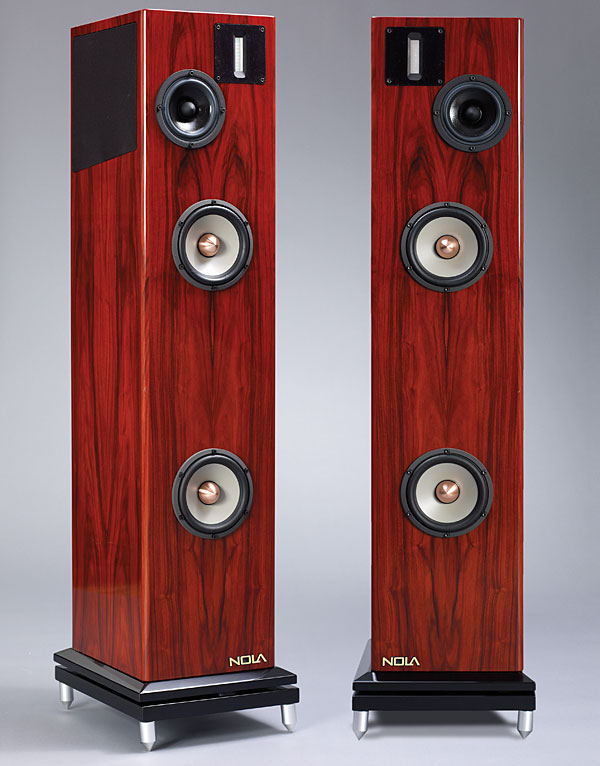
Nola Metro Grand Reference Gold loudspeaker

For a reviewer, deciding which products to write about is a tricky business. You want to do a professional job of evaluation, but you also want to be able to wrest maximum enjoyment from your music while you do so. Attending audio shows is where reviewers perform sonic triage, weeding out the products that aren't ready for prime time, and making a note of those they wish to invite home after the show.

Audio Streams #3

Do you travel? Commute, perhaps? Just like to listen to music privately around the house? No matter—the Astell&Kern AK240 is the luxury choice in high-resolution portable music players (footnote 1). It even comes with a lovely leather case that beautifully cradles its angular beauty. The AK240 can play all of your PCM files, up to a resolution of 24-bit/192kHz, as well as DXD and single- and double-rate DSD, natively, and can do so from its internal storage, from a microSD card, or from your computer via WiFi or a wired connection. It can also function as a DAC or USB-to-TosLink converter. I'm not so sure there's much left wanting.

Siltech SAGA power amplifier

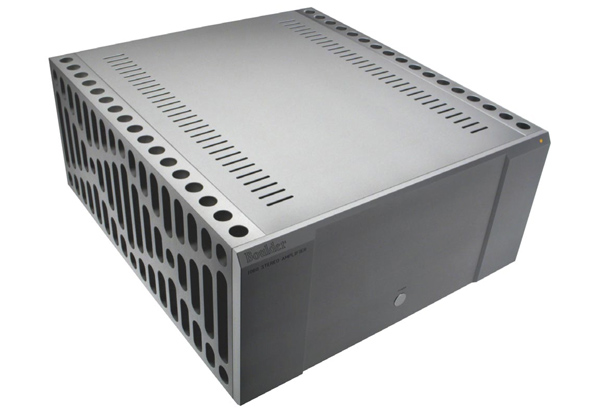
Among the biggest buzzes at the January 2013 Consumer Electronics Show, and at Munich's High End Show the following May, was the sound in the room of Siltech BV, a Dutch company best known for its high-end cables. Siltech was demonstrating an innovative new power amplifier, and using it to drive the company's glass-cabineted Arabesque loudspeakers ($90,000/pair). The sound was unmistakably lush yet also remarkably linear, notably dynamic, and seemingly free of electronic artifacts. It sounded like the sound of "nothing"—which was really something!—and so much of a something that it caught the attention of many reviewers. But while there's often controversy and disagreement about a given product's sound quality, this time the enthusiasm seemed unanimous.

Mark Levinson HQD loudspeaker system

We wrote a long, rather unkind report on the HQD, pointing out that, if that was typical of the way it was supposed to sound (And why not, after Mr. Levinson had installed and tweaked it?), then it had to be the most expensive bomb ever to be made available for civilian use. Mr. Levinson responded with a phone call during which he:

1) Told us we had not heard it at its best, but refused to address himself to our specific criticisms;

2) Claimed that many practicing professional musicians felt the HQD to be "extremely realistic";

3) Informed us that, since he sold very few HQD systems and would soon be discontinuing them anyway because Quad had ceased making those speakers, the "sensible" thing to do would be to kill the report; and

4) Mentioned, just in passing of course, that he was currently writing a feature article for Time on the subject of "underground" audio magazines.

Advertisement
Advertisement
Advertisement