Audacious Audio

Sort By:  Post Date TitlePublish Date

Analog Corner #239: Swedish Analog Technologies tonearm

Late in the fall of 1982, Los Angeles turned ugly for me. I'd finished my work on Tron and despite the Academy Award nomination for Best Sound (which went to the mixing team, not the sound supervisor), it was obvious that nothing else was coming my way anytime soon. To earn a living, I had to reinvent myself.

So there I was in Las Vegas, at the 1983 Consumer Electronics Show, schlepping heavy bags filled with press kits, each containing an audio cassette of a dozen radio commercials for a car-stereo store that I'd voiced and produced, along with a résumé-bio and endorsements from clients.

Bel Canto Design Black amplification system

Stereophile normally doesn't review audio systems. We review individual components. We've made an exception for the Bel Canto Black system because it deserves to be evaluated as such. It consists of three dense, almost identically sized cases of black-anodized aluminum. One, the ASC1 Asynchronous Stream Controller, is what in a conventional system would be called a "preamplifier." The other two, a pair of MPS1 Mono PowerStreams, would in a conventional system be called "monoblock power amplifiers."

Valve Amplification Company Signature SE preamplifier

For me, the highlights of any audio show are finding a room with great sound and visiting it often throughout the show, to relax and absorb a wide range of great music. At the NY Audio Show in April 2012 in New York City, it was the room occupied by the Valve Amplification Company. There, I fell in love with the sound coming through the Signature Mk IIa line-stage preamplifier, and remembered that while I'd heard many VAC products at audio shows over the past two decades, and had enjoyed the sound every time, I'd never had a VAC product in my house. I requested a review sample.

Wadia Digimaster 2000 Mk.2 digital processors

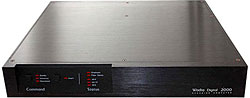
666wawaWadia2000.1250.jpgDuring my reviews of digital processors in the past year or so, I've made comparisons with the Wadia 2000 Digital Decoding Computer first reviewed by Arnis Balgalvis in Vol.13 No.1. I've felt that, as good as the 2000 is, other processors—many costing less than the 2000's $8500 price tag—are now superior.

However, a visiting Wadia representative looked inside our sample and used the word "ancient" to describe its circuitry in relation to current production. In addition, I was never able to audition the 2000 with a glass fiber-optical interface, standard equipment on Wadia's transports. Similarly, the $2000 Wadia X-32 had undergone a minor circuit revision, including the inclusion of the glass optical input. Consequently, a follow-up of these two excellent processors seemed in order.

Bricasti Design M28 monoblock power amplifier

Google Bricasti and all that comes up are sites relating to Bricasti Design products. The name must be fanciful—it sounds Italian, but cofounders Brian Zolner and Casey Dowdell most likely are not, and the company's headquarters are not in Milan or Turin but in Massachusetts.

While its name might be whimsical, nothing else about Bricasti is. As John Marks reported in his review of Bricasti's M1 DAC in the August 2011 issue, both founders previously worked at Lexicon: Dowdell as a DSP-software engineer, Zolner as international sales manager. Bricasti develops its products in conjunction with Aeyee Labs, formed by a group of ex-employees of Madrigal Audio Laboratories and based in New Haven, Connecticut.

Theta Data universal disc transport

"In the fields of observation, chance favors only the mind that is prepared."

When Louis Pasteur uttered these words more than a hundred years ago, he must have speculated that they would apply equally well to future circumstances as to the events of his day. What he couldn't anticipate, however, was the technology to which his insight now seems so appropriate.

Thöress 300B monoblock power amplifier

I was weak and easily led.

In 1978, after enduring four or five years of wretched music made by men with long hair and beards and tendencies toward eonic guitar solos, I suddenly discovered that the only music worth hearing was made by clean-shaven men of limited musical proficiency. I embraced the Clash, the Pistols, the New York Dolls, the Ramones, and the Buzzcocks. I cut my hair and gave away some of my old records. I even threw out my copy of Jethro Tull's A Passion Play—which, now that I think about it, wasn't that bad an idea.

Then I woke up and remembered: I'd left the baby in the bathwater.

Wilson Audio Specialties Duette Series 2 loudspeaker

I've seen how most manufacturers work. They start out by making products they believe in—products consumers are likely to love. But after a while they begin listening to their dealers and distributors and marketing consultants, most of whom are inclined to say things like: "You need to make a six-figure turntable, to compete with all the other six-figure turntables." "You need to make a $1500 amplifier, to fill that price gap in your product line." "You need to make a small, stand-mounted loudspeaker."

Theta Digital Prometheus monoblock power amplifier

Several seconds after I began listening to it, I knew that Theta Digital's Prometheus monoblock amplifier ($12,000/pair) was different from other amplifiers. The violins and brass were more dynamic, and had more pace. The orchestra sounded more three-dimensional, depicted in relief by a degree of hall ambience I hadn't heard when I played the same recording through my reference solid-state stereo amplifier, a Mark Levinson No.334.
Advertisement
Advertisement
Advertisement