Historical

Sort By:  Post Date TitlePublish Date

What a Difference a Wire Makes

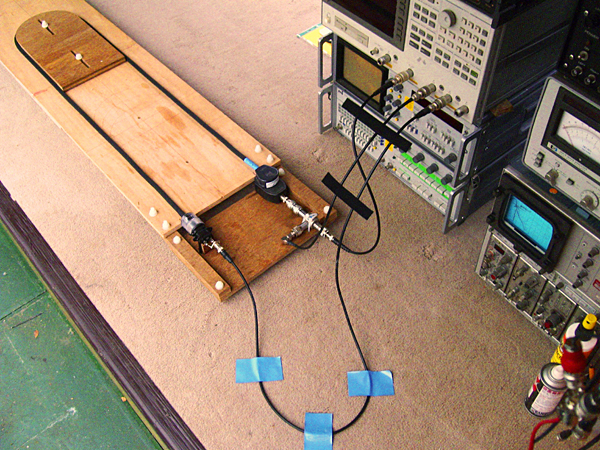
Testing the RF transmission of Kimber Kable, up to 3GHz, at Ben Duncan Research Labs, in 2008. The resulting proof of RF rejection was published on-line by Russ Andrews Accessories in England. (Photo: Naomi Swain).

Editor's Preface: In an article in the October 1995 issue of Stereophile, Professor Malcolm Omar Hawksford used Maxwell's Equations to develop a mathematical model describing the behavior of cables at audio frequencies. Among the predictions of this model were that for good conductors there exists an optimum size of wire for audio signal transmission, and that for a wire larger than this size an energy storage mechanism would exist. In his article Malcolm described a simple experiment, the results of which appeared to confirm his hypothesis.

Then serendipity struck. English engineer Ben Duncan, whose writings have occasionally appeared in Stereophile, sent me an article he had written for the pro-audio magazine Studio Sound. The results of a series of cable measurements he had performed seemed to confirm the Hawksford Hypothesis. We offer them here for your delight and delectation.—John Atkinson

John Atkinson: a Career in Audio

At the end of April, Adrian Low, the proprietor of Toronto retailer Audio Excellence, asked if he could interview me. "I've been interviewing audio luminaries for some time," Adrian wrote, "partly because I am so interested in how they started, their experiences, and also to share these with fellow audio enthusiasts."

We connected with Skype and, in the two videos embedded below, Adrian and I, along with Jan and Vilip from Audio Excellence, talk about many things connected with my 52 years as an audiophile, my 43 years in audio magazine publishing, and my 33 years at the editorial helm of Stereophile.

Krell Power: A Visit to the Laboratory of Doctor Morbius

The only one who knows this ounce of words is just a token
Is he who has a tongue to tell, but must remain unspoken.
—Moondog, 1968

The Lockheed 1011 sits dormant on the ground at Chicago's O'Hare airport. "We have a little light bulb problem here" drawls the pilot in the approved Right Stuff manner. "We don't know if it's the bulb or what, we'll let you know."

2020 Jitter Measurements

Even as digital/analog processors were becoming a hot product category in the early 1990s, audiophiles were also learning that timing uncertainties in the AES/EBU and S/PDIF serial datastreams—jitter—would compromise any improvement in sound quality offered by these DACs. Some companies therefore introduced products to reduce or eliminate jitter—in the November 1994 issue of Stereophile, Robert Harley reviewed three such products: the Audio Alchemy DTI Pro, the Digital Domain VSP, and the Sonic Frontiers UltrajitterBug. I still have Stereophile's review samples of the UltraJitterBug and VSP, along with two contemporary DACs: a PS Audio UltraLink and a Parts Connection Assemblage DAC-1.

As our reviews of these products were published before Paul Miller's and the late Julian Dunn's development of the "J-Test" diagnostic signal, I performed J-Test jitter measurements to bring that 1994 review into the 21st Century. You can see what I found here.

Audio Research Dual 150 power amplifier

We mentioned in the last issue that we were becoming increasingly disturbed by "a certain manic quality that is creeping into this pursuit of sonic perfection." We were referring then to a manufacturer's announcement of the imminent availability of a speaker system weighing over 1000 lb per channel, but we could just as well have been speaking of this behemoth from Audio Research.

Hegeman Model 1 omnidirectional loudspeaker

Ye Editor had his first exposure to a true omnidirectional speaker system 15 years ago, while he was employed as chief equipment tester for High Fidelity magazine. The speaker was a most unusual-looking device for its time, being roughly a foot square and standing 3 feet high, with a "cube" of grille cloth at the top like a cupola. Inside the cupola was an 8" woofer facing upwards. Directly above it was the weirdest-looking tweeter you ever saw.

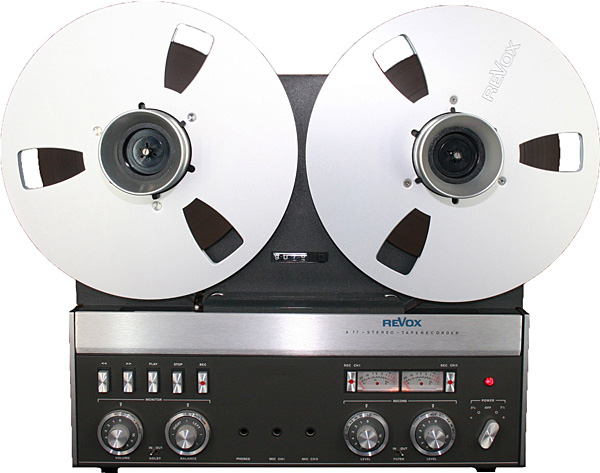
Revox A-77 open-reel tape recorder

The Revox A-77 has extremely good speed regulation, vanishingly low wow and flutter, very low noise, superb tape handling, and the smoothest, widest-range frequency response of any recorder we have ever tested.

The portable version, with built-in monitor amps and speakers, is very compact for a machine with 10½ reel capacity, and is easily carried by one person. Now that the later version is equipped with a flutter-filtering tension arm, our only criticism of the A-77 is its use of three-circuit jacks for the micro phone inputs instead of the XLR-type receptacles that are considered to be "standard" in the US for on-location audio recording.

Advertisement
Advertisement
Advertisement