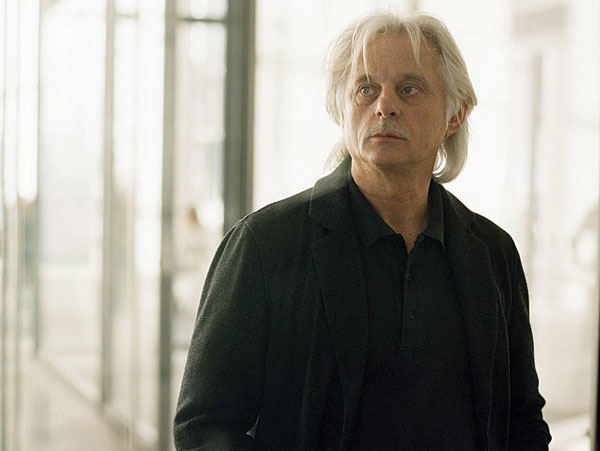
Steve Earle: Hardcore Troubador
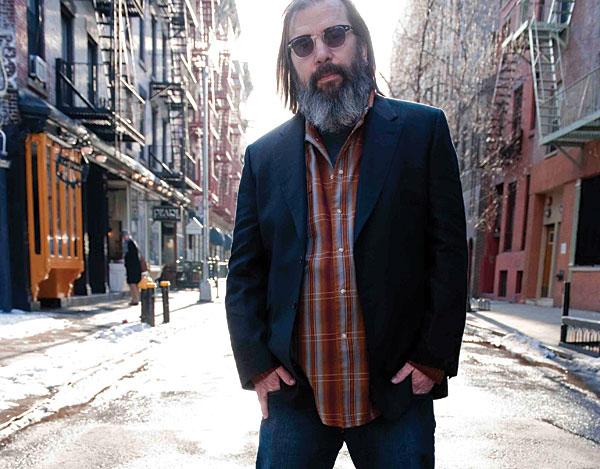
To write about music, you must first come to terms with your fanboy urges. You must brush off the fairy dust and see your heroes for who they really area picture that in many cases is all too human. Yet that first blush of idolatry is an experience you never quite forget, no matter how many times you interview a person.
There was a time, back in the St. Elmo's Fire 1980s, when Steve Earle's first album, Guitar Town, was an object of abject slobbery for a generation of rock critics. Turning a near-mint LP copy of that album over in his hands, Earle begins to reminisce about a record that changed Nashville and country-rock music and, for many, remains his undisputed career masterpiece.
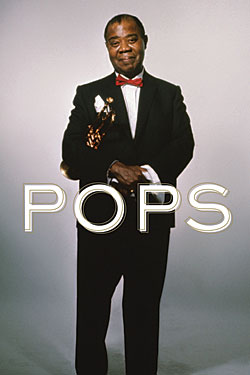 Pops: A Life of Louis Armstrong, by Terry Teachout (Houghton Mifflin Harcourt, 2009): 475pp. Hardcover, $30; paperback, $16.95.
If you plan to read just one book about Louis Armstrong, whose virtuosic cornet solos pushed jazz past rudimentary ensemble playing and launched his phenomenal career as an instrumentalist and singer, make it Pops. Teachout built it on brickwork laid by authors who preceded him, so you'll benefit from their research, as well as from narrative on 650 previously private reels of tape that Armstrong recorded and archived. Moreover, Teachout is a musician and music critic who offers opinions on his subject's discography.
Few people seem to realize that Armstrong (19011971) called himself LOU-iss. "All White Folks call me Louie," he once noted, and in some instances that may have been patronizing. In others, it was surely an instinctive response to the man's infectious warmth and informality.
Pops: A Life of Louis Armstrong, by Terry Teachout (Houghton Mifflin Harcourt, 2009): 475pp. Hardcover, $30; paperback, $16.95.
If you plan to read just one book about Louis Armstrong, whose virtuosic cornet solos pushed jazz past rudimentary ensemble playing and launched his phenomenal career as an instrumentalist and singer, make it Pops. Teachout built it on brickwork laid by authors who preceded him, so you'll benefit from their research, as well as from narrative on 650 previously private reels of tape that Armstrong recorded and archived. Moreover, Teachout is a musician and music critic who offers opinions on his subject's discography.
Few people seem to realize that Armstrong (19011971) called himself LOU-iss. "All White Folks call me Louie," he once noted, and in some instances that may have been patronizing. In others, it was surely an instinctive response to the man's infectious warmth and informality.

 The question kept running through my head as I marveled at the breadth and maturity of Attention Screen's remarkable improvisations during a pre-concert sound check in the Piano Salon of Yamaha Artist Services, Inc. (YASI), at 689 Fifth Avenue, in the heart of Manhattan.
Attention Screen impressed even more at the public concert the following night, April 24, 2010. As the band members engaged in one improvisational miracle after another, fearlessly exploring new territory, the beauty and inventiveness of their playing astounded me.
The question kept running through my head as I marveled at the breadth and maturity of Attention Screen's remarkable improvisations during a pre-concert sound check in the Piano Salon of Yamaha Artist Services, Inc. (YASI), at 689 Fifth Avenue, in the heart of Manhattan.
Attention Screen impressed even more at the public concert the following night, April 24, 2010. As the band members engaged in one improvisational miracle after another, fearlessly exploring new territory, the beauty and inventiveness of their playing astounded me.
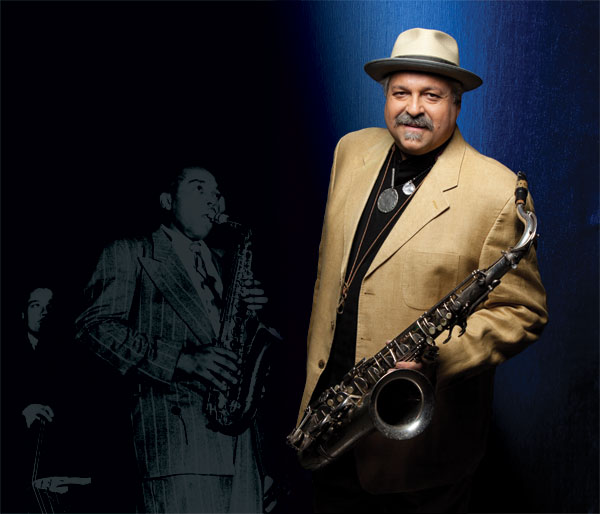
 Thelonious Monk: The Life and Times of an American Original
 The Cello Suites: J.S. Bach, Pablo Casals, and the Search for a Baroque Masterpiece, by Eric Siblin (New York: Atlantic Monthly Press, 2009); hardcover, 318 pp. $24.
In his lifetime, J.S. Bach (16851750) was an obscure figure. He never lived in a major city, he didn't work in the musical formoperathat in his era could propel a composer to stardom, and his style seemed antiquated to many. Bach saw a mere nine of his compositions published; when his consummate masterwork, The Art of the Fugue, appeared the year after he died, it sold just 30 copies.
Eric Siblin includes these and countless other facts in The Cello Suites, a book that will fascinate anyone who loves Bach's music. He notes, for instance, that Bach's four musical sons kept his work in circulation, that Mozart was mightily impressed by a motet he heard at a Leipzig church, and that the 12-year-old Beethoven raised some eyebrows when he performed The Well-Tempered Clavier in Vienna.
The Cello Suites: J.S. Bach, Pablo Casals, and the Search for a Baroque Masterpiece, by Eric Siblin (New York: Atlantic Monthly Press, 2009); hardcover, 318 pp. $24.
In his lifetime, J.S. Bach (16851750) was an obscure figure. He never lived in a major city, he didn't work in the musical formoperathat in his era could propel a composer to stardom, and his style seemed antiquated to many. Bach saw a mere nine of his compositions published; when his consummate masterwork, The Art of the Fugue, appeared the year after he died, it sold just 30 copies.
Eric Siblin includes these and countless other facts in The Cello Suites, a book that will fascinate anyone who loves Bach's music. He notes, for instance, that Bach's four musical sons kept his work in circulation, that Mozart was mightily impressed by a motet he heard at a Leipzig church, and that the 12-year-old Beethoven raised some eyebrows when he performed The Well-Tempered Clavier in Vienna.