Room Treatment Reviews

Sort By:  Post Date TitlePublish Date

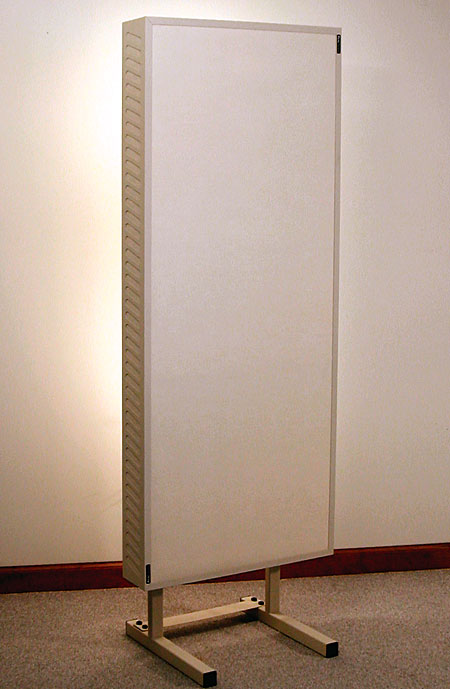
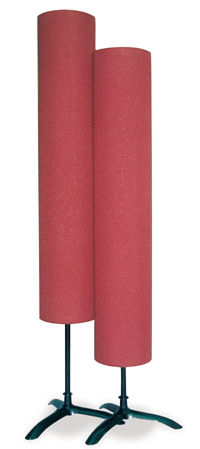
Nucore Cathedral Sound Room Treatments

One of my favorite Charles Rodrigues cartoons, originally published in Stereo Review and reprinted in the book Total Harmonic Distortion (Perfectbound Press, 1988), shows a customer in the soundroom of an audio dealer, auditioning a pair of speakers. This is no ordinary soundroom: the floor, walls, and ceiling are completely covered with irregularly shaped boxes, apparently an extreme form of acoustical treatment. The salesman is saying, "Of course, you realize that it won't sound exactly the same in your living room, sir..."
Acoustic Sciences Corp. Tube Traps

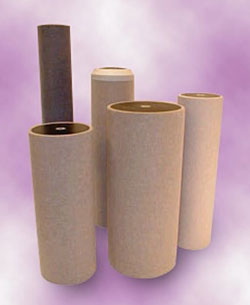
In my rather jaded report">http://www.stereophile.com/asweseeit/the_1986_winter_ces/">report from the 1986 Winter CES (Vol.9 No.2), I remarked that there was nothing really new in the field of high-end audio. Well, I was wrong. I overlooked the Acoustic Sciences Corporation Tube Traps, a patented new acoustic device designed by Arthur Noxon (president of ASC). The Traps represent the first practical and effective solution to a perennial audiophile problem: standing waves in the listening room.

Music in the Round #31

Recently, I got an e-mail from a colleague at another audio magazine complaining about the paucity of new SACD hardware. We've been hearing about the slowing pace of new SACD releases, and about Sony's neglect of a format they themselves developed, but I now realize that, apart from the High End (footnote 1), machines that can play SACDs have been fast disappearing from the middle of the market. When the battle of SACD vs DVD-Audio was raginghttp://www.stereophile.com/asweseeit/305awsi">raging;, universal players that could play both formats were available from almost every major manufacturer. Even John Atkinson jumped on the bandwagon, acquiring a Pioneer DV-578A universal player for $150 to use as a reference. The exceptions were the very companies that had developed the new formats: Sony offered only SACD players, and Panasonic, at least at first, only DVD-A players. No matter—you could buy a universal player at any national electronics chain store, even if that store didn't stock recordings in either format and their staff had never heard of DVD-As or SACDs. Some things never change.

Anti-Node: Active Room-Acoustics Correction

Recently, I assessed four disparate room-correction systems based on digital signal processing (DSP): Copland DRC205, Lyngdorf Audio RoomPerfect, Velodyne">http://www.stereophile.com/musicintheround/1105mitr">Velodyne SMS-1, and Meridian">http://www.stereophile.com/musicintheround/706mitr">Meridian DRC. I concluded that Meridian's approach—which applies IIR (Infinite Impulse Response) "anti-resonance" filters to suppress room resonant modes, if only partially—was, in many respects, the best. What I particularly like about Meridian DRC is that, unlike the Copland and Lyngdorf processors, its approach to system tonal balance is largely hands-off. Yes, it lightens up the extreme bass a little, as you'd expect, but it doesn't recast the system balance in any way that might prove undesirable. If you like your system's tonal character as it is, Meridian DRC behaves just as you'd want a room-correction system to behave: it quells room resonance effects while leaving the system's essential sound well alone.

Phantom Acoustics Shadow active low-frequency acoustic control

The acoustic environment for music reproduction is easily the most overlooked source of sonic degradation. Many fine playback systems are compromised by room-induced anomalies that severely color the reproduced sound. When we live in a world of directional wire, high-end AC power cords, and $4000 CD transports, paying attention to the listening room's contribution to the musical experience takes on greater urgency.

RealTraps MondoTrap room acoustics treatment

For a hobby based on science and technology, audiophilia has more than its share of unscientific elements. That's not necessarily a bad thing; not all of those elements are obvious snake oil, and there's more than science to creating—or re-creating—a musical experience. Still, for the more technical-minded it's a little disconcerting that even the most basic distinctions, such as why two CD players sound different from each other, are hard to explain using technical measurements and simple scientific concepts.

Acoustic Sciences Corporation Studio Traps

Over time I've successfully used a variety of tuning devices to refine the acoustics in Kathleen's and my listening room. But I've always suspected that Acoustic">http://www.stereophile.com/accessoryreviews/215">Acoustic Science's Tube Traps might be a good way to finish it off. I've occasionally asked visitors to stand in one spot or another behind the speakers as I listened for tergiversation (ie, "to change one's tune"; Hoo-hah!). I found several locations where a nice, dense audiophile body made an improvement to the sound.

Echo Busters Decorative Room Treatments

One of the biggest challenges in setting up any new listening room is getting the room to work with your equipment rather than against it. I faced this challenge in spades when Trish and I moved into our dream house in the California hills. What would serve as my listening room was a wonderful, open space with panoramic views of the surrounding hills—a space that bore no resemblance at all to a traditional, rectangular, dedicated listening room. Instead, there was a wall of glass, a huge marble-and-glass fireplace, a 20' ceiling—and did I mention that it isn't actually a "room," but one arm of a continuous flowing space?

Rives Audio PARC 3-Band Parametric Equalizer

Last January, the Stereophile website conducted a pollhttp://www.stereophile.com/showvote.cgi?236">poll; asking readers what they thought was their audio system's weakest link . The results indicated that 24% thought that their room was the most problematic component. What this says is that, though often accused of being obsessed with hardware, we audiophiles are aware of what a potent effect the speaker-room setup has.

TacT Audio RCS 2.0 digital equalizer/preamplifier

I anticipated the installation of the TacT Audio RCS 2.0 room-correction processor with mixed emotions—I already liked my system and room, and such a device threatened to make all my studied efforts trivial. What if one might use any decent amps and speakers, cables that were merely conductive, and no room treatment at all? And what if, on top of that, you could just put them wherever your significant other thought they looked right? What if all the magic you needed was contained in this box? Scary.

Advertisement
Advertisement
Advertisement