Solid State Power Amp Reviews

Sort By:  Post Date TitlePublish Date

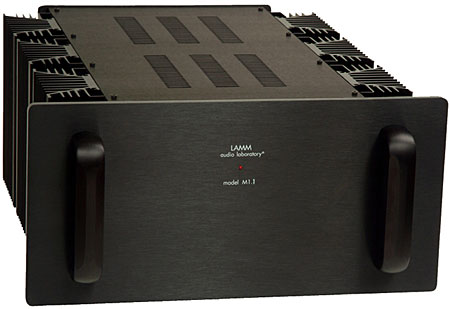
Lamm Industries M1.1 monoblock power amplifier

What is it about a component that makes the blasé High Ender sit up and say, "Hey, this is special!"? What elements of its reproduction reach out to you and won't let go? How does the intrepid audio reviewer find a way to describe these hopefully recurring moments of musical discovery which define the high-end experience? How many times, after all, can you say, "Ooooo, ahhhhh, that's the best [insert some part of the frequency range here]," ad nauseam? How much difference is there, anyway? Therein lies the tale...

Chord SPM 650 power amplifier

High-tech, compact, and lightweight, Chord's entry-level SPM 650 power amplifier ($4995) promises robust power output, low distortion and noise, flat and ultra-wideband frequency response, and bulletproof reliability—all in what seems an impossibly small package measuring 16.4" wide by 3.4" high by 13.8" deep and weighing only 22 lbs.

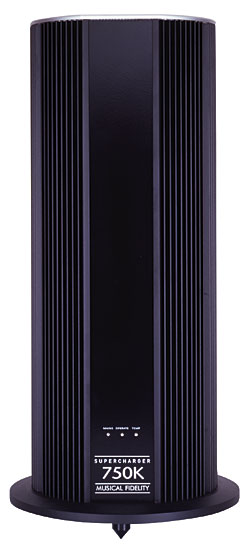
Musical Fidelity 750K Supercharger monoblock power amplifier

Musical Fidelity's "Supercharger" concept is simple, which is perhaps why no one had thought of it before: If you love the sound of your low-powered amplifier but your speakers are insensitive, or you just need more loudness, you insert the high-power Supercharger amplifier between your low-powered amp and speakers. The Supercharger loads the small amplifier with an easy-to-drive 50 ohms, and, in theory, has so little sonic signature itself that it passes on the sonic signature of the small amp unchanged, but louder.

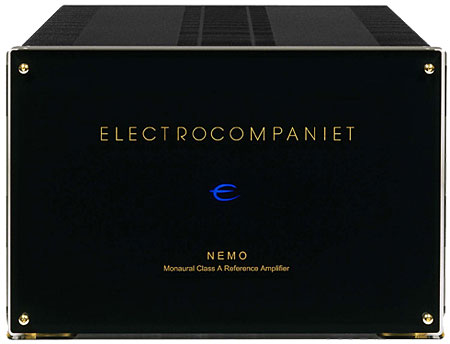
Electrocompaniet Nemo monoblock power amplifier

In his 20,000 Leagues Under the Sea, Jules Verne presents the enigmatic Captain Nemo, commander of the great submarine Nautilus, as powerful, charismatic, and mysterious. On first meeting Nemo, the narrator, M. Aronnax, notes, "I made out his prevailing qualities directly: self-confidence—because his head was well set on his shoulders, and his black eyes looked around with cold assurance; calmness—for his skin, rather pale, showed his coolness of blood; energy—evinced by the rapid contraction of his lofty brows; and courage—because his deep breathing denoted great power of lungs." All in all, "this man was certainly the most admirable specimen I had ever met."

Luxman M-800A power amplifier

Founded in 1925, Luxman has long been one of Japan's most highly regarded audio manufacturers. Throughout the 1970s and into the 1980s, Luxman's tube preamplifiers and power amplifiers occupied the top shelves of high-performance audio retailers, and to many older American audiophiles, the Luxman name is as familiar and esteemed as those of such storied American brands as McIntosh and Marantz. Luxman's combination of rich, warm sound, superb build quality, and indelible industrial design made its products fully competitive with other brands then considered among the world's best.

Marantz SM-11S1 Reference power amplifier

Some of the old audio names, such as Eico and Pilot, are gone. Others—Fisher, AR, KLH, H.H. Scott, etc.—have been rendered meaningless by corporate mergers and acquisitions. Yet more than 50 years after their founding, McIntosh and Marantz, arguably the two most prestigious names in American high-quality audio electronics, survive. The products they make today are probably closer in spirit to their original classics of half a century ago than at any time since the early 1970s.

Pass Aleph 1.2 monoblock power amplifier

We all have biases. The trick is knowing your biases so they don't get in your way. Mine are pretty obvious. I don't like "fussy" gear that demands special care and feeding. I'm lazy—I want to just turn stuff on and begin listening. Perhaps that's why I have a positive bias toward Nelson">http://www.stereophile.com/interviews/1191pass">Nelson Pass's designs. They're reliable, untweaky, and usually sound good.

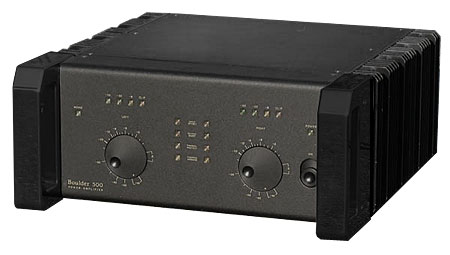
Boulder 500AE power amplifier

To high-end audiophiles, the Boulder 500 amplifier and its less expensive derivative, the 500AE (Audiophile Edition), would not seem to be "high-end" designs. They are designed around op-amps (felt by many to be generally poor-sounding), they have scads of negative feedback (which is perhaps why op-amps sound bad), and they have only a moderately hefty power supply. Why, then, is Stereophile publishing a review of an op-amp–based power amplifier? Read on...

Advertisement
Advertisement
Advertisement