Think Pieces

Sort By:  Post Date TitlePublish Date

Vertigo

In Alfred Hitchcock's great film Vertigo, filmed in San Francisco in 1957, the protagonist, Scottie, played by James Stewart, becomes obsessed with Madeleine, played by Kim Novak. Scottie, a retired detective, suffers from a disabling case of acrophobia, which becomes a critical if tenuous plot point.

Notes to a New Audiophile

Dear Newbie: Welcome to the wonderful world of hi-fi! If you're besotted with a desire for audio gear that can make your recorded music sound better than you've ever heard it, you've come to the right place.

And at just the right time: Not only is there an unprecedented amount of sanely priced, excellent-sounding audio gear on the market; there's this thing happening between us right here and now—the fact that you're reading a letter I wrote especially for you.

Why Do Any of This At All?

I've just returned home from one of the greatest concerts of my life, and felt absolutely compelled to share my thoughts with you. Yo-Yo Ma performed all six of J.S. Bach's Cello Suites, from memory, over a mesmerizing two-and-a-half hours at Red Rocks Amphitheatre, in Morrison, Colorado. It was a truly special experience.

Snake Oil: A Short History

If there's one thing audiophiles agree on, it's that snake oil is bad—even if they can't agree about what snake oil actually is.

In audio, snake oil means fake science or fake technology—anything that's claimed to improve the sound of a system but that looks like an obvious rip-off. For some people, expensive speaker cables and interconnects are snake oil. A few objectivists consider AC power treatments snake oil: most modern audio components, after all, can correct for AC line-voltage flaws and reject "ripple" in a power supply's output. A handful of hard-core objectivists maintain that every new digital technology since the advent of the Compact Disc is snake oil.

Cables & the Case for Solder

When you graduate from mass-market hi-fi to high-end audio, one of the first things you notice is that audiophile gear dispenses with the gadgets and gimmicks that clutter up the front panels of most stereo receivers and integrated amplifiers. The dominant philosophy in mass-market design is that features sell products: the more functions a product has, the more desirable it will seem in the store. High-end designers, on the other hand, prefer the KISS approach: Keep It Simple, Stupid!

The Improvement Disease

It has been said that the high-end audio industry has a weakness which perversely has also helped to maintain its growth. The evolutionary process whereby designs are improved, upgraded, and supplanted at regular intervals keeps everyone interested, and of course affords reviewers useful employment. On the other hand, once a purchase has been made there may be resentment on the part of owners who find that, by the time their choice has become established and awarded sufficient review recommendation, a product upgrade is already in the pipeline.

Living with the Lamms

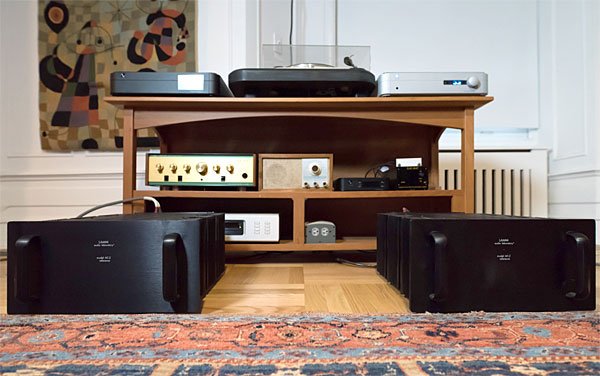
Although I've never tried one, I think "lifestyle" audio systems are a bit of a joke. My in-laws' decade-old Bose Wave Radio sounds good for what it is, although its obvious flaws—boomy, undefined lower mids masquerading as bass, a frustrating lack of sonic and musical resolution, etc.—become grating fairly quickly. These days, there are far more accomplished and expensive lifestyle systems out there, but because I haven't tried them I won't comment on them, except to say that I'm not really interested.

Perfection: Here at Last?

Long-time Stereophile readers May be dismayed by what appears to be our unfettered satisfaction with some of the recent crop of new components. Aren't we, after all, dedicated to the pursuit of perfection? Do we really feel that some products are all that close to it? The answer to both questions is "Yes."
Advertisement
Advertisement
Advertisement