My wife's cousin Steve used to sell antiques. Whenever he would display in his shop's window an impeccable (and expensive) item such as a Colonial pie safe, someone would inevitably walk into the shop and demand to know its price. He'd quote a staggering figure, and the browser would get excited. "Why, I have a piece at home exactly the same as that one! Do you think I could get that sort of money for it?" Steve, having learned his lesson the hard way, would be noncommittal.  "Yes, it's exactly the same..." continued the customer, "only mine has new hinges and latches, and it's not natural pine, it's been decoupaged. One of the legs got knocked off the last time we moved—and so did some of the decorative molding around the top, but mine is even better, because I cut a slot in the back so we could hide the TV in it." After several years of this, Steve formulated an incredibly useful philosophical construct: the Same-But-Different theorem. It can be used to explain almost anything. For instance, in last month's review of the Audio Research CD2, I postulated that Stephen J. Gould's theory of evolutionary convergence had kicked in in a big way among high-end CD players: each has a strength or strengths that distinguish it from the others, but the actual differences have become minute. You see? The same, but different. Which brings us to the Meridian 508.24 CD player, a beautiful design with impeccable technical credentials—a CD player that belongs, with only a few others, at the very sharpest portion of the leading edge, and that joins them in producing sound that is highly musical and hard to criticize. The same, but very different.
Little boxes...and they all look just the same
"Yes, it's exactly the same..." continued the customer, "only mine has new hinges and latches, and it's not natural pine, it's been decoupaged. One of the legs got knocked off the last time we moved—and so did some of the decorative molding around the top, but mine is even better, because I cut a slot in the back so we could hide the TV in it." After several years of this, Steve formulated an incredibly useful philosophical construct: the Same-But-Different theorem. It can be used to explain almost anything. For instance, in last month's review of the Audio Research CD2, I postulated that Stephen J. Gould's theory of evolutionary convergence had kicked in in a big way among high-end CD players: each has a strength or strengths that distinguish it from the others, but the actual differences have become minute. You see? The same, but different. Which brings us to the Meridian 508.24 CD player, a beautiful design with impeccable technical credentials—a CD player that belongs, with only a few others, at the very sharpest portion of the leading edge, and that joins them in producing sound that is highly musical and hard to criticize. The same, but very different.
Little boxes...and they all look just the same
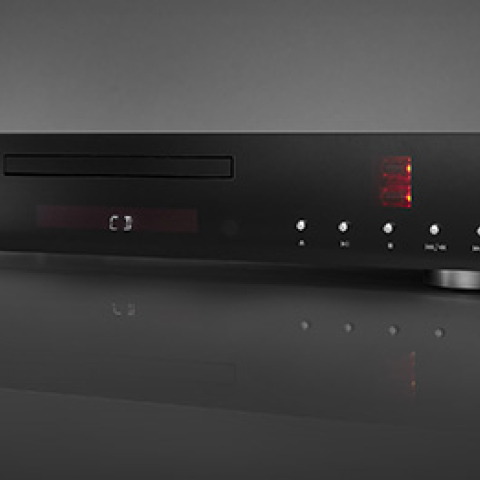
Meridian just doesn't do things the way other audio companies do them. Take the box itself, for instance—designed by Alan Boothroyd. The 508 is compact (12 5/8" W by 3½" H by 13" D) and subdued in appearance. The top-plate and front display are black glass—the rest of the case is textured black enamel. The disc drawer occupies the left side of the 508's face, while the right has a row of broad buttons separated by eight thin raised strips—or so it seems. In reality, the wide "buttons" are the spacers and the raised strips are the controls. There's no real confusion, however, as the functions are clearly labeled. The whole package is quite elegant. Which is not to say that functionality has suffered. The rear panel features a mains assembly that includes a power switch, fuse-holder, and IEC power-cord socket; two five-pin Meridian Comm ports (to enable the 508 to communicate with other Meridian kit); balanced XLR and single-ended RCA analog outputs; S/PDIF output on RCA; as well as accommodation for optical EIAJ. Yet despite the unit's compact size, the rear panel isn't cramped—there's lots of room for making connections. Would that this were always true! The 508.24 isn't a totally new design, but grew out of the 508.20 that Sam Tellig wrote about back in June 1996 (Vol.19 No.6). The major change is its use of direct-coupled Crystal CS4390 delta-sigma converters in dual-differential mode. According to the player's designer, Bob Stuart, the 4390 "is an evolution of the Crystal 20-bit part (CS4329), which we used in the 508.20 player. Its development took quite a long time and was a collaboration between Meridian and Crystal. We helped them out with the 20-bit DAC as well as with this one. We were all very pleased with the way it worked, and they gave us the first shot at using it. It's a nice DAC—a delta-sigma type with digital filtering. It's very smooth. The two DACs are pin-compatible, which is nice, but we didn't just drop the new chip in—we can't just swap them for customers who own the 508.20, unfortunately."
That's because the new DAC is far from the only difference in the unit. Stuart also changed the CD mechanism. "We were using the Philips CDM12.4, now we're using the CDM12.5—it's more reliable, tracks better, and it has a Hall-Effect spinning motor—a separate drive motor always gives you a smoother spin and finer control. CDs don't spin at the same speed throughout the disc, of course, they're constantly changing rotational speed, and the more precisely you can control that speed and stability, the better the performance. "We also changed the software related to our adaptive servo system, which recalibrates itself for every disc you put in—things like the reflectivity of each disc change, and our servo system will optimize itself to ensure its capacity to play all the way through a disc, to play through defects. It gives an improvement in sound quality—although the tradeoff is in its ability to withstand shocks. You can't go jogging with it." For all the differences, some things in the 508.24 remain the same. "It still uses the same analog-domain pre-dejittering that we developed in earlier models of the 500 series. And it still employs a three-beam laser tracking system and our Foucault focus arrangement."
Analog-domain pre-dejittering is a pretty slick trick. The RF signal coming from the laser pickup is analyzed, and if its parameters seem degraded, the servo is adjusted for better tracking.
"Yes, it's exactly the same..." continued the customer, "only mine has new hinges and latches, and it's not natural pine, it's been decoupaged. One of the legs got knocked off the last time we moved—and so did some of the decorative molding around the top, but mine is even better, because I cut a slot in the back so we could hide the TV in it." After several years of this, Steve formulated an incredibly useful philosophical construct: the Same-But-Different theorem. It can be used to explain almost anything. For instance, in last month's review of the Audio Research CD2, I postulated that Stephen J. Gould's theory of evolutionary convergence had kicked in in a big way among high-end CD players: each has a strength or strengths that distinguish it from the others, but the actual differences have become minute. You see? The same, but different. Which brings us to the Meridian 508.24 CD player, a beautiful design with impeccable technical credentials—a CD player that belongs, with only a few others, at the very sharpest portion of the leading edge, and that joins them in producing sound that is highly musical and hard to criticize. The same, but very different. Meridian just doesn't do things the way other audio companies do them. Take the box itself, for instance—designed by Alan Boothroyd. The 508 is compact (12 5/8" W by 3½" H by 13" D) and subdued in appearance. The top-plate and front display are black glass—the rest of the case is textured black enamel. The disc drawer occupies the left side of the 508's face, while the right has a row of broad buttons separated by eight thin raised strips—or so it seems. In reality, the wide "buttons" are the spacers and the raised strips are the controls. There's no real confusion, however, as the functions are clearly labeled. The whole package is quite elegant. Which is not to say that functionality has suffered. The rear panel features a mains assembly that includes a power switch, fuse-holder, and IEC power-cord socket; two five-pin Meridian Comm ports (to enable the 508 to communicate with other Meridian kit); balanced XLR and single-ended RCA analog outputs; S/PDIF output on RCA; as well as accommodation for optical EIAJ. Yet despite the unit's compact size, the rear panel isn't cramped—there's lots of room for making connections. Would that this were always true! The 508.24 isn't a totally new design, but grew out of the 508.20 that Sam Tellig wrote about back in June 1996 (Vol.19 No.6). The major change is its use of direct-coupled Crystal CS4390 delta-sigma converters in dual-differential mode. According to the player's designer, Bob Stuart, the 4390 "is an evolution of the Crystal 20-bit part (CS4329), which we used in the 508.20 player. Its development took quite a long time and was a collaboration between Meridian and Crystal. We helped them out with the 20-bit DAC as well as with this one. We were all very pleased with the way it worked, and they gave us the first shot at using it. It's a nice DAC—a delta-sigma type with digital filtering. It's very smooth. The two DACs are pin-compatible, which is nice, but we didn't just drop the new chip in—we can't just swap them for customers who own the 508.20, unfortunately."