It's been a while since I auditioned a Meridian CD player in my system. I had enthusiastically reviewed the English company's groundbreaking Pro-MCD player in early 1986, and over the years had kept up with the progress they were making in digital playback, either through my own reviews or by performing the measurements to accompany reviews by other Stereophile writers. The 508-24 player, reviewed by Wes Phillips in May 1998, was one of the finest digital products of the 1990s, I thought. But when Meridian began promoting surround sound and DVD-Audio at the turn of the century, their goals became somewhat incompatible with my own. Yes, I can appreciate what surround playback can do, but my own musical life is still solidly rooted in Two-Channel Land.
 Then, in 2004, Meridian introduced its 808 Signature Reference player. An unabashedly two-channel product, the 808 represented everything Meridian's Technical Director, Bob Stuart, and his design team knew about CD playback. Why Stereophile didn't review the original 808, I have no idea. But then, at the January 2008 Consumer Electronics Show, Meridian introduced the Signature Reference 808.2. "We've changed its drive, drive navigation software, power supply, DSP, and clocking and buffering," Stuart told Wes. "I'd like to say that the only thing we've retained is the case, but we've improved that, too."
The 808.2 and 808i.2
Then, in 2004, Meridian introduced its 808 Signature Reference player. An unabashedly two-channel product, the 808 represented everything Meridian's Technical Director, Bob Stuart, and his design team knew about CD playback. Why Stereophile didn't review the original 808, I have no idea. But then, at the January 2008 Consumer Electronics Show, Meridian introduced the Signature Reference 808.2. "We've changed its drive, drive navigation software, power supply, DSP, and clocking and buffering," Stuart told Wes. "I'd like to say that the only thing we've retained is the case, but we've improved that, too."
The 808.2 and 808i.2
Housed in a large, handsome chassis, the 808.2 is based on a card-frame topology, to which subsystems can be added as desired. Thus the basic 808.2 player ($15,995) can be upgraded to 808i.2 player/processor-preamplifier status ($16,995) by adding cards for analog inputs (six pairs, on RCAs) and digital inputs (two TosLink optical, three S/PDIF on RCAs). Another card carries a single S/PDIF digital output on an RCA, as well as Meridian's SpeakerLink balanced digital output on an RJ45 jack, which sends encrypted AES/EBU-formatted data upsampled to 24 bits/88.2kHz on a single CAT5 cable to a pair of Meridian's active speakers.
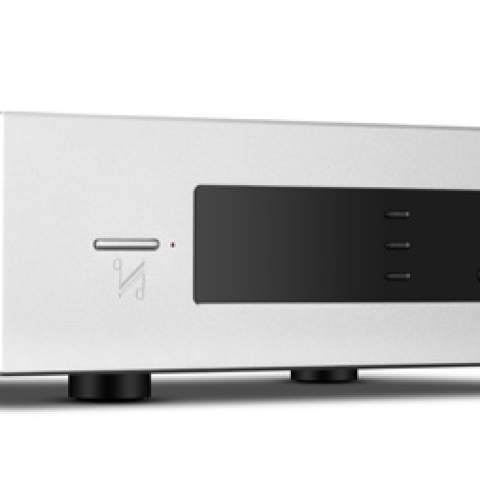
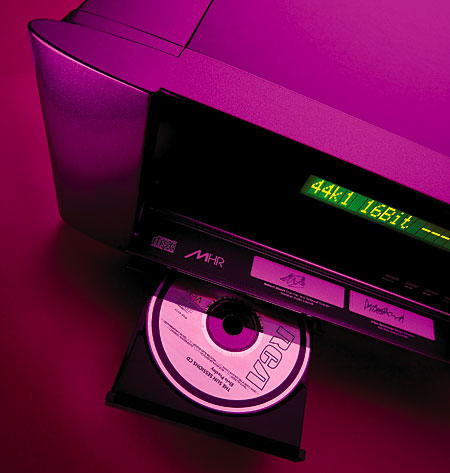
The 808i.2's front panel is dominated by the large LCD display, which was easily legible from across the room. Below it to the left is the drawer for the transport, which is based on a DVD-ROM drive. This was chosen because it allows a disc to be reread if necessary to ensure optimal data retrieval from the disc, as well as full buffering of those data to minimize jitter. The transport controls lie along the bottom right of the front panel, while a hinged door in the center folds down to allow access to ancillary controls such as Volume Up and Down, Mute, Display, etc. Behind the door are the signatures of Bob Stuart and his longtime industrial-designer partner, Meridian's Design Director, Allen Boothroyd.
The real beauty of the 808i.2 lies inside, however. The CD data are upsampled to a 176.4kHz sample rate and 24-bit depth by Meridian's proprietary Resolution Enhancement algorithm before being sent to high-quality but unidentified delta-sigma DAC chips. But along the way, the data are subjected to a new kind of reconstruction filter that Meridian calls an "apodizing" device.
"Apodizing"
A pair of technical papers in the March 2004 issue of the Journal of the Audio Engineering Society (Vol.52 No.3) indicated the direction Meridian would be taking with the 808.2 (footnote 1) In "Coding for High-Resolution Audio Systems," Bob Stuart examined what was required to get the highest audio quality from a digital system, while in "Antialias Filters and System Transient Response at High Sample Rates," Peter Craven examined the nature of the ubiquitous anti-aliasing filter (in A/D conversion) and reconstruction filter (in D/A conversion) (footnote 2).
Keith Howard had explored this second subject for Stereophile in January 2006. While the linear-phase Finite Impulse Response filters routinely used in digital audio can offer superb performance in the frequency domain, in the time domain they introduce preresponses that occur prior to the main peak of the impulse response, something that never occurs in nature and thus will not be masked by the music. The brevity of these preresponses that occurs with high sample rates has led some commentators to decide that this is why high sample rates produce better sound quality, and not the octave extension in bandwidth itself. On the face of it, however, this improvement seems paradoxical: the preresponse comprises ringing at half the sample rate (called the Nyquist Frequency), which, even with CD, is above the limit of human hearing. But the preresponse does appear to have an audible effect, perhaps because the human ear/brain system acts as a wavefront detector rather than as a spectrum analyzer.
What Peter Craven explored in his paper was the idea that you could process the audio data with a minimum-phase low-pass filter whose first null is at the original Nyquist frequency. This will therefore kill all the ringing from the original A/D converter, replacing the preresponse ringing with postresponse ringing from the new filter. As this new ringing would a) be natural in that it occurs after the event, and b) takes place entirely within the human auditory system's masking interval, the data would be audibly cleaned up. The tradeoff, however, is that the new minimum-phase "apodizing," or windowing, filter has to begin rolling off below the original Nyquist frequency, thus sacrificing a small fraction of the top octave of the original passband in order to optimize the time-domain performance.
Footnote 1: Both papers are available as pdfs from www.aes.org. Footnote 2: Bob Stuart gives an overview of these papers in an interview with Keith Howard, downloadable here as an MP3 file.
Then, in 2004, Meridian introduced its 808 Signature Reference player. An unabashedly two-channel product, the 808 represented everything Meridian's Technical Director, Bob Stuart, and his design team knew about CD playback. Why Stereophile didn't review the original 808, I have no idea. But then, at the January 2008 Consumer Electronics Show, Meridian introduced the Signature Reference 808.2. "We've changed its drive, drive navigation software, power supply, DSP, and clocking and buffering," Stuart told Wes. "I'd like to say that the only thing we've retained is the case, but we've improved that, too."
The 808.2 and 808i.2
Housed in a large, handsome chassis, the 808.2 is based on a card-frame topology, to which subsystems can be added as desired. Thus the basic 808.2 player ($15,995) can be upgraded to 808i.2 player/processor-preamplifier status ($16,995) by adding cards for analog inputs (six pairs, on RCAs) and digital inputs (two TosLink optical, three S/PDIF on RCAs). Another card carries a single S/PDIF digital output on an RCA, as well as Meridian's SpeakerLink balanced digital output on an RJ45 jack, which sends encrypted AES/EBU-formatted data upsampled to 24 bits/88.2kHz on a single CAT5 cable to a pair of Meridian's active speakers.
A pair of technical papers in the March 2004 issue of the Journal of the Audio Engineering Society (Vol.52 No.3) indicated the direction Meridian would be taking with the 808.2 (footnote 1) In "Coding for High-Resolution Audio Systems," Bob Stuart examined what was required to get the highest audio quality from a digital system, while in "Antialias Filters and System Transient Response at High Sample Rates," Peter Craven examined the nature of the ubiquitous anti-aliasing filter (in A/D conversion) and reconstruction filter (in D/A conversion) (footnote 2).
Footnote 1: Both papers are available as pdfs from www.aes.org. Footnote 2: Bob Stuart gives an overview of these papers in an interview with Keith Howard, downloadable here as an MP3 file.