| Columns Retired Columns & Blogs |

HRT Music Streamer USB D/A Converter
My favorite moment in the Zack Snyder film Watchmen—apart from the Dylan-fueled title sequence, which itself contains some of the most memorable scenes in recent cinema—comes when retired crimefighter Daniel "Nite Owl II" Dreiberg arrives home to find the doctrinaire and mildly crazy Walter "Rorschach" Kovacs in his kitchen, eating beans straight from the can. The startled Dreiberg asks his visitor, "Would you like me to heat those up for you?"
Rorschach's spare reply: "Fine like this."
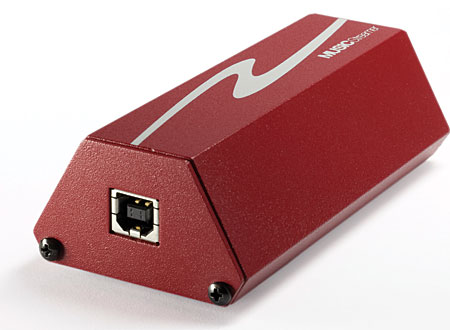
Not long ago, after I'd already spent a fair amount of time with the High Resolution Technologies Music Streamer+ ($299), Stephen Mejias forwarded a sample of HRT's basic, entry level, we-can't-do-it-for-any-less-than-this product, the original Music Streamer ($99). I replaced the cheap product with the very cheap product almost at once, and toward the end of the day I joked with the empty room in the same gravelly voice: "Fine like this." And it was.
Like the MS+, the standard MS uses a USB-specific PCM2706 chip as a datastream transceiver, while D/A conversion and digital filtering are done by a separate, higher-quality chip. (The subboards of the MS and MS+ looked identical to me, but designer Kevin Halverson says there are differences between the two—and that the component parts of current-production MS units are all on a single board.) A key distinction of the Music Streamer is its PCM1744 D/A chip, which is less sophisticated and less expensive than the PCM1794 used in the Music Streamer+. Other differences abound, including those between the two products' I/V conversion and analog output stages.
As with the Music Streamer+, of which the Music Streamer seems just a shorter, redder version, installation was a breeze: I plugged, I clicked, I conquered. Getting a handle on the performance differences wasn't nearly as easy. Yes, there were consistent distinctions between the two, and yes, I did prefer the more expensive DAC for most of my listening. But the ultimate question of the products' relative values wasn't nearly as clear-cut.
Sonics
In a general way, the Music Streamer sounded smaller, less grand, and decidedly less refined. On "Conquistador," from a fine new remastering of Procol Harum's Live in Concert with the Edmonton Symphony Orchestra (CD, Salvo CD023), the left-to-right spread of the orchestra wasn't as wide through the MS as through the MS+, while cymbals and the like sizzled and rang just a shade too long. Notes played by the electric bass also had trouble letting go—and on this and other selections, the MS appeared to goose up the bass even more than the MS+ did, albeit by very small margins in both cases.
More specifically, the basic Music Streamer didn't retrieve subtle information as well as its dearer brother, something that was most apparent when listening at the low volume levels demanded by certain musical pieces. During Elgar's Elegy, Op.58, performed by Paul Goodwin and the English Chamber Orchestra (CD, Harmonia Mundi HMU 907258), the MS led me to believe that the players actually ceased playing for the briefest of moments, following the ritard at the end of the second phrase; the MS+ revealed that they never quite let go of the note. And the ritards within the already slow, hushed opening bars of Lovro von Matacic and the Czech Philharmonic's recording of Bruckner's Symphony 5 (CD, JVC JM-XR24203) were comparatively grainy and less clear through the basic Music Streamer.
Yet for all that, the Music Streamer's flaws were dwarfed by the product's overall enjoyability. While the MS fell short of the MS+ in letting me hear and enjoy the guitar fills in "The Hobo Song," by Old & In the Way, from their first, eponymous album (download, Arista), the cheaper D/A got most of the musical basics right—especially the timing of the mandolin "chops" and the double-time bass playing in the choruses. And with many (mostly pop) recordings, I'd be lying if I said the extra bass bothered me.
Summing Up
Asking whether the Music Streamer+ is worth $299 is not the same as asking whether the Music Streamer+ is worth three times the price of the Music Streamer: The first question can only be answered Yes, while the answer to the second may vary from one person to the next. Suffice it to say that spending $99 on an HRT Music Streamer and $200 on some new high-definition downloads doesn't seem at all crazy to me.
NEXT: Specifications »
 | |||||||||||

|
|
| |||||||||
- Log in or register to post comments












| Loudspeakers Amplification Digital Sources | |
Analog Sources Accessories Featured | |
Music Columns Retired Columns | |
Show Reports | |
Features Latest News Community | |
Resources Subscriptions |
 © 2024 Stereophile
AVTech Media Americas Inc., USA
All rights reserved