If you read much promotional literature for recently introduced high-quality equipment, you'll notice a common theme emerging: balanced connection. Balanced inputs and outputs are becoming a must for any audio equipment that has any claim to quality. The word itself has promotional value, suggesting moral superiority over the long-established "unbalanced" connection (for the purpose of this discussion, I will call this "normal"). What's my problem with this? Simply this: The High End could be paying dangerous, costly lip service to the received wisdom that balanced operation is the goal for an audio system. To give you a flavor of the literature using balanced operation as a selling point, Audio Research's literature for their LS5 preamplifier describes "an imposing array of...professional-grade XLR connectors...clearly proclaims the fully balanced design...an uncompromising approach. While the professional industry and recording studio used balanced operation and connectors as a standard for many years, the consumer electronic industry is only now gradually adapting its products to this superior format." In my view, unwarranted and unwanted assumptions are being made in the dissemination of such claims. I am not singling out Audio Research—this approach is rife at present.
A state of madness currently exists wherein several international markets are discriminating against some excellent audio equipment simply because it doesn't have balanced signal connections. This is madness; there's no reliable proof that an audio system with balanced connections sounds any better than a well-designed normal system. In fact, time and again, top-line components that come my way for evaluation suggest no advantage—and, in some cases, even demonstrate performance loss—for balanced operation. Market pressures are so great that, much against their better judgment, a number of designers are succumbing to the demand for balanced equipment, passing the extra cost on to their customers. For example, I know of a fine D/A processor that delivers superb sound quality in its normal form. One of its primary virtues is its very short signal path following the DAC chip, which the designer refused to sully with the usual, compromised, tacked-on balanced output amplifier. To maintain sound quality in the market-mandated balanced form, the designer was driven to replicate the entire DAC chain, driving the second DAC with a non-invasive, inverted digital data signal in order to achieve the pair of audio outputs for balanced working. It almost doubles the cost of the decoder, with no perceptible audible benefit. [However, it does lower DAC noise by 3dB, which some will feel a worthwhile increase in resolution, while the D/A processor's overall linearity can also be improved.—Ed.] While this is an extreme example, there's no dispute that balanced designs generally cost more. Most "balanced" products are, in fact, single-ended inside with messy, potentially sound-corrupting conversion buffer/amplifiers at the inputs and outputs. Some components even have more amplification stages in the cold line than in the hot. Only a few products are truly balanced from input to output, but then costs escalate. For example, a true balanced preamplifier, such as the Audio Research LS5, needs a four-gang selector switch and a four-gang volume control, each section closely matched to the others.
Normal vs. balanced
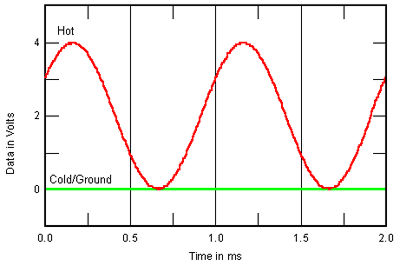
I suspect many of us do not know what balanced operation is, other than that it involves a different kind of signal connector from the familiar RCA plug. Audiophiles have lived with normal connections—two wires, respectively, for ground and signal connections—for decades without experiencing significant problems (figs.1 & 2). Even the requirements of those delicate low-level signals from moving-coil cartridges can be handled satisfactorily, provided that appropriate care is taken with local hum fields and system grounding. And with digital sources, the signal levels are so high that noise and hum are considered wholly negligible. If a normal, unbalanced connection can be made to work for a tenth of a thousandth of a volt signal from a low-output phono cartridge, it must be cast-iron reliable for the 1V or 2V signal from a modern digital source.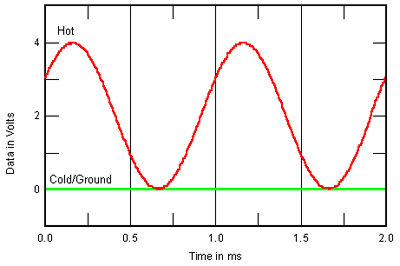 Fig.1 An unbalanced signal connection.
 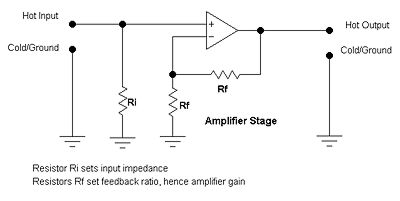 Fig.2 A typical unbalanced amplifier input stage (which may be either discrete or in the form of an IC).
I suspect many of us do not know what balanced operation is, other than that it involves a different kind of signal connector from the familiar RCA plug. Audiophiles have lived with normal connections—two wires, respectively, for ground and signal connections—for decades without experiencing significant problems (figs.1 & 2). Even the requirements of those delicate low-level signals from moving-coil cartridges can be handled satisfactorily, provided that appropriate care is taken with local hum fields and system grounding. And with digital sources, the signal levels are so high that noise and hum are considered wholly negligible. If a normal, unbalanced connection can be made to work for a tenth of a thousandth of a volt signal from a low-output phono cartridge, it must be cast-iron reliable for the 1V or 2V signal from a modern digital source.
Fig.1 An unbalanced signal connection. Fig.2 A typical unbalanced amplifier input stage (which may be either discrete or in the form of an IC).