How can you tell an audiophile from a normal person? Well, given a list of names like "Haydn, Mozart, Bach, Beethoven, and Mahler," the normal person might respond, "Composers." The audiophile's response is likely to be "Loudspeakers from Vienna Acoustics." Anyway, that's my association when I see these names, which may tell you something about my state of normalcy. 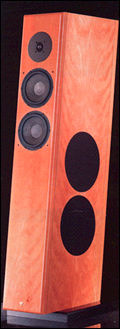 I have a good excuse, though. Three years ago, I reviewed the Vienna Acoustics Mozart (Stereophile, January 1997), and have some familiarity with their small two-way, the Haydn; the larger, floorstanding Bach; and the Beethoven, until recently the top of Vienna's line. All of these models are still being manufactured, but the Beethoven now has a speaker above it: the Mahler. Musicologists (and, if he were still around to be polled, Ludwig van himself) may question putting Mahler above Beethoven, but it does make a kind of sense if one considers the relative sizes of the orchestras required by the music of these composers. I find Gustav Mahler's music to be on the ponderous side, but when I heard the Vienna Acoustics Mahlers at HI-FI '99, I was sufficiently impressed that I began the process of getting a pair for review. Description and design
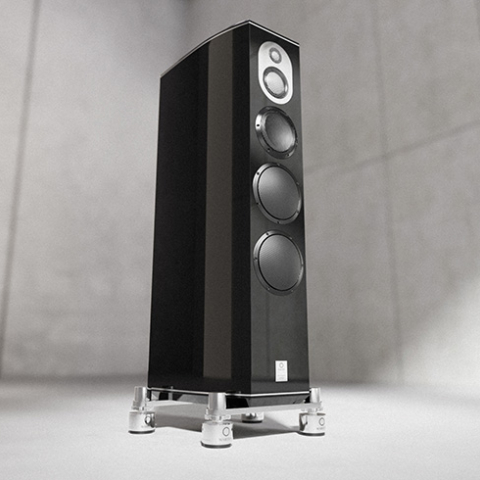
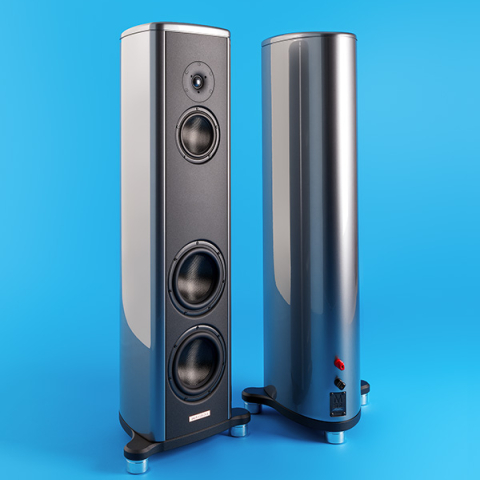
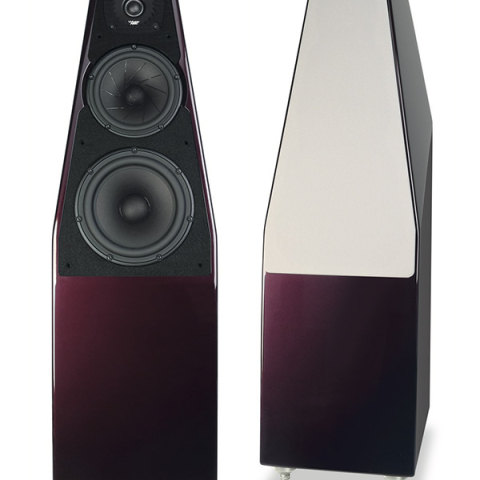
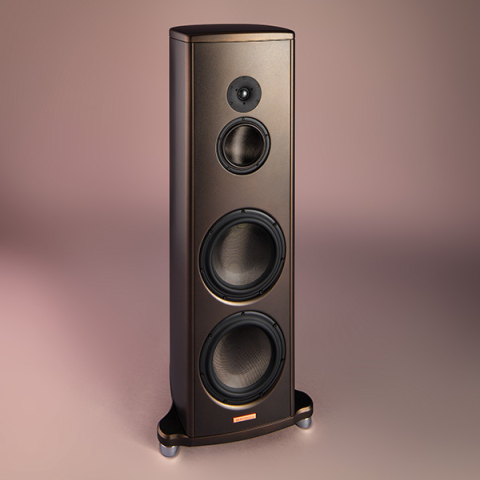
This is a gorgeous loudspeaker. As audiophiles, devoted to the pursuit of high accuracy and musicality in sound reproduction, we may protest that sound quality is the only thing that's important. But the fact is that speakers are objects in the listening/living room that you have to look at even when they're silent—appearance can be an important determinant of overall satisfaction. The Mahler's slim, backward-leaning cabinet and impeccable glossy finish on all sides (rosewood in the review samples) are elegant without being overly fussy. For a full-range speaker, the Mahler is of modest size, with a relatively small footprint and a narrow front panel, so it's more likely to blend into a room's d;aecor than to dominate it. According to John Hunter of Sumiko, Vienna Acoustics' US importer, the design of the Mahler began with the selection of the Scan-Speak 7" midrange driver, felt by many speaker people to be the best unit of its type. This driver can cover a wide range, and I know of some designs in which it's used to cover the bass as well as the midrange. (Scan-Speak calls it a "mid/woofer.") However, Vienna Acoustics designer Peter Gansterer feels that using the Scan-Speak midrange to extend all the way down would result in impaired dynamics and transparency, so, after much experimentation (John Hunter says he participated in listening sessions that involved 73 iterative changes!), 70Hz was selected as the lower limit for the midrange drivers. The lower of the two drivers has a crossover that rolls off its response above 200Hz, using a simple 6dB slope, with additional crossover points at 400Hz (12dB/octave) and 800Hz (18dB/octave)—an approach intended to produce a smooth transition to the treble. The other midrange driver is crossed over to the tweeter at 3.6kHz, so that it covers about a 5½-octave range. Each midrange driver is in its own sealed subcabinet.
The lower bass is handled by two side-firing 10" Eton woofers, a carbon-fiber honeycomb-cone driver preferred by Peter Gansterer for its high stiffness and speed. Each woofer has its subcabinet, with nonparallel walls, and is vented out the back. The woofers begin crossing over at 50Hz, and are filtered more at 100Hz, and again at 200Hz. The tweeter is a variant of Scan-Speak's D-29 1.2" silk dome, well-known for its smoothness and "silkiness." To ensure that the tweeter is not disturbed by vibrations from the cabinet, it's mounted with silicone gel injected into the cabinet recess. This effectively floats the tweeter, with no rigid mechanical connection to the cabinet—a clever bit of engineering.
I have a good excuse, though. Three years ago, I reviewed the Vienna Acoustics Mozart (Stereophile, January 1997), and have some familiarity with their small two-way, the Haydn; the larger, floorstanding Bach; and the Beethoven, until recently the top of Vienna's line. All of these models are still being manufactured, but the Beethoven now has a speaker above it: the Mahler. Musicologists (and, if he were still around to be polled, Ludwig van himself) may question putting Mahler above Beethoven, but it does make a kind of sense if one considers the relative sizes of the orchestras required by the music of these composers. I find Gustav Mahler's music to be on the ponderous side, but when I heard the Vienna Acoustics Mahlers at HI-FI '99, I was sufficiently impressed that I began the process of getting a pair for review. Description and design This is a gorgeous loudspeaker. As audiophiles, devoted to the pursuit of high accuracy and musicality in sound reproduction, we may protest that sound quality is the only thing that's important. But the fact is that speakers are objects in the listening/living room that you have to look at even when they're silent—appearance can be an important determinant of overall satisfaction. The Mahler's slim, backward-leaning cabinet and impeccable glossy finish on all sides (rosewood in the review samples) are elegant without being overly fussy. For a full-range speaker, the Mahler is of modest size, with a relatively small footprint and a narrow front panel, so it's more likely to blend into a room's d;aecor than to dominate it. According to John Hunter of Sumiko, Vienna Acoustics' US importer, the design of the Mahler began with the selection of the Scan-Speak 7" midrange driver, felt by many speaker people to be the best unit of its type. This driver can cover a wide range, and I know of some designs in which it's used to cover the bass as well as the midrange. (Scan-Speak calls it a "mid/woofer.") However, Vienna Acoustics designer Peter Gansterer feels that using the Scan-Speak midrange to extend all the way down would result in impaired dynamics and transparency, so, after much experimentation (John Hunter says he participated in listening sessions that involved 73 iterative changes!), 70Hz was selected as the lower limit for the midrange drivers. The lower of the two drivers has a crossover that rolls off its response above 200Hz, using a simple 6dB slope, with additional crossover points at 400Hz (12dB/octave) and 800Hz (18dB/octave)—an approach intended to produce a smooth transition to the treble. The other midrange driver is crossed over to the tweeter at 3.6kHz, so that it covers about a 5½-octave range. Each midrange driver is in its own sealed subcabinet.