Back in March, I wrote a reviewlet of Channel Islands Audio's VHP•1 headphone amplifier for the Stereophile eNewsletter. (What—you aren't receiving that free download yet? Well, log on to www.stereophile.com and opt in.) The VHP•1 has continued to enchant me—reason enough to examine it in greater detail, I reckoned. But the real reason I returned to the VHP•1 ($349) is that CIA's Dusty Vawter recently sent me his new VAC•1 ($159), a replacement power supply for the VHP•1's stock wall-wart supply. Could a new power supply really offer a substantial improvement in performance?
Little darlin'
The VHP•1 is tiny for a home headphone amp, but it's quite a bit larger than such portables as the Ray Samuels Audio Emmeline SR-71 (reviewed in September). The extra real estate afforded by its 4.4" W by 2.6" H by 4" D extruded-aluminum chassis means that the VHP•1 can offer a ¼" headphone jack appropriate for a home unit, a pushbutton gain switch, and two pairs of RCA jacks: one for signal input, one for unity-gain feed-through.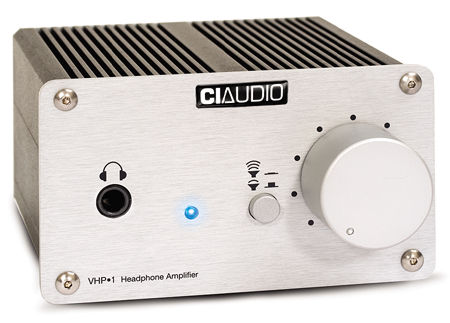 The heart of the VHP•1 is a surface-mount IC current-feedback amplifier (instead of an op-amp, usually a voltage-feedback device) designed specifically for use in pro-audio headphone monitoring. Vawter decided to employ the chip because headphone amplifiers present a challenge, given the wide range of load impedances they're required to work with. "Low-impedance headphones need a lot of current and high-impedance headphones need a lot of voltage," said Vawter. "After I experimented with headphone amps for a while, I realized that you really can't dial in a compromise that works for both low- and high-impedance headphones—it became obvious that we had to have some method to select gain."
The stock power supply is fairly hefty by wall-wart standards, offering 14VAC with 850mA. The VAC•1 uses a better transformer than the stock unit, with larger wire and an output voltage of 14V at 1.44A. "I didn't reinvent the wheel or anything with the VAC•1," Vawter said. "It's just a good step-down transformer with a cap across the AC line where the power comes in and a couple of ferrite beads where the power goes out."
The VAC•1 offers 115/230V switching and an IEC mains socket, "so that consumers can add an aftermarket power cable that costs more than the VHP•1 and VAC•1 combined—assuming they want to," said Vawter.
Little revelations
The heart of the VHP•1 is a surface-mount IC current-feedback amplifier (instead of an op-amp, usually a voltage-feedback device) designed specifically for use in pro-audio headphone monitoring. Vawter decided to employ the chip because headphone amplifiers present a challenge, given the wide range of load impedances they're required to work with. "Low-impedance headphones need a lot of current and high-impedance headphones need a lot of voltage," said Vawter. "After I experimented with headphone amps for a while, I realized that you really can't dial in a compromise that works for both low- and high-impedance headphones—it became obvious that we had to have some method to select gain."
The stock power supply is fairly hefty by wall-wart standards, offering 14VAC with 850mA. The VAC•1 uses a better transformer than the stock unit, with larger wire and an output voltage of 14V at 1.44A. "I didn't reinvent the wheel or anything with the VAC•1," Vawter said. "It's just a good step-down transformer with a cap across the AC line where the power comes in and a couple of ferrite beads where the power goes out."
The VAC•1 offers 115/230V switching and an IEC mains socket, "so that consumers can add an aftermarket power cable that costs more than the VHP•1 and VAC•1 combined—assuming they want to," said Vawter.
Little revelations
I didn't want to, but I had an Audience powerChord to hand, which, at $379, does cost more than the VHP•1, if not the combo—so I used it just to be perverse. When I took the VHP•1–VAC•1 ministack to the recent Cantus sessions in Sioux Falls, South Dakota, to watch John Atkinson record There Lies the Home, the choral group's 2006 release, I forgot the powerChord and used a standard AC cable from John's trunk o' wires and noticed no significant degradation in sound quality.
Around my house, I connected the VHP•1 to a Musical Fidelity stack—X-RayV3 CD player and X-DACV3 digital/analog converter with Stereovox Studio HDSE interconnect—and used a Stereovox HDXV S/PDIF cable to pass the bits from player to DAC. I listened to my Etymotic ER-6S and AKG K-501 headphones through the VHP•1 set to its Low gain setting, and my Sennheiser HD-600 and HD-650 'phones at the CIA's High gain position.
Little wonder
That sounds like a lot of gear to attach to a cheap'n'cheerful headphone amp, but $349 isn't really all that cheap—add a $160 power supply and it's even less so. More to the point, the Channel Islands amp acted like a high-end piece of kit, so I treated it like one. I was very impressed by the VHP•1's silence when driven by its stock 14V, 850mA power supply. This is particularly important in a headphone amp because the transducers are only fractions of an inch from your ears (or, in the case of the Etymotics, from your eardrums)— any noise, even a millivolt's worth of offset, is audible. And remember, there's no ambient room noise to mask it, as there is with a loudspeaker-based system.
Once the music started, however, it was the VHP•1's bass power and extension that next impressed me. Trevor Horn's pop production of Belle and Sebastian's Dear Catastrophe Waitress (CD, Rough Trade 83216-2) just lopes along atop rock-solid bass and drums. Pure pop doesn't have to be lightweight, and DCW isn't. In fact, as Horn piles instrument on top of instrument, Belle and Sebastian seem to be channeling such great 1960s-era singles bands as the Box Tops, the Kinks, and the Stories with dense, layered, and above all, light pop fantasias.
I was just talking about the VHP•1's slam, wasn't I? Actually, I said that its slam was the second thing I noticed. What kept bringing me back for more was the way it resolved complex arrangements and overlapping voices—such as those on the Hilliard Ensemble's recording of the Motets of Guillame de Machaut (CD, ECM New Series 1823). The Hilliard's lineup of two countertenors, two tenors, and a baritone is ideal for this music, which is written primarily for three or four vocal lines that twist and twine about one another, seeking the limits of melodic connection (and sometimes exceeding them—Machaut wasn't afraid of a little dissonance).
The VHP•1 delivered all of the vocal warmth and burr of the Hilliards, but I was most impressed by its ability to capture the way those voices filled and defined the acoustic space they inhabited. It's one of those things that seems so basic, yet is actually very difficult to get right. The VHP•1 placed the Hilliard Ensemble bodily into the reverberant acoustic of Propstei St. Gerold, one of producer Manfred Eicher's favorite recording venues, and captured that hall's long, lingering decay with a precision and clarity that startled me every time I returned to the CD, which I did repeatedly. Sound that good is like audio crack—no sooner had I finished listening to those Motets than I began jonesing for my next fix.
I had the Ray Samuels Audio Emmeline SR-71 battery-powered headphone amp ($395) in-house while I was auditioning the VHP•1, so I did some comparative listening. The two share many characteristics—like the VHP•1, the SR-71 is dead quiet, warm, and detailed. In fact, using my favorite on-the-go headphones, the Etymotic ER-6Ses, it was hard to choose between the two. The SR-71 sorted out the layers of Trevor Horn's pop operatic flights of fancy on Dear Catastrophe Waitress with aplomb, albeit with perhaps a tad less sparkle. Was the VHP•1 bright or the SR-71 dark? I couldn't decide. I finally left it as a matter of perspective—the tonal difference was very, very subtle.
There was less timbral difference with the Machaut. Like the VHP•1, the SR-71 gave me voices and hall with startling clarity and low-level detail. If I had to choose between the two, I wouldn't find it easy to do on the basis of performance—my choice would come down to features.
One of the most essential differences I experienced was that the CIA amp had enough gain to handle the heavy-hitter Sennheiser HD-600 and HD-650 headphones I favor for serious monitoring and at-home listening. The SR-71 could drive the HD-600s, just not to the higher volume levels I require when monitoring a recording session. That's probably beside the point—as its 1/8" input and headphone jacks indicate, Ray Samuels designed the '71 primarily for on-the-go listening. Even I'm not enough of a headphone dork to travel with a pair of HD-600s on my head.
Now that I've brought it up, however, my very favorite feature on the Channel Islands amp is its High-Gain setting, which seems tailor-made for the Sennheisers. Now there's a match made in heaven.
Little miracle
Especially if you add the VAC•1. I'd been listening to the VHP•1–HD-650 team for several months when I finally received a VAC•1, and I wasn't sure I expected a big difference. I hoped there would be, but I was so happy with the VHP•1's stock performance that I wasn't anticipating a slam dunk. You'd think I'd get tired of being so consistently wrong. Adding the VAC•1 didn't make much difference in the elements of the VHP•1's sound that I most admired: It continued to be warm, detailed, and dead quiet. But the VHP•1's already impressive bass response became even more powerfully solid with the heavy-duty power supply. Not deeper, simply more physical. If the bane of headphone listening is that "it's all in your head" sensation, the VAC•1 went a long way toward making music a total-body experience.
The VHP•1 is tiny for a home headphone amp, but it's quite a bit larger than such portables as the Ray Samuels Audio Emmeline SR-71 (reviewed in September). The extra real estate afforded by its 4.4" W by 2.6" H by 4" D extruded-aluminum chassis means that the VHP•1 can offer a ¼" headphone jack appropriate for a home unit, a pushbutton gain switch, and two pairs of RCA jacks: one for signal input, one for unity-gain feed-through.
The heart of the VHP•1 is a surface-mount IC current-feedback amplifier (instead of an op-amp, usually a voltage-feedback device) designed specifically for use in pro-audio headphone monitoring. Vawter decided to employ the chip because headphone amplifiers present a challenge, given the wide range of load impedances they're required to work with. "Low-impedance headphones need a lot of current and high-impedance headphones need a lot of voltage," said Vawter. "After I experimented with headphone amps for a while, I realized that you really can't dial in a compromise that works for both low- and high-impedance headphones—it became obvious that we had to have some method to select gain."
I didn't want to, but I had an Audience powerChord to hand, which, at $379, does cost more than the VHP•1, if not the combo—so I used it just to be perverse. When I took the VHP•1–VAC•1 ministack to the recent Cantus sessions in Sioux Falls, South Dakota, to watch John Atkinson record There Lies the Home, the choral group's 2006 release, I forgot the powerChord and used a standard AC cable from John's trunk o' wires and noticed no significant degradation in sound quality.
That sounds like a lot of gear to attach to a cheap'n'cheerful headphone amp, but $349 isn't really all that cheap—add a $160 power supply and it's even less so. More to the point, the Channel Islands amp acted like a high-end piece of kit, so I treated it like one. I was very impressed by the VHP•1's silence when driven by its stock 14V, 850mA power supply. This is particularly important in a headphone amp because the transducers are only fractions of an inch from your ears (or, in the case of the Etymotics, from your eardrums)— any noise, even a millivolt's worth of offset, is audible. And remember, there's no ambient room noise to mask it, as there is with a loudspeaker-based system.
Especially if you add the VAC•1. I'd been listening to the VHP•1–HD-650 team for several months when I finally received a VAC•1, and I wasn't sure I expected a big difference. I hoped there would be, but I was so happy with the VHP•1's stock performance that I wasn't anticipating a slam dunk. You'd think I'd get tired of being so consistently wrong. Adding the VAC•1 didn't make much difference in the elements of the VHP•1's sound that I most admired: It continued to be warm, detailed, and dead quiet. But the VHP•1's already impressive bass response became even more powerfully solid with the heavy-duty power supply. Not deeper, simply more physical. If the bane of headphone listening is that "it's all in your head" sensation, the VAC•1 went a long way toward making music a total-body experience.