With whom are you most intimate? Your wife? Husband? Your modern-times Significant Other? Your pet? Or, like a lot of audiophiles, is it your audio system? Do you nitpick and tweak it as if it were your pet? 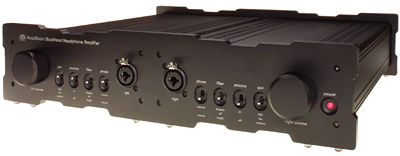 I'll tell you what I'm most intimate with (after K-10, of course): my BlockHead. The HeadRoom BlockHead headphone amplifier, that is, the top-of-the-line, $3888 stepped-attenuator model. (A version with Nobel volume pots sells for a still mighty $3333.) I listen to headphones for hours at a stretch while writing my reviews. The equipment I listen to spoils me to death, and I need a headphone rig to match. Rather amusingly, when Wes Phillips reviewed the single-chassis Max HeadRoom back in February 1997, Tyll Hertsens, Head HeadRoomer, declared, "Frankly, my feeling is that if anyone should build a $2000-$3000 headphone amp, it should be Sonic Frontiers or Counterpoint—which are companies who have licensed the module from us—not us. I have no desire to go beyond the Max."
Heh-heh. He's gone beyond the Max, all right. Way beyond. Who you callin' a BlockHead?
I'll tell you what I'm most intimate with (after K-10, of course): my BlockHead. The HeadRoom BlockHead headphone amplifier, that is, the top-of-the-line, $3888 stepped-attenuator model. (A version with Nobel volume pots sells for a still mighty $3333.) I listen to headphones for hours at a stretch while writing my reviews. The equipment I listen to spoils me to death, and I need a headphone rig to match. Rather amusingly, when Wes Phillips reviewed the single-chassis Max HeadRoom back in February 1997, Tyll Hertsens, Head HeadRoomer, declared, "Frankly, my feeling is that if anyone should build a $2000-$3000 headphone amp, it should be Sonic Frontiers or Counterpoint—which are companies who have licensed the module from us—not us. I have no desire to go beyond the Max."
Heh-heh. He's gone beyond the Max, all right. Way beyond. Who you callin' a BlockHead?
A picture is worth a thousand words, as copy editor Richard Lehnert likes to remind reviewers, and this one's worth a dictionary full. Take a good squint at the photo to savor the BlockHead's unusual turreted looks, which resemble two HeadRoom Maxes attached at their front and rear panels. That's exactly what the BlockHead is. Look at it from the top and you'll see that the two modules are truly separate dual-mono chassis held together by the almost ¾" front and rear aluminum plates. The left and right sides are mirror-imaged, and the anodized aluminum, Swiss-made detented volume controls at either end are a pleasure to use. They have a flat slice on the front so you can tell where you are, volume-wise. Working in toward the center, there are four switches in nicely machined depressions. First is the three-position gain switch, which accommodates different headphones' power needs: Low is perfect for Grado headphones, permitting a wider range on the volume controls, while Medium and High are more appropriate for Sennheiser HD 580s or HD 600s. (At the moment, only these three 'phones take the special cable required for the dual-mono BlockHead.) Next are the Process switches, which I'll come to presently. Then there are the Filter switches. These compensate for what HeadRoom calls the processor's "warming action." The center position means there's no filter in the circuit; generally, HeadRoom recommends this setting. But if the processor is putting out too much bass or blurring the central image, the filters can be engaged to provide a mild high-frequency boost. The Bright setting accentuates the highs at about 3kHz, and the Brighter setting begins its rise an octave below, thus affecting the upper mids. Basically, HeadRoom suggests you relax and set it to whatever sounds best to you.
Polarity-inverting switches are next in line. Then, either side of center, are the headphone jacks—Neutriks, which clamp down tightly for optimum signal transfer. They'll take a ¼" TRS plug as well as XLR connectors—although XLRs are the way to go with the BlockHead, for reasons that will become apparent. Oh, and the tiny red LEDs outboard of the volume controls simply indicate that the unit is on. (Whaddaya want? I'm a reviewer—spell it out for me!) Around back (also mirror-imaged) are the IEC mains-in sockets and power switches with adjustable fuse holders next to them. Line-in XLRs are next, with ground-lift switches next to each. For normal use, HeadRoom recommends lifting, or "floating," the ground. Hum problems? Unfloat your boat, as it were. A pair each of Crossfeed Out and In connectors, which allow the HeadRoom Process to do its stuff, sit inboard of the ground switches, and dedicated DiMarzio cables are supplied for the trivially easy (even for me) task of hooking up the male to female XLRs, which connect the two chassis for the processor to work.
I'll tell you what I'm most intimate with (after K-10, of course): my BlockHead. The HeadRoom BlockHead headphone amplifier, that is, the top-of-the-line, $3888 stepped-attenuator model. (A version with Nobel volume pots sells for a still mighty $3333.) I listen to headphones for hours at a stretch while writing my reviews. The equipment I listen to spoils me to death, and I need a headphone rig to match. Rather amusingly, when Wes Phillips reviewed the single-chassis Max HeadRoom back in February 1997, Tyll Hertsens, Head HeadRoomer, declared, "Frankly, my feeling is that if anyone should build a $2000-$3000 headphone amp, it should be Sonic Frontiers or Counterpoint—which are companies who have licensed the module from us—not us. I have no desire to go beyond the Max." A picture is worth a thousand words, as copy editor Richard Lehnert likes to remind reviewers, and this one's worth a dictionary full. Take a good squint at the photo to savor the BlockHead's unusual turreted looks, which resemble two HeadRoom Maxes attached at their front and rear panels. That's exactly what the BlockHead is. Look at it from the top and you'll see that the two modules are truly separate dual-mono chassis held together by the almost ¾" front and rear aluminum plates. The left and right sides are mirror-imaged, and the anodized aluminum, Swiss-made detented volume controls at either end are a pleasure to use. They have a flat slice on the front so you can tell where you are, volume-wise. Working in toward the center, there are four switches in nicely machined depressions. First is the three-position gain switch, which accommodates different headphones' power needs: Low is perfect for Grado headphones, permitting a wider range on the volume controls, while Medium and High are more appropriate for Sennheiser HD 580s or HD 600s. (At the moment, only these three 'phones take the special cable required for the dual-mono BlockHead.) Next are the Process switches, which I'll come to presently. Then there are the Filter switches. These compensate for what HeadRoom calls the processor's "warming action." The center position means there's no filter in the circuit; generally, HeadRoom recommends this setting. But if the processor is putting out too much bass or blurring the central image, the filters can be engaged to provide a mild high-frequency boost. The Bright setting accentuates the highs at about 3kHz, and the Brighter setting begins its rise an octave below, thus affecting the upper mids. Basically, HeadRoom suggests you relax and set it to whatever sounds best to you.