"When I find something that works," John Candy leered, "I stick with it!" I have no idea if the folks at Stax Industries are fans of Splash or not, but they've certainly taken Candy's philosophy as their own. Despite manufacturing superb—if demanding—loudspeakers and electronics for the last 15 years or so, Stax has been best known for producing one thing: electrostatic ear-speakers, aka headphones. 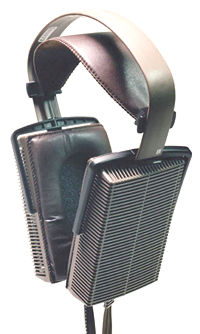 Stax headsets aren't quite like any others. The Lambda series sports large rectangular drivers that are held away from the ear at an angle—they're deeper at the front than at the rear. They function more like tiny electrostatic speakers placed within an inch of the ear than like a conventional headphone that couples to the ear canal—which also means that they feature less of that "in your head" sensation than most headsets, although they aren't any better at portraying image depth with conventional stereo recordings. Stax has continually refined the basic Lambda headset by improving the diaphragm, as well as by upgrading the energizer/amplifier that drives it. As a result, one incarnation after another has inhabited the Class A section of our "Recommended Components" listing since the Lambda's inception. John Atkinson and Steven Stone use the Lambda Signatures as location monitors for their recording projects, while TJN—lucky man!—uses the state-of-the-art Omega (currently not in production) as his reference for neutrality in a transducer. I've owned a pair of Lambda Pros since 1984—complete with a no-longer-in-production battery-powered energizer. So it came to a shock and a severe disappointment to audiophiles everywhere when we heard that Stax had closed its doors about a year ago. Just when things looked darkest, however, a group of engineers—former employees—were allowed to reestablish the marque for limited production of the ear-speakers, on the condition that they honor existing warranties on Stax products. (Actually, this didn't put an end to the confusion, as the new Stax authorized no fewer than four US companies to distribute the line. However, since three of them have not placed any orders with Stax recently, it seems that Audio Advisor has become their sole agent by default.)
"I'm just changing."
Stax headsets aren't quite like any others. The Lambda series sports large rectangular drivers that are held away from the ear at an angle—they're deeper at the front than at the rear. They function more like tiny electrostatic speakers placed within an inch of the ear than like a conventional headphone that couples to the ear canal—which also means that they feature less of that "in your head" sensation than most headsets, although they aren't any better at portraying image depth with conventional stereo recordings. Stax has continually refined the basic Lambda headset by improving the diaphragm, as well as by upgrading the energizer/amplifier that drives it. As a result, one incarnation after another has inhabited the Class A section of our "Recommended Components" listing since the Lambda's inception. John Atkinson and Steven Stone use the Lambda Signatures as location monitors for their recording projects, while TJN—lucky man!—uses the state-of-the-art Omega (currently not in production) as his reference for neutrality in a transducer. I've owned a pair of Lambda Pros since 1984—complete with a no-longer-in-production battery-powered energizer. So it came to a shock and a severe disappointment to audiophiles everywhere when we heard that Stax had closed its doors about a year ago. Just when things looked darkest, however, a group of engineers—former employees—were allowed to reestablish the marque for limited production of the ear-speakers, on the condition that they honor existing warranties on Stax products. (Actually, this didn't put an end to the confusion, as the new Stax authorized no fewer than four US companies to distribute the line. However, since three of them have not placed any orders with Stax recently, it seems that Audio Advisor has become their sole agent by default.)
"I'm just changing."
As I mentioned above, the basic Lambda design is familiar: They're kind of bulky, although not particularly heavy, and tend to slide off your head if you're given to sudden movements. They're reasonably comfortable, although the vinyl "synthetic leather" earpads become uncomfortably warm and slick if worn for extended periods in warm weather. The ear-speakers attach to a U-shaped "spring," under which is slung a synthetic leather strip that rests upon the head. By sliding the strip up or down the side pieces of the spring, the headsets can be adjusted for different-sized heads. I find this arrangement comfortable; others—my wife among them—do not. The most visible difference between the Lambda Nova Signatures and earlier Lambdas is the color: The Nova Signatures are a soft brown, whereas the earlier models were black. Inside, Stax claims, the diaphragm is thinner and the electrodes have been improved. The six-conductor ribbon cable that attaches the headset to its energizer/amplifier is wider than on previous models, and each strand appears to be thicker, while the conductors are now made from Pure Crystal Ohno Continuous Casting copper. Electrostatic headsets require "energizer" boxes, specialized power amplifiers that both charge the stator and drive the ear-speakers. The Lambda Nova Signatures are sold with two different models—the SRM-T1S and the SRM- T1W, both utilizing FETs in the first stage and pairs of 6FQ7/5CG7 triodes in the output stage. Both amplifiers accommodate balanced inputs without resorting to the use of transformers or inversion amplifiers in the signal path, due to the double-axis quad volume controls Stax employs.
SRM-T1S: The SRM-T1S can be considered the "standard" model; it was the amplifier TJN used in his review of the $6000 Omega S system. It's quite deep (14" from volume control to RCA input), but only 8" wide and 4" tall. The front two-thirds of the top plate is perforated for ventilation; in the center, the two 6FQ7s bulge slightly out from the surface—circular patterns in the perforation, resembling stylized daisies, highlight their location. There's no practical advantage to this, of course, but it adds a welcome touch of whimsy to the otherwise austere package. Dominating the front panel, on the far right, is a large split volume control; the front half adjusts the left channel, while the rear half adjusts the right. This pot has a silky feel and both halves track tightly. To the left of the volume pot, in a row along the lower half of the face, are three connections for Stax headphones (Stax does not use the typical ¼" phono plug)—two are labeled pro only, the other normal. Above them are three switches: power, and inputs 1 and 2.
Stax headsets aren't quite like any others. The Lambda series sports large rectangular drivers that are held away from the ear at an angle—they're deeper at the front than at the rear. They function more like tiny electrostatic speakers placed within an inch of the ear than like a conventional headphone that couples to the ear canal—which also means that they feature less of that "in your head" sensation than most headsets, although they aren't any better at portraying image depth with conventional stereo recordings. Stax has continually refined the basic Lambda headset by improving the diaphragm, as well as by upgrading the energizer/amplifier that drives it. As a result, one incarnation after another has inhabited the Class A section of our "Recommended Components" listing since the Lambda's inception. John Atkinson and Steven Stone use the Lambda Signatures as location monitors for their recording projects, while TJN—lucky man!—uses the state-of-the-art Omega (currently not in production) as his reference for neutrality in a transducer. I've owned a pair of Lambda Pros since 1984—complete with a no-longer-in-production battery-powered energizer. So it came to a shock and a severe disappointment to audiophiles everywhere when we heard that Stax had closed its doors about a year ago. Just when things looked darkest, however, a group of engineers—former employees—were allowed to reestablish the marque for limited production of the ear-speakers, on the condition that they honor existing warranties on Stax products. (Actually, this didn't put an end to the confusion, as the new Stax authorized no fewer than four US companies to distribute the line. However, since three of them have not placed any orders with Stax recently, it seems that Audio Advisor has become their sole agent by default.) As I mentioned above, the basic Lambda design is familiar: They're kind of bulky, although not particularly heavy, and tend to slide off your head if you're given to sudden movements. They're reasonably comfortable, although the vinyl "synthetic leather" earpads become uncomfortably warm and slick if worn for extended periods in warm weather. The ear-speakers attach to a U-shaped "spring," under which is slung a synthetic leather strip that rests upon the head. By sliding the strip up or down the side pieces of the spring, the headsets can be adjusted for different-sized heads. I find this arrangement comfortable; others—my wife among them—do not. The most visible difference between the Lambda Nova Signatures and earlier Lambdas is the color: The Nova Signatures are a soft brown, whereas the earlier models were black. Inside, Stax claims, the diaphragm is thinner and the electrodes have been improved. The six-conductor ribbon cable that attaches the headset to its energizer/amplifier is wider than on previous models, and each strand appears to be thicker, while the conductors are now made from Pure Crystal Ohno Continuous Casting copper. Electrostatic headsets require "energizer" boxes, specialized power amplifiers that both charge the stator and drive the ear-speakers. The Lambda Nova Signatures are sold with two different models—the SRM-T1S and the SRM- T1W, both utilizing FETs in the first stage and pairs of 6FQ7/5CG7 triodes in the output stage. Both amplifiers accommodate balanced inputs without resorting to the use of transformers or inversion amplifiers in the signal path, due to the double-axis quad volume controls Stax employs.