When a well-respected analog disc-mastering veteran like Stan Ricker says that the Alesis MasterLink ML-9600, a hard-disk-based digital recorder/CD burner, is "the best tool in my mastering bag...done right it can sound better than all but the absolute top drawer analog," you take the endorsement seriously. Progress is possible. Mastering tool, CD burner, 24-bit/96kHz recorder, audio reviewer's best friend—the versatile MasterLink is one of the coolest products I've ever had my hands on. 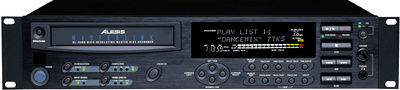 For a company that was on the brink of bankruptcy (it was bought and resurrected by Numark), Alesis has perhaps found a savior in the ML-9600. The world seems to be in love with it. Capitol studios in L.A. is using them instead of DAT machines for references and mixdowns. I just wonder if Alesis is making any money: the ML-9600's list price is $1699, but you can find it online for less than $1000. But you're not a mastering engineer or a recording artist—what can the MasterLink do for you?
Say you want to transfer your collection of original UK Island Roxy Music LPs to CD, which is what a friend asked me to do for him just as the MasterLink arrived. Think about your CD burner and consider this: with the ML-9600, you could record to its hard drive at any combination of 44.1, 48, 88.2, or 96kHz sample rates and 16-, 20-, and 24-bit word lengths. Once the tracks are recorded to a Playlist on the HD, you can alter the running order, apply compression to individual tracks, do fade-ins and -outs, and edit out bad starts or end-of-side goofs where you let the stylus go 'round and 'round in the lead-out groove. You can apply compression, a limiter, and EQ settings used for one track to all tracks on a Playlist (not that you'd want to use any of those in this example). You can insert track divisions after the fact, so your friend doesn't get an entire LP side as "track 1." You don't have to sit there inserting the track marks in real time (though you can), and you can adjust the levels of individual tracks. You can substitute a better-sounding track from another pressing by adding it at the end of the Playlist, deleting the bad track, and replacing it with the new one in the original LP sequence. And, of course, you rip one or all the tracks from a regular CD onto the hard drive as a Playlist that you can then manipulate. Making compilations couldn't be easier or more fun. And since you can name the Playlists and the individual tracks, keeping track of both is easy. When you've gotten the Playlist just the way you want it, you insert a blank CD-R in the tray, push a button, and record a 16-bit/44.1kHz "Red Book" CD, either in real time, faster (it's a 4x-speed burner), or slower, depending on if you've specified EQ and/or other DSP changes to the original recording. Or you could burn a "CD24"—an uncompressed 24-bit/96kHz AIFF file carried on a standard CD—on the MasterLink. You get about 20 minutes per 80-minute blank, so it's one CD per average LP side, but the pure, analog-like transparency compared to the original LP will astonish you. Then listen to the "Red Book" CD you made for your friend and you'll hear why you're not so keen on CDs. (Though CD24 discs are conventional CD-R discs that conform to the ISO 9660 standard can be played on the MasterLink and on PCs and Macs equipped with 24/96 D/A converters, they won't play on your regular CD player.)
Think of the possibilities for a reviewer: LPs as played through different phono sections, turntables, and cartridges can be archived to 24/96 discs and be compared later with new products being reviewed—the MasterLink's fidelity is that good. I'm not saying it's perfect (sound forever), but it's close enough to the original to make meaningful comparisons possible.
For a company that was on the brink of bankruptcy (it was bought and resurrected by Numark), Alesis has perhaps found a savior in the ML-9600. The world seems to be in love with it. Capitol studios in L.A. is using them instead of DAT machines for references and mixdowns. I just wonder if Alesis is making any money: the ML-9600's list price is $1699, but you can find it online for less than $1000. But you're not a mastering engineer or a recording artist—what can the MasterLink do for you?
Say you want to transfer your collection of original UK Island Roxy Music LPs to CD, which is what a friend asked me to do for him just as the MasterLink arrived. Think about your CD burner and consider this: with the ML-9600, you could record to its hard drive at any combination of 44.1, 48, 88.2, or 96kHz sample rates and 16-, 20-, and 24-bit word lengths. Once the tracks are recorded to a Playlist on the HD, you can alter the running order, apply compression to individual tracks, do fade-ins and -outs, and edit out bad starts or end-of-side goofs where you let the stylus go 'round and 'round in the lead-out groove. You can apply compression, a limiter, and EQ settings used for one track to all tracks on a Playlist (not that you'd want to use any of those in this example). You can insert track divisions after the fact, so your friend doesn't get an entire LP side as "track 1." You don't have to sit there inserting the track marks in real time (though you can), and you can adjust the levels of individual tracks. You can substitute a better-sounding track from another pressing by adding it at the end of the Playlist, deleting the bad track, and replacing it with the new one in the original LP sequence. And, of course, you rip one or all the tracks from a regular CD onto the hard drive as a Playlist that you can then manipulate. Making compilations couldn't be easier or more fun. And since you can name the Playlists and the individual tracks, keeping track of both is easy. When you've gotten the Playlist just the way you want it, you insert a blank CD-R in the tray, push a button, and record a 16-bit/44.1kHz "Red Book" CD, either in real time, faster (it's a 4x-speed burner), or slower, depending on if you've specified EQ and/or other DSP changes to the original recording. Or you could burn a "CD24"—an uncompressed 24-bit/96kHz AIFF file carried on a standard CD—on the MasterLink. You get about 20 minutes per 80-minute blank, so it's one CD per average LP side, but the pure, analog-like transparency compared to the original LP will astonish you. Then listen to the "Red Book" CD you made for your friend and you'll hear why you're not so keen on CDs. (Though CD24 discs are conventional CD-R discs that conform to the ISO 9660 standard can be played on the MasterLink and on PCs and Macs equipped with 24/96 D/A converters, they won't play on your regular CD player.)
Think of the possibilities for a reviewer: LPs as played through different phono sections, turntables, and cartridges can be archived to 24/96 discs and be compared later with new products being reviewed—the MasterLink's fidelity is that good. I'm not saying it's perfect (sound forever), but it's close enough to the original to make meaningful comparisons possible.
For a company that was on the brink of bankruptcy (it was bought and resurrected by Numark), Alesis has perhaps found a savior in the ML-9600. The world seems to be in love with it. Capitol studios in L.A. is using them instead of DAT machines for references and mixdowns. I just wonder if Alesis is making any money: the ML-9600's list price is $1699, but you can find it online for less than $1000. But you're not a mastering engineer or a recording artist—what can the MasterLink do for you?