Well into dCS managing director Mike Story's attempted explanation of upsampling, there came an epic moment when the ever-expanding universe of his thoughts—which we had been following to new heights of digital enlightenment—broke free of our collective grip, snapped back on itself, and caused a conceptual implosion of nearly cataclysmic proportions. The blank, spent expressions on the faces of the journalists gathered in the small attic-like meeting room at dCS's Great Chesterford (UK) facility all seemed to say, "What the hell was that? Was it just me, or did you feel that too?" 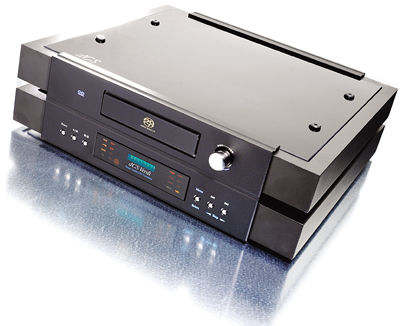 We'd come so close to genuinely "getting" upsampling—how it differed from oversampling, why it might make an audible difference. But in this arena, "close" gets you nowhere. I'm back to square one with upsampling, and apparently dCS is not many squares ahead: the instruction manual for the Purcell, the digital/digital converter (DDC) that does the upsampling in the dCS system, comes right out and says "Upsampling cannot increase the amount of information in a signal, and the exact mechanism behind the perceived sonic improvements is currently not entirely clear. We are continuing our research into this subject." When they've finished, perhaps they can explain it. I can't. That meeting, two years ago, was supposed to be a prelude to my receiving dCS's new Verdi SACD transport, along with the company's Purcell DDC and Elgar Plus, an upgraded digital/analog converter (DAC) that, among other things, adds DSD (SACD) decoding to the original dCS Elgar (footnote 1). But getting Sony to go along with shooting the DSD bitstream out of the transport and into the Elgar Plus proved more difficult than expected, in terms of both the encryption software and the IEEE1394 FireWire buffer interface, and the project was subjected to many delays. All of these issues have finally been resolved, which is why the three dCS boxes now sit on my equipment rack.
One point dCS wanted me to get across to potential buyers of this system, or of any of the individual components, is that every Elgar ever made can be upgraded to current specs, and that that policy will continue. Whatever the future of digital audio brings, your investment in expensive dCS components should be protected. What you get for $33,985
We'd come so close to genuinely "getting" upsampling—how it differed from oversampling, why it might make an audible difference. But in this arena, "close" gets you nowhere. I'm back to square one with upsampling, and apparently dCS is not many squares ahead: the instruction manual for the Purcell, the digital/digital converter (DDC) that does the upsampling in the dCS system, comes right out and says "Upsampling cannot increase the amount of information in a signal, and the exact mechanism behind the perceived sonic improvements is currently not entirely clear. We are continuing our research into this subject." When they've finished, perhaps they can explain it. I can't. That meeting, two years ago, was supposed to be a prelude to my receiving dCS's new Verdi SACD transport, along with the company's Purcell DDC and Elgar Plus, an upgraded digital/analog converter (DAC) that, among other things, adds DSD (SACD) decoding to the original dCS Elgar (footnote 1). But getting Sony to go along with shooting the DSD bitstream out of the transport and into the Elgar Plus proved more difficult than expected, in terms of both the encryption software and the IEEE1394 FireWire buffer interface, and the project was subjected to many delays. All of these issues have finally been resolved, which is why the three dCS boxes now sit on my equipment rack.
One point dCS wanted me to get across to potential buyers of this system, or of any of the individual components, is that every Elgar ever made can be upgraded to current specs, and that that policy will continue. Whatever the future of digital audio brings, your investment in expensive dCS components should be protected. What you get for $33,985
Explaining what you get for your $34k is somewhat easier than explaining upsampling, but due to the dCS gear's enormous flexibility and multitude of features, it's not that much easier. The new Verdi SACD transport ($10,995) is based on a fast-reading, drawer-loading Sony transport with two lasers (one each for CD and SACD). It outputs the encrypted 1-bit, 2.822MS/s DSD data via an IEEE1394 bus. Standard CD 16-bit/44.1kHz data are available via three AES/EBU XLR jacks (using two in dual AES/EBU configuration can get you 176.4kHz and 192kHz sample rates), four S/PDIF jacks (RCA, BNC, TosLink optical, and optional ST optical), and Sony's SDIF-2 interface, which carries the wordclock on a separate link. CD data can also be upsampled to DSD using dCS's IEEE1394-equipped Purcell DDC.
The Verdi can be used in conventional manner, but it also includes a word-clock input that allows it to be synchronized to an outboard master clock, or to the Elgar Plus or (lower-priced) Delius DACs operating in master mode. Like other dCS products, the Verdi is upgradeable via CD-ROM or from a PC, when such upgrades become available. A hefty anodized aluminum remote control is included. The Purcell DDC is capable of upsampling and increasing word length of 16/44.1 data to 24/88.2, 24/96, 24/176.4, 24/192, or DSD. The Purcell is based on dCS's 972 professional DDC. dCS says the Purcell uses the same DSP engine and code as the 972 and sounds identical. The instruction manual says that dCS has carried out listening tests using CDs manufactured from 24/96 digital masters and has found that upsampling reveals information present in the master source but inaudible during regular CD playback—though why this should be so, since upsampling can't increase the amount of information in the signal, remains a mystery. If you don't buy the upsampling voodoo, you can skip the Purcell and connect the Verdi directly to the Elgar Plus and play CDs as CDs and SACDs as SACDs. A second remote controls both the Purcell and the Elgar.
Footnote 1: John Atkinson's original review of the Elgar appeared in July 1997, while Jonathan Scull's review of the Purcell, which included a followup on the Elgar Plus, was published in February 2001.
We'd come so close to genuinely "getting" upsampling—how it differed from oversampling, why it might make an audible difference. But in this arena, "close" gets you nowhere. I'm back to square one with upsampling, and apparently dCS is not many squares ahead: the instruction manual for the Purcell, the digital/digital converter (DDC) that does the upsampling in the dCS system, comes right out and says "Upsampling cannot increase the amount of information in a signal, and the exact mechanism behind the perceived sonic improvements is currently not entirely clear. We are continuing our research into this subject." When they've finished, perhaps they can explain it. I can't. That meeting, two years ago, was supposed to be a prelude to my receiving dCS's new Verdi SACD transport, along with the company's Purcell DDC and Elgar Plus, an upgraded digital/analog converter (DAC) that, among other things, adds DSD (SACD) decoding to the original dCS Elgar (footnote 1). But getting Sony to go along with shooting the DSD bitstream out of the transport and into the Elgar Plus proved more difficult than expected, in terms of both the encryption software and the IEEE1394 FireWire buffer interface, and the project was subjected to many delays. All of these issues have finally been resolved, which is why the three dCS boxes now sit on my equipment rack. Explaining what you get for your $34k is somewhat easier than explaining upsampling, but due to the dCS gear's enormous flexibility and multitude of features, it's not that much easier. The new Verdi SACD transport ($10,995) is based on a fast-reading, drawer-loading Sony transport with two lasers (one each for CD and SACD). It outputs the encrypted 1-bit, 2.822MS/s DSD data via an IEEE1394 bus. Standard CD 16-bit/44.1kHz data are available via three AES/EBU XLR jacks (using two in dual AES/EBU configuration can get you 176.4kHz and 192kHz sample rates), four S/PDIF jacks (RCA, BNC, TosLink optical, and optional ST optical), and Sony's SDIF-2 interface, which carries the wordclock on a separate link. CD data can also be upsampled to DSD using dCS's IEEE1394-equipped Purcell DDC.
Footnote 1: John Atkinson's original review of the Elgar appeared in July 1997, while Jonathan Scull's review of the Purcell, which included a followup on the Elgar Plus, was published in February 2001.