One day last year, my friend Larry and I were talking about our college-fraternity days and loudspeakers. Those were four of the best years of my life. Strong friendships were formed, and ever since, we've kept in touch with most of our fraternity's brothers-in-heart. Ours was not a jock house, nor was it the last bastion of rampant male sexuality—it was, after all, an MIT frat house. But it was full of music lovers who fell neatly into three camps: the California School owned JBL Decades, the New England School had Smaller Advents, and the Renegades boasted bootlegged Bose 901s (footnote 1).
 I never had enough cash to buy my own hi-fi until well after graduate school, so I freeloaded off my brothers' systems. I'd always favored the Advent camp, and not just because they seemed to play the most interesting music—their systems always sounded the most natural and uncolored. I attended one of my brothers' wedding receptions (he's still happily married 32 years later), for which another brother had donated his original "Large" Advents for DJ duty. (These were the higher-cost model, with the sexy real-wood cabinets.) I was floored by how well and effortlessly these speakers filled the banquet hall with clean, distortion-free sound.
As Larry and I talked about speakers, our attention shifted to more current designs. Although he loves music, and is a talented designer at chip maker Analog Devices, Larry is not an audiophile. Still, he agreed that the affordable speakers he's heard at my house have steadily improved in quality over the past 15 years. I pointed out that the speakers I now review sound far more natural and detailed than designs I reviewed ten or even five years ago, and that none of the speakers we listened to in college could possibly compete with them—except, perhaps, the Smaller Advent. Larry then admitted that his own Smaller Advents, bought in 1972, still sounded great. A bell went off. I commandeered Larry's speakers as subjects of a "vintage" review for Stereophile.
Trailblazers
I never had enough cash to buy my own hi-fi until well after graduate school, so I freeloaded off my brothers' systems. I'd always favored the Advent camp, and not just because they seemed to play the most interesting music—their systems always sounded the most natural and uncolored. I attended one of my brothers' wedding receptions (he's still happily married 32 years later), for which another brother had donated his original "Large" Advents for DJ duty. (These were the higher-cost model, with the sexy real-wood cabinets.) I was floored by how well and effortlessly these speakers filled the banquet hall with clean, distortion-free sound.
As Larry and I talked about speakers, our attention shifted to more current designs. Although he loves music, and is a talented designer at chip maker Analog Devices, Larry is not an audiophile. Still, he agreed that the affordable speakers he's heard at my house have steadily improved in quality over the past 15 years. I pointed out that the speakers I now review sound far more natural and detailed than designs I reviewed ten or even five years ago, and that none of the speakers we listened to in college could possibly compete with them—except, perhaps, the Smaller Advent. Larry then admitted that his own Smaller Advents, bought in 1972, still sounded great. A bell went off. I commandeered Larry's speakers as subjects of a "vintage" review for Stereophile.
Trailblazers
The word that summarized Advent's approach to product design was innovation. When Henry Kloss left KLH in 1967 to found Advent, his goal was to develop a commercially viable large-screen television. In 1970, Kloss developed the original Advent Loudspeaker, which represented his latest thinking on the acoustic-suspension bookshelf speaker. The Advent featured a small, hard-dome tweeter and a 12" air-suspension woofer and was available in a cabinet of MDF (standard) or real wood. It also had a tweeter-level control. Soon after, Advent developed the 200/201, the first audiophile cassette deck, with built-in Dolby circuitry and a large, professional-grade VU meter; and, later, the visually distinctive and eminently musical 300 receiver, with circuitry designed by a very young Tomlinson Holman, who would later found Apt and THX.
But in 1972, Kloss wanted to make a less expensive speaker, and began to develop the Smaller Advent. It was very similar to the original Advent, although with an 8½" woofer diaphragm on a 9½" frame in a smaller cabinet. The tweeter and crossover frequency were the same, but lacked the original Advent's tweeter control and optional real-wood cabinet. The price was also about 30% less: $139.90/pair ($668/pair in 2006 dollars). Kloss brought in designer Andy Kostatos (later to found Boston Acoustics) to voice the speaker and fine-tune its crossover. (Kloss left Advent in 1974, after new investors had been brought in to recapitalize the company.)
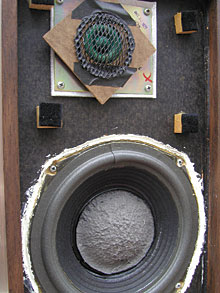
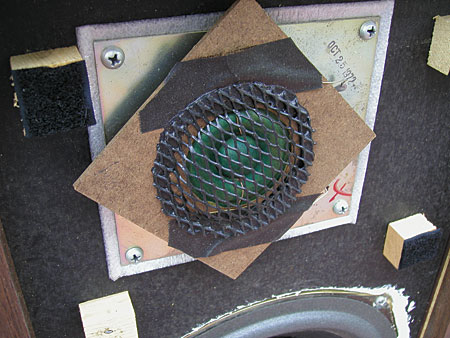 The Smaller Advents I reviewed are entirely stock, except for some minor refurbishing done five years ago to replace the shredded woofer cones and disintegrating rubber-gasket surrounds. The woofers' original voice-coils remain (footnote 2).
System and setup
The Smaller Advents I reviewed are entirely stock, except for some minor refurbishing done five years ago to replace the shredded woofer cones and disintegrating rubber-gasket surrounds. The woofers' original voice-coils remain (footnote 2).
System and setup
For this review, I decided on a tack different from those in reviews of vintage gear by some of my Stereophile colleagues. I had no interest in assembling an early-1970s system to re-create "the sound of my youth." Instead, as I do with any affordable speaker I review, I placed the Smaller Advents on my Celestion Si stands, which are loaded with sand and lead shot, and gave them the same scrutiny that I do current designs. I did most of my listening with my highly revealing (and expensive) reference system, which includes AudioValve and Audio Research electronics and VPI-Immedia-Koetsu-Vendetta and Lector front ends. Finally, and also as usual, I compared the Advents with some of my favorite current affordable designs. In short, I cut the 34-year-old Advents no slack.
As I set up the speakers, I was struck by three things. First, the Smaller Advent is not that small. In fact, it's bigger than 90% of all the "bookshelf" speakers I've reviewed for Stereophile. Second, its construction quality seemed pretty rugged, and the fairly sophisticated binding posts seemed of higher quality than those on most of the other speakers I've reviewed. Finally, the detailed original owner's manual was still stapled to the back of one of the speakers. Unusually for its day, it makes clear that the Smaller Advent was designed to be a serious audiophile loudspeaker.
Listening
I expected my reference system to reveal all sorts of annoying colorations and anomalies that, 34 years ago, I would never have noticed listening to the Smaller Advents with a 20W Sherwood receiver. Indeed there were colorations, which I'll describe shortly, but overall I was surprised—at no time did those colorations detract from my musical enjoyment. What struck me immediately were the speaker's greatest strengths—which, back in the '70s, I wouldn't have noticed either.
Footnote 1: A student had somehow got hold of the parts list and assembly instructions for constructing the 901. For $120, he would sell you the instructions and all of the parts needed, sans lumber and grillecloth, to assemble your own set, a legit pair of which cost $800. About eight in our group built their own Bose-o's, as we called them. Each pair sounded different. Amar Bose was then and still is an MIT professor.
Footnote 2: This work was done by New England Speaker Inc., 221 Main Street, Suite 3, Stoneham, MA 02180-1620. Tel: (781) 438-1786. Web: www.nespeaker.com. [Layne Audio, http://layneaudio.hypermart.net/Advent.htm, also offers replacement drivers.—Ed.]
I never had enough cash to buy my own hi-fi until well after graduate school, so I freeloaded off my brothers' systems. I'd always favored the Advent camp, and not just because they seemed to play the most interesting music—their systems always sounded the most natural and uncolored. I attended one of my brothers' wedding receptions (he's still happily married 32 years later), for which another brother had donated his original "Large" Advents for DJ duty. (These were the higher-cost model, with the sexy real-wood cabinets.) I was floored by how well and effortlessly these speakers filled the banquet hall with clean, distortion-free sound.
As Larry and I talked about speakers, our attention shifted to more current designs. Although he loves music, and is a talented designer at chip maker Analog Devices, Larry is not an audiophile. Still, he agreed that the affordable speakers he's heard at my house have steadily improved in quality over the past 15 years. I pointed out that the speakers I now review sound far more natural and detailed than designs I reviewed ten or even five years ago, and that none of the speakers we listened to in college could possibly compete with them—except, perhaps, the Smaller Advent. Larry then admitted that his own Smaller Advents, bought in 1972, still sounded great. A bell went off. I commandeered Larry's speakers as subjects of a "vintage" review for Stereophile.
Trailblazers
The word that summarized Advent's approach to product design was innovation. When Henry Kloss left KLH in 1967 to found Advent, his goal was to develop a commercially viable large-screen television. In 1970, Kloss developed the original Advent Loudspeaker, which represented his latest thinking on the acoustic-suspension bookshelf speaker. The Advent featured a small, hard-dome tweeter and a 12" air-suspension woofer and was available in a cabinet of MDF (standard) or real wood. It also had a tweeter-level control. Soon after, Advent developed the 200/201, the first audiophile cassette deck, with built-in Dolby circuitry and a large, professional-grade VU meter; and, later, the visually distinctive and eminently musical 300 receiver, with circuitry designed by a very young Tomlinson Holman, who would later found Apt and THX.
The Smaller Advents I reviewed are entirely stock, except for some minor refurbishing done five years ago to replace the shredded woofer cones and disintegrating rubber-gasket surrounds. The woofers' original voice-coils remain (footnote 2).
System and setup
For this review, I decided on a tack different from those in reviews of vintage gear by some of my Stereophile colleagues. I had no interest in assembling an early-1970s system to re-create "the sound of my youth." Instead, as I do with any affordable speaker I review, I placed the Smaller Advents on my Celestion Si stands, which are loaded with sand and lead shot, and gave them the same scrutiny that I do current designs. I did most of my listening with my highly revealing (and expensive) reference system, which includes AudioValve and Audio Research electronics and VPI-Immedia-Koetsu-Vendetta and Lector front ends. Finally, and also as usual, I compared the Advents with some of my favorite current affordable designs. In short, I cut the 34-year-old Advents no slack.
I expected my reference system to reveal all sorts of annoying colorations and anomalies that, 34 years ago, I would never have noticed listening to the Smaller Advents with a 20W Sherwood receiver. Indeed there were colorations, which I'll describe shortly, but overall I was surprised—at no time did those colorations detract from my musical enjoyment. What struck me immediately were the speaker's greatest strengths—which, back in the '70s, I wouldn't have noticed either.
Footnote 1: A student had somehow got hold of the parts list and assembly instructions for constructing the 901. For $120, he would sell you the instructions and all of the parts needed, sans lumber and grillecloth, to assemble your own set, a legit pair of which cost $800. About eight in our group built their own Bose-o's, as we called them. Each pair sounded different. Amar Bose was then and still is an MIT professor.