Specialization seems to be an inevitable consequence of progress: As the products of man and God become more and more complex, they're called on to do fewer things in more focused ways.
 So it goes in domestic audio, however much we pretend otherwise. We buy an amplifier, bring it home, and give it a job to do—which, in terms of associated equipment, room size, music selection, and listening style, is very different from the job it will be called on to do elsewhere. Thus, direct comparisons often provide strangely little insight, and products that are truly universal are few.
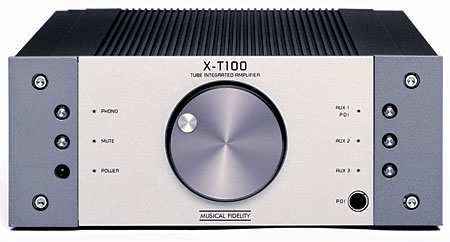
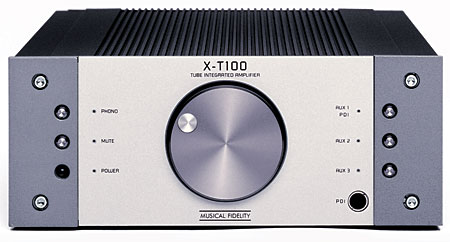
The appealingly small Musical Fidelity X-T100 ($1500), a hybrid integrated amp with an outboard power supply, cooperated nicely with that intro. When I used it—in place of an expensive, handmade 10Wpc amplifier—to drive a pair of very efficient loudspeakers, the X-T100 was adequate but no more. Yet when I gave its output section a bit more to do—much as one tries to keep a border collie busy at all times, to prevent it from behaving badly—it rose to the occasion handsomely.
Design and construction
So it goes in domestic audio, however much we pretend otherwise. We buy an amplifier, bring it home, and give it a job to do—which, in terms of associated equipment, room size, music selection, and listening style, is very different from the job it will be called on to do elsewhere. Thus, direct comparisons often provide strangely little insight, and products that are truly universal are few.
The appealingly small Musical Fidelity X-T100 ($1500), a hybrid integrated amp with an outboard power supply, cooperated nicely with that intro. When I used it—in place of an expensive, handmade 10Wpc amplifier—to drive a pair of very efficient loudspeakers, the X-T100 was adequate but no more. Yet when I gave its output section a bit more to do—much as one tries to keep a border collie busy at all times, to prevent it from behaving badly—it rose to the occasion handsomely.
Design and construction
Here's why, from a technical point of view: This newest member of Musical Fidelity's X series was intended to offer a decent amount of output power (more on that later), as well as a reasonably good batch of convenience items, such as a Mute button, a remote control, and a built-in moving-magnet phono section. To do all that while keeping cost and size below certain levels, Musical Fidelity designed the X-T100's output section around bipolar transistors, operated in class-A/B instead of the arguably sweeter, more timbrally (though not necessarily temporally) nuanced class-A. (The latter would require more heatsink area, to dissipate the energy that's been sacrificed to the gods of inefficiency, and might also require an increase in the number of output devices, if comparable power is to be had. So while it's true that less is more, it's sometimes just as true that more is less.) Because Musical Fidelity's managing director, Antony Michaelson, appreciates the distinctive sounds of tube circuits, and because he knows a few things about putting them to work, it was determined that the X-T100 should have dual-triodes in its preamp section, which is arguably where they can do the most good for the least money in a product such as this. Michaelson also opted for a remote power supply, which energizes the amplifier by means of a 44", six-conductor cable. The power supply, called the Triple-X, is included in the price of the X-T100, and can also be used to power a companion CD player, the X-Ray, and an expected tuner, the X-Plora. (It could be worse: If this were Linn, we'd have the K-Sedilla, the K-SeraSera, perhaps even the K-Why.) One can buy a Musical Fidelity X-T100 and X-Ray at the same time—they'll share a single Triple-X, of course—for $3000, or an X-Ray with its own Triple-X for $1999. Oddly, there is no published price for an X-Ray without a Triple-X. While Musical Fidelity's management and design departments remain in England, manufacturing has been outsourced—to Taiwan, in the case of my review sample. Construction and parts quality met my expectations for the price, and Michaelson's distinctive form-as-function approach to styling remains healthily in place. Alloy extrusions comprise the sides of the chassis and double as heatsinks, playing host to the complementary pairs of San-Ken output transistors and the largest of the amp's positive-voltage regulators. The main circuit board is modern and clean—where do they get tube sockets for those things!—although some of the connective wiring seemed to meander a bit. Each channel has a single ECC 88 (6DJ8, 6922, et al) dual-triode tube, for voltage gain. The moving-magnet phono section, housed on a very small board of its own, uses a Texas Instruments op-amp for gain.
Apart from those phono inputs, the X-T100 has three pairs of line-level inputs. Of those, Aux 1 is addressed by a front-mounted 1/8" stereo jack in addition to the usual RCA jacks: An MP3 player plugged into the former will override the latter. There's also a buffered Tape Out pair, as well as a pair of Preamp Out jacks—the latter notable for an exceedingly low (47 ohms) output impedance. The amp's front panel has soft-touch buttons for source selection and muting, all of which straddle a large-diameter volume knob. My usual complaint, which with each passing month probably sounds more like an elderly man wheezing about the artificial bacon-bits at the Ponderosa salad bar, is sadly germane: There's no balance control and no mono switch.
Installation and listening
If you buy a Musical Fidelity X-T100 integrated amplifier and X-Ray CD player at the same time, they'll share more than just a power supply: They'll also have a remote handset in common. The handset is nice looking and uncluttered as such things go, and I was grateful that its large, color-keyed volume buttons didn't confound my middle-aged eyes. Because the X-T100 is small, light, and ran only slightly warm to the touch, and because its designers dispensed with individual feet in favor of a pair of long rubber ridges—an especially nice touch—I had more installation flexibility than usual. I tried it on a variety of shelves and supports, noting as I did that the amp's performance could be improved with various isolation products, including my preferred Ayre Myrtle Blocks. (The Triple-X power supply seemed immune to such things.) I used only banana plugs with the X-T100's five-way speaker connectors, and only RCA plugs with the inputs. I stayed with the stock tubes and didn't experiment with alternatives, for fear that the very opinionated Antony Michaelson would make fun of me. Had he done so, I would have had my revenge in using a nearly $8000 moving-coil step-up transformer, the Audio Note AN-S8, with his $1500 integrated amp. (I used some cheaper ones too, of course.)
So it goes in domestic audio, however much we pretend otherwise. We buy an amplifier, bring it home, and give it a job to do—which, in terms of associated equipment, room size, music selection, and listening style, is very different from the job it will be called on to do elsewhere. Thus, direct comparisons often provide strangely little insight, and products that are truly universal are few.
The appealingly small Musical Fidelity X-T100 ($1500), a hybrid integrated amp with an outboard power supply, cooperated nicely with that intro. When I used it—in place of an expensive, handmade 10Wpc amplifier—to drive a pair of very efficient loudspeakers, the X-T100 was adequate but no more. Yet when I gave its output section a bit more to do—much as one tries to keep a border collie busy at all times, to prevent it from behaving badly—it rose to the occasion handsomely.
Here's why, from a technical point of view: This newest member of Musical Fidelity's X series was intended to offer a decent amount of output power (more on that later), as well as a reasonably good batch of convenience items, such as a Mute button, a remote control, and a built-in moving-magnet phono section. To do all that while keeping cost and size below certain levels, Musical Fidelity designed the X-T100's output section around bipolar transistors, operated in class-A/B instead of the arguably sweeter, more timbrally (though not necessarily temporally) nuanced class-A. (The latter would require more heatsink area, to dissipate the energy that's been sacrificed to the gods of inefficiency, and might also require an increase in the number of output devices, if comparable power is to be had. So while it's true that less is more, it's sometimes just as true that more is less.) Because Musical Fidelity's managing director, Antony Michaelson, appreciates the distinctive sounds of tube circuits, and because he knows a few things about putting them to work, it was determined that the X-T100 should have dual-triodes in its preamp section, which is arguably where they can do the most good for the least money in a product such as this. Michaelson also opted for a remote power supply, which energizes the amplifier by means of a 44", six-conductor cable. The power supply, called the Triple-X, is included in the price of the X-T100, and can also be used to power a companion CD player, the X-Ray, and an expected tuner, the X-Plora. (It could be worse: If this were Linn, we'd have the K-Sedilla, the K-SeraSera, perhaps even the K-Why.) One can buy a Musical Fidelity X-T100 and X-Ray at the same time—they'll share a single Triple-X, of course—for $3000, or an X-Ray with its own Triple-X for $1999. Oddly, there is no published price for an X-Ray without a Triple-X. While Musical Fidelity's management and design departments remain in England, manufacturing has been outsourced—to Taiwan, in the case of my review sample. Construction and parts quality met my expectations for the price, and Michaelson's distinctive form-as-function approach to styling remains healthily in place. Alloy extrusions comprise the sides of the chassis and double as heatsinks, playing host to the complementary pairs of San-Ken output transistors and the largest of the amp's positive-voltage regulators. The main circuit board is modern and clean—where do they get tube sockets for those things!—although some of the connective wiring seemed to meander a bit. Each channel has a single ECC 88 (6DJ8, 6922, et al) dual-triode tube, for voltage gain. The moving-magnet phono section, housed on a very small board of its own, uses a Texas Instruments op-amp for gain.
If you buy a Musical Fidelity X-T100 integrated amplifier and X-Ray CD player at the same time, they'll share more than just a power supply: They'll also have a remote handset in common. The handset is nice looking and uncluttered as such things go, and I was grateful that its large, color-keyed volume buttons didn't confound my middle-aged eyes. Because the X-T100 is small, light, and ran only slightly warm to the touch, and because its designers dispensed with individual feet in favor of a pair of long rubber ridges—an especially nice touch—I had more installation flexibility than usual. I tried it on a variety of shelves and supports, noting as I did that the amp's performance could be improved with various isolation products, including my preferred Ayre Myrtle Blocks. (The Triple-X power supply seemed immune to such things.) I used only banana plugs with the X-T100's five-way speaker connectors, and only RCA plugs with the inputs. I stayed with the stock tubes and didn't experiment with alternatives, for fear that the very opinionated Antony Michaelson would make fun of me. Had he done so, I would have had my revenge in using a nearly $8000 moving-coil step-up transformer, the Audio Note AN-S8, with his $1500 integrated amp. (I used some cheaper ones too, of course.)