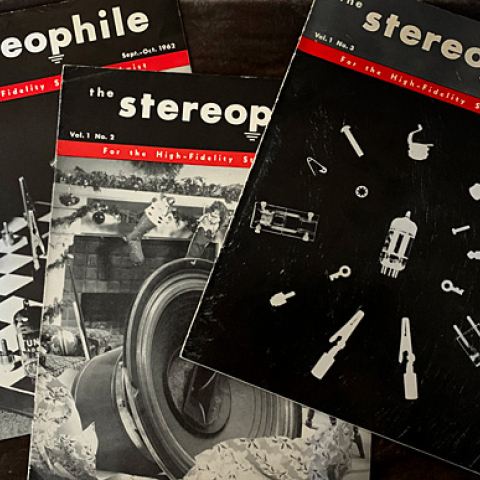
September 1997 saw the 35th anniversary of Stereophile magazine, founded by J. Gordon Holt back in 1962. If any interview needs no introduction, this is it. My interview with Gordon was conducted around the kitchen table in Gordon's Boulder, Colorado home over a couple of cold beers. It seemed appropriate to start at the very beginning...
J. Gordon Holt: I don't remember when that was. Steven Stone: [laughs] You don't remember when you were born?
Holt: It was 1930. Stone: And your parents were...
Holt: Older than I was... Stone: I would hope.
Holt: Justin Gordon Holt and Katherine Holt. My father was a chemical engineer with an American textile firm. I was born in North Carolina, and lived there until I was five. We moved to Melbourne, Australia until I was 17. Then my father dropped dead and my mother and I came back here. She bought a house in Pennsylvania, and since then I haven't lived in any one place longer than 10 years. Stone: Did you grow up in a household that had a lot of music?
Holt: My parents were not musical as far as I know. They didn't play instruments. They used to listen to music---mainly pop. It wasn't really the center of their life. I used to buy occasional pop records in my early teens. When I was 15 I took one of these stupid music-education courses in school, where they teach you about music. It's a historical approach---you start with the dullest music imaginable, then you move with snail-like speed to stuff that's more and more interesting. I sat through the whole thing, having great difficulty staying awake. They played them on a very ambitious---for the time---phonograph. The loudspeaker was about 5' high and had been donated to the school by the Carnegie Foundation.
The classes were held in the chapel, which had fairly good acoustics---it wasn't one of those places with bare walls that sounded like a bathroom. The teacher would wheel this big loudspeaker to center-stage, play the records, and they sounded pretty good. One time while I was dozing he got talking about Wagner, and he pulled out a piece of music---the Prelude to Act III of Lohengrin, or something like that. All of a sudden I woke up. It stood my hair on end. I'd never heard anything like this. So I went out the next weekend to the record store and bought that record, brought it home, and listened to it on my parent's phonograph. It was a little wind-up acoustical Victrola, and it didn't sound the same! [laughs] That was when I first realized that all phonographs were not created equal. One of my hobbies became trying to modify that phonograph so it would sound better. And one of the things I did was take half of a pair of dynamic earphones---actually, they were moving-iron earphones---and I removed the mica disc from the record player's acoustical tonearm and substituted the headphone instead. I soldered the thing via an outside input to a big table radio and had a component system. It had more bass, it would play louder....That was the beginning of it. Stone: What did your parents think about that modification?
Holt: They were amused. [laughs] They took sort of a patronizing interest in what I was doing, but most of the time they weren't that fascinated.
Stone: When did you first begin doing recordings?
Holt: In high school. I went into a store in town and I heard what I think was the first consumer tape deck. It was something called the Soundmirror BK401, made by a firm called Brush, who prior to that time had been noted only for making crystal headphones. I heard the thing in a store and they were playing an opera recording. You wouldn't believe it. The tape the thing was playing looked as if the backing had been made from old brown paper bags, and the coating on it was black and had about as much surface polish as slate. But the sound that was coming out of that one little 8" loudspeaker had such a sense of immediacy and depth. I was standing about 2' away from it and I had the feeling I was listening right through the speaker to what was going on. I was hooked. My mother bought the thing for me for Christmas. Then I started recording concerts at my high school. I recorded the high-school play, The Importance of being Ernest. [laughs] I don't think the school had an orchestra, but I did several recordings of the band. As a matter of fact, in response to the first Stereophile Test CD, which came out in 1990 and had a 1948 mono recording of my school band on it, I got a letter from one of the people who used to play in that band. Through college, I recorded the orchestra there, the choruses, and the concert band---just about anything I could aim my microphone at. I had gone to Lehigh University with the idea of being an electrical engineer because I'd gotten heavily into electronics and audio and building stuff from scratch and all that kind of thing. When I was about 16, I built a little, very simple, battery-operated portable radio. Really jerry-built. I mean, the antenna was a thin bamboo stick with a wire wrapped around it. I wrote an article about its construction and sold it to an Australian magazine called Radio and Hobbies. That was my first published piece. About a week after that issue of the magazine came out, I got a phone call from someone who was thinking of building it, and he needed some additional details. As soon as he heard my voice---I guess it was my voice, how young I was---all of a sudden he backed off. He wasn't interested anymore! [laughs] I don't blame him. But anyway, yeah, that was the first one.
The math at college killed me. I had the choice of either switching majors after the second year or flunking out. So I switched to journalism, which I thoroughly enjoyed, and worked with the school paper. One of the courses I was required to take was in magazine article writing. The rules of the game were, regardless of what grade you got for an assignment, if you sold the thing, you'd get an A. I wrote two articles and sold them both to High Fidelity. This was in 1953. After I graduated, the editor invited me to come up to Great Barrington, Massachusetts, and visit. I came up and met all the staff members. A whole bunch of us went out to dinner and got absolutely bombed. A good time was had by all. They enjoyed my scintillating personality so much they invited me to join the staff. I moved to Great Barrington and was there for five years. That was 1955. I started off writing equipment reports. While I was there they started up a new magazine called Audiocraft. I used to do a column about tape recording for it. Apparently Audiocraft was getting very successful, and there was some sort of a problem. I was never really told what it was, but the story I heard was that even though it didn't have as high a circulation as High Fidelity, it seemed to have more appeal to advertisers. It was drawing a lot of High Fidelity's advertisers, who would then move to Audiocraft and not pay as much money for ads because Audiocraft didn't have as high a circulation. The publisher decided it was a threat and folded it.
J. Gordon Holt: I don't remember when that was. Steven Stone: [laughs] You don't remember when you were born?
Holt: It was 1930. Stone: And your parents were...
Holt: Older than I was... Stone: I would hope.
Holt: Justin Gordon Holt and Katherine Holt. My father was a chemical engineer with an American textile firm. I was born in North Carolina, and lived there until I was five. We moved to Melbourne, Australia until I was 17. Then my father dropped dead and my mother and I came back here. She bought a house in Pennsylvania, and since then I haven't lived in any one place longer than 10 years. Stone: Did you grow up in a household that had a lot of music?
Holt: My parents were not musical as far as I know. They didn't play instruments. They used to listen to music---mainly pop. It wasn't really the center of their life. I used to buy occasional pop records in my early teens. When I was 15 I took one of these stupid music-education courses in school, where they teach you about music. It's a historical approach---you start with the dullest music imaginable, then you move with snail-like speed to stuff that's more and more interesting. I sat through the whole thing, having great difficulty staying awake. They played them on a very ambitious---for the time---phonograph. The loudspeaker was about 5' high and had been donated to the school by the Carnegie Foundation.
Holt: They were amused. [laughs] They took sort of a patronizing interest in what I was doing, but most of the time they weren't that fascinated.
Holt: In high school. I went into a store in town and I heard what I think was the first consumer tape deck. It was something called the Soundmirror BK401, made by a firm called Brush, who prior to that time had been noted only for making crystal headphones. I heard the thing in a store and they were playing an opera recording. You wouldn't believe it. The tape the thing was playing looked as if the backing had been made from old brown paper bags, and the coating on it was black and had about as much surface polish as slate. But the sound that was coming out of that one little 8" loudspeaker had such a sense of immediacy and depth. I was standing about 2' away from it and I had the feeling I was listening right through the speaker to what was going on. I was hooked. My mother bought the thing for me for Christmas. Then I started recording concerts at my high school. I recorded the high-school play, The Importance of being Ernest. [laughs] I don't think the school had an orchestra, but I did several recordings of the band. As a matter of fact, in response to the first Stereophile Test CD, which came out in 1990 and had a 1948 mono recording of my school band on it, I got a letter from one of the people who used to play in that band. Through college, I recorded the orchestra there, the choruses, and the concert band---just about anything I could aim my microphone at. I had gone to Lehigh University with the idea of being an electrical engineer because I'd gotten heavily into electronics and audio and building stuff from scratch and all that kind of thing. When I was about 16, I built a little, very simple, battery-operated portable radio. Really jerry-built. I mean, the antenna was a thin bamboo stick with a wire wrapped around it. I wrote an article about its construction and sold it to an Australian magazine called Radio and Hobbies. That was my first published piece. About a week after that issue of the magazine came out, I got a phone call from someone who was thinking of building it, and he needed some additional details. As soon as he heard my voice---I guess it was my voice, how young I was---all of a sudden he backed off. He wasn't interested anymore! [laughs] I don't blame him. But anyway, yeah, that was the first one.