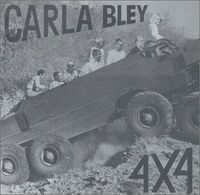
Even though she calls her new band, 4x4, a "small" group, it's a
big band—almost too big for the stage of the Knitting Factory on the night of October 11, 2000, as it makes its first American appearance. Bley's piano is so far to stage left, she has to lean against the wall and stoop under a hanging monitor speaker to address the audience. Four music stands dominate the rest of the apron—her front line of tenor saxophone, alto saxophone, trumpet, and trombone stand shoulder to shoulder, blocking the audience's view of Larry Goldings and his Hammond B3, drummer Billy Drummond, and bassist Steve Swallow, who stands 15' back and on a riser. If she'd showed up with her 17-piece band, they'd have had to have hung the horn sections from the rafters, like the sound system.
That comic image would probably amuse Bley. Over the last three decades, she has constructed a body of work that has distinguished itself as much for its sly wit as for her austerely beautiful melodies. Yet, her music is no joke—she has amassed an impressive list of artistic triumphs as she has hewn to an almost contrarian career path. In an age that reveres the soloist, she has succeeded as a songwriter and arranger; in a world of trios and quartets, she has flourished by thinking big—compared to her big band, which ranges from 12 to 17 pieces, an octet
is a small ensemble, the space constraints of the Knitting Factory stage not withstanding.
"I can't remember who first suggested it, but it just made sense to tour with a stripped-down ensemble," Bley said. "I'm not comfortable performing on stage, so I like to be surrounded by people. My favorite
favorite format is
Escalator over the Hill [
the revolutionary, genre-bending, two-hour "chronotransduction" that catapulted Bley to fame in 1971], where I don't play a note, I just stand up there and conduct. My second favorite is big band, where I just have to play a little accompaniment and wave my arms. After that, 4x4 is my next favorite, because I have a lot of great soloists, and again, all I have to do is a little accompanying and hardly wave my arms at all."
Bley has written for and performed in a wide range of ensembles. She has written piano music for Ursula Oppens, chamber works for the Lincoln Center Chamber Music Society, big-band arrangements for Charlie Haden's Liberation Music Orchestra, several albums' worth of music for vibraphonist Gary Burton's quartet and sextet, as well as for Pink Floyd drummer Nick Mason's first solo album. She has fronted just about every size of large ensemble, but has also toured as part of a sextet (guitar, piano, organ, bass, drums, percussion), trio (sax, piano, bass), and duo (with lifelong advocate, bassist Steve Swallow). The three albums partnering her piano with Swallow's electric bass are fascinating: As frequently as not, she provides the rhythmic bottom for Swallow's soaring melodic forays, inverting the expectation for that instrumental combination. Of course, it also means she has to solo half the time, so she claims to hate it.
"Yeah, but that's the end of that—never again!" she confessed in an interview a few days before the Knitting Factory date. An improvisational duet does seem a strange form for an arranger to encompass. "Too strange—I just can't do it. It's really rough for me to carry that heavy a load. It's hard to get up on the stage and make the announcements and memorize all the tunes and play for two hours, taking more than half the solos. I'm not ever doing it again."
That's too bad; the duets projects offer an incredibly intimate look at Bley and her music. ("Too much so, I think. Woof, it's scary.") Her piano playing has great drive, and an ebullient propensity for ringing chords and bouncy rhythms. Her musical affinity with Steve Swallow seems almost telepathic, and it should; he's played with her from the beginning, and, in fact, commissioned the first piece she sold.
"Yeah, that was over 40 years ago! He's just always been with me—and who wouldn't want to play with a musician like Steve? He plays just like satin. All he has to do is pick up the instrument and everything is covered with satin.
Mwahhh, so marvelous, so luxurious, so slippery, so wonderful."
Swallow is known as the bass player's bass player. He can play deep and low, but tends to soar up into regions that make most players nervous—and then burble along creatively, seeming to play accompaniments as complex as the improvisations they underpin.
"Oh, he's the Yma Sumac of the bass, alright. There
are guys that play really squeaky high notes that are higher than his, but they're not ever in tune."
Over the years, Bley has worked with a remarkable number of musicians, ranging from Gary Burton, who commissioned
A Genuine Tong Funeral from her more than 30 years ago (at the suggestion of his bass player, Steve Swallow), to Charlie Haden, who worked with her through two incarnations of the Liberation Music Orchestra. She's worked with soloists as disparate as NRBQ's Terry Adams and David Letterman guitarist Hiram Bullock to a small coterie of musicians who have played with her so regularly they have become what she refers to as "my guys": trumpet player Lew Soloff, trombonist Gary Valente, alto saxophonist Wolfgang Puschnig, tenor saxophonist Andy Sheppard, and drummer Victor Lewis. 4x4 consists of "her guys," including Swallow, and augmented by organist Goldings. Her list of collaborators seems so inclusive that I ask if there are any contemporary artists she
hasn't played with or written for.