Get Better Sound
By Jim Smith. Quarter Note Press (Cumming, GA), 2008. Paperback, 293 pages. ISBN 978-0-9820807-0-2. $44.50.
Web: www.getbettersound.com. Good advice is the gift that keeps on taking: The more you give it, the more people want from you. No one knows that better than Jim Smith, an experienced audio maven who doesn't have customers so much as a client list. Smith's audio career has included jobs in retail sales (for years, he and his wife owned one of the most successful high-end audio stores in the southeast), customer-service positions at Audio Research and Magnepan, and a few years as the US distributor for Avantgarde Acoustic loudspeakers and Audiopax electronics. It was during the latter period that Smith wrote and produced a booklet, 31 Secrets to Better Sound, which he gave away for the asking. Certainly, 31 Secrets didn't hurt Avantgarde's business any—but it was also the rare freebie that readers agreed was worth significantly more than they'd paid for it.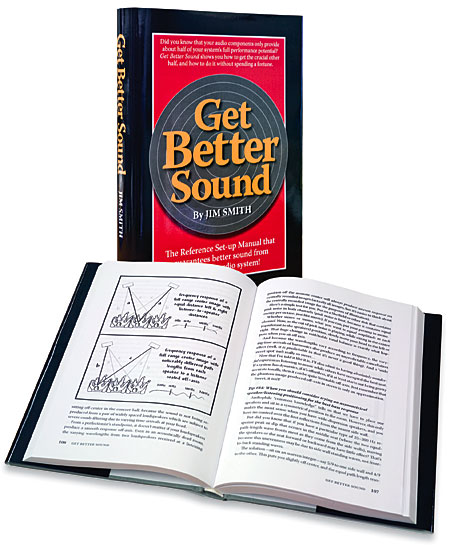 Jim Smith got out of distribution a couple of years ago, but he's returned to the audio scene with a book-length version of his earlier effort, now titled Get Better Sound ($44.50). Over the course of 293 pages, Get Better Sound provides 202 distinct, clearly written, well-illustrated, and generally insightful suggestions on how to maximize and improve the performance of the gear you already own. Although it betrays a certain competence on Smith's part, Get Better Sound is not itself a technical book: It neither requires the reader to know dither from jitter, nor explains such things for those who wish to learn. Rather, in tone and content, Get Better Sound calls to mind the trademark coined by the noted computer guru and audio enthusiast Dave Pogue for his own excellent books: "the missing manual."
In a word, it works—and I wasn't sure that it would. Get Better Sound works because Jim Smith has a talent for offering advice—not because he wants you to think he's the smartest, or funniest, or altogether most powerful alpha male in the audio jungle, but because he loves domestic audio, and he loves sharing his passion for it. That quality is rarer than an atheist at a taffy pull, yet in Get Better Sound, it fairly shines from virtually every page.
Get Better Sound also works by dint of the quality of its ideas—which is more or less the same as saying that many, if not most, of the suggestions in Smith's book reflect my own opinions. (There's nothing a reviewer likes more than to see someone agree with him in print.) Smith says that an equipment rack is best placed off to one side of the room, as far from the speakers as possible (Tip 72); that AC cords and interconnect cables should intersect only at a 90° angle (Tip 130); and that it's pointless to dial in your final speaker location before making sure that you've determined the correct AC polarity for all your components (Tip 81). He's right on all counts. So what if I don't agree when he recommends using Ayre's Irrational but Efficacious CD in system tuning (God bless the guys at Ayre, but my Quad-based system had a horrible reaction to that one), or when he says that the ideal loudspeaker would impress all listeners, and that "personal taste" shouldn't enter in? Smith makes good enough cases that you'll learn something just by following his reasoning.
And I can say, with hand on heart: Get Better Sound has altered my point of view on at least one topic. Before I read it, I was dead set against room treatments, simply because I thought it was the job of an expensive system to adapt itself to my life, not the other way around. Having now spent some time with Smith's thoughts on diffusion, Tube Traps, and the like, I believe I'm ready to try a few changes.
If you've already read 31 Secrets—hell, if you've seen any of the great Avantgarde ads that Jim used to write—you'll recognize the same easy, conversational tone in Get Better Sound. The copyeditor in me wanted to "correct" some things, but the simple fact is, GBS is just plain readable—and clear. When Smith suggests where in the room to begin placing Tube Traps—or how far to toe-in your speakers toward the listening area, or when to know if you should consider asymmetric speaker placement—you won't have to guess at his meaning. My only quibble is that the book would have been greatly enhanced by a few more graphics, the likes of which have appeared in a few earlier efforts: generic but useful things such as a music note-to-frequency chart, a room-dimension-vs-low-frequency quarterwave chart (for those of us who have trouble committing such formulas to memory), a simple cartridge-alignment grid (for those of us who have trouble remembering where we've put the protractor), and so forth. Perhaps in a future edition†...
Here's the cliché for which you've no doubt braced yourself: Get Better Sound is the cheapest good tweak you can buy for your system. True—and I'm not bashful about saying it. It also has the potential to be among the best system investments you can make, period, partly for its breadth of subject matter, and partly because it could lead any open-minded reader, the next time he buys some new gear, to a greater understanding of what it is he really wants. And who among us wouldn't benefit from that? Heartily recommended to newbies and vets alike.—Art Dudley
Jim Smith got out of distribution a couple of years ago, but he's returned to the audio scene with a book-length version of his earlier effort, now titled Get Better Sound ($44.50). Over the course of 293 pages, Get Better Sound provides 202 distinct, clearly written, well-illustrated, and generally insightful suggestions on how to maximize and improve the performance of the gear you already own. Although it betrays a certain competence on Smith's part, Get Better Sound is not itself a technical book: It neither requires the reader to know dither from jitter, nor explains such things for those who wish to learn. Rather, in tone and content, Get Better Sound calls to mind the trademark coined by the noted computer guru and audio enthusiast Dave Pogue for his own excellent books: "the missing manual."
In a word, it works—and I wasn't sure that it would. Get Better Sound works because Jim Smith has a talent for offering advice—not because he wants you to think he's the smartest, or funniest, or altogether most powerful alpha male in the audio jungle, but because he loves domestic audio, and he loves sharing his passion for it. That quality is rarer than an atheist at a taffy pull, yet in Get Better Sound, it fairly shines from virtually every page.
Get Better Sound also works by dint of the quality of its ideas—which is more or less the same as saying that many, if not most, of the suggestions in Smith's book reflect my own opinions. (There's nothing a reviewer likes more than to see someone agree with him in print.) Smith says that an equipment rack is best placed off to one side of the room, as far from the speakers as possible (Tip 72); that AC cords and interconnect cables should intersect only at a 90° angle (Tip 130); and that it's pointless to dial in your final speaker location before making sure that you've determined the correct AC polarity for all your components (Tip 81). He's right on all counts. So what if I don't agree when he recommends using Ayre's Irrational but Efficacious CD in system tuning (God bless the guys at Ayre, but my Quad-based system had a horrible reaction to that one), or when he says that the ideal loudspeaker would impress all listeners, and that "personal taste" shouldn't enter in? Smith makes good enough cases that you'll learn something just by following his reasoning.
And I can say, with hand on heart: Get Better Sound has altered my point of view on at least one topic. Before I read it, I was dead set against room treatments, simply because I thought it was the job of an expensive system to adapt itself to my life, not the other way around. Having now spent some time with Smith's thoughts on diffusion, Tube Traps, and the like, I believe I'm ready to try a few changes.
If you've already read 31 Secrets—hell, if you've seen any of the great Avantgarde ads that Jim used to write—you'll recognize the same easy, conversational tone in Get Better Sound. The copyeditor in me wanted to "correct" some things, but the simple fact is, GBS is just plain readable—and clear. When Smith suggests where in the room to begin placing Tube Traps—or how far to toe-in your speakers toward the listening area, or when to know if you should consider asymmetric speaker placement—you won't have to guess at his meaning. My only quibble is that the book would have been greatly enhanced by a few more graphics, the likes of which have appeared in a few earlier efforts: generic but useful things such as a music note-to-frequency chart, a room-dimension-vs-low-frequency quarterwave chart (for those of us who have trouble committing such formulas to memory), a simple cartridge-alignment grid (for those of us who have trouble remembering where we've put the protractor), and so forth. Perhaps in a future edition†...
Here's the cliché for which you've no doubt braced yourself: Get Better Sound is the cheapest good tweak you can buy for your system. True—and I'm not bashful about saying it. It also has the potential to be among the best system investments you can make, period, partly for its breadth of subject matter, and partly because it could lead any open-minded reader, the next time he buys some new gear, to a greater understanding of what it is he really wants. And who among us wouldn't benefit from that? Heartily recommended to newbies and vets alike.—Art Dudley
By Jim Smith. Quarter Note Press (Cumming, GA), 2008. Paperback, 293 pages. ISBN 978-0-9820807-0-2. $44.50.
Web: www.getbettersound.com. Good advice is the gift that keeps on taking: The more you give it, the more people want from you. No one knows that better than Jim Smith, an experienced audio maven who doesn't have customers so much as a client list. Smith's audio career has included jobs in retail sales (for years, he and his wife owned one of the most successful high-end audio stores in the southeast), customer-service positions at Audio Research and Magnepan, and a few years as the US distributor for Avantgarde Acoustic loudspeakers and Audiopax electronics. It was during the latter period that Smith wrote and produced a booklet, 31 Secrets to Better Sound, which he gave away for the asking. Certainly, 31 Secrets didn't hurt Avantgarde's business any—but it was also the rare freebie that readers agreed was worth significantly more than they'd paid for it.
Jim Smith got out of distribution a couple of years ago, but he's returned to the audio scene with a book-length version of his earlier effort, now titled Get Better Sound ($44.50). Over the course of 293 pages, Get Better Sound provides 202 distinct, clearly written, well-illustrated, and generally insightful suggestions on how to maximize and improve the performance of the gear you already own. Although it betrays a certain competence on Smith's part, Get Better Sound is not itself a technical book: It neither requires the reader to know dither from jitter, nor explains such things for those who wish to learn. Rather, in tone and content, Get Better Sound calls to mind the trademark coined by the noted computer guru and audio enthusiast Dave Pogue for his own excellent books: "the missing manual."