The word on Bel Canto's upsampling DAC was already out when I visited their room at the 2000 Consumer Electronics Show looking to get one of the first samples. But despite my protestations, all Bel Canto's Mike McCormick wanted to talk about was their company's new digital amp, the eVo 200.2. Sure, there's a future out there in which all sources will be digital and D/A conversion will occur in the speaker (or later?). But today, I see no practical advantage in a digital amplifier with only an analog input. It may be more efficient and it may be new technology, but the amplifier has got to stand on the same footing as any analog design and justify its existence by the way it sounds. The eVo did make a good case for itself at the demo, so I signed up to get one for review. 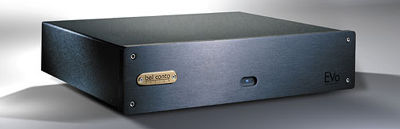 The eVo 200.2, a two-channel amp of trim dimensions and reasonable heft, is based on the class-T digital circuit developed by Dr. Adya Tripathi and Tripath Technology Inc. But while it uses digital signal processing, the eVo is really an amplifier with a switch-mode (class-D) output stage. Switch-mode amps switch their output transistors fully on and fully off at high speeds so that the speaker is alternately connected directly to the positive and negative supply rails. With no audio modulation, the time the plus transistors are on is equal to the time the minus transistors are on, and no audio signal is passed to the speaker load by the intervening low-pass output filter (footnote 1). Standard pulse-width modulation (PWM) amps operate with a fixed switching frequency and vary the width of each + or - pulse so that the post-filter output recovers the amplified audio signal. Because no power is wasted as heat dissipated in the output transistors, a class-D amplifier can in theory approach 100% efficiency at converting the power in the wall socket into power used to drive the loudspeaker.
Class-T, not D
The eVo 200.2, a two-channel amp of trim dimensions and reasonable heft, is based on the class-T digital circuit developed by Dr. Adya Tripathi and Tripath Technology Inc. But while it uses digital signal processing, the eVo is really an amplifier with a switch-mode (class-D) output stage. Switch-mode amps switch their output transistors fully on and fully off at high speeds so that the speaker is alternately connected directly to the positive and negative supply rails. With no audio modulation, the time the plus transistors are on is equal to the time the minus transistors are on, and no audio signal is passed to the speaker load by the intervening low-pass output filter (footnote 1). Standard pulse-width modulation (PWM) amps operate with a fixed switching frequency and vary the width of each + or - pulse so that the post-filter output recovers the amplified audio signal. Because no power is wasted as heat dissipated in the output transistors, a class-D amplifier can in theory approach 100% efficiency at converting the power in the wall socket into power used to drive the loudspeaker.
Class-T, not D
As far as I can glean from the available information the Tripath/EVo approach differs somewhat from strict class-D operation. Class-T amplifiers dither the switching frequency, adjust the "dead time" to suit the output devices, and modulate the switching frequency with the signal. In the EVo, the no-signal switching frequency is about 600kHz and the low-pass LC filter is set at 80kHz. The N-channel output devices (only two per channel) are capable of switching on and off in 30 nanoseconds, which means they can operate at rates approaching 33MHz! When an input is provided, the switching frequency is varied from about 200kHz up to 1.5MHz. Because this variation is in inverse relation to the amplitude of the audio, it's supposed to provide very good linearity at low levels and very good efficiency at high levels. (Dare we infer that there is less linearity at high levels and, inconsequentially, less efficiency at low levels?) I can't find any description of how this modulation relates to a change in pulse width or duty cycle. The application notes do use an example of PWM in their general description of operations, although they insist that "Tripath uses a different technique, having nothing to do with PWM." Because "Tripath does not disclose the exact nature of its technology in order to protect its intellectual property," it will be especially interesting to see what John Atkinson discovers on the test bench. What is apparent from Tripath's information is that its technology, while seemingly simple, needs to be optimized for the particular implementation, and a slew of application notes are provided their manufacturer customers for this. Bel Canto has built the eVo 200.2 with high-quality audio in mind. They use high-speed, audio-quality, differential input devices, optimize the "dead time" for the specific output devices, configure the two channels in anti-phase, and they provide on the printed circuit boards a dual-zone star grounding scheme with double-sided ground planes. The anti-phase relation between the two channels permits easy bridging without the additional stages, and the use of differential input amps provides for balanced and unbalanced inputs.
Initial Impressions
As the eVo emerged from its shipping carton, it was immediately apparent that its fit and finish are excellent. The front panel bears only a Bel Canto medallion and power LEDs. The rear panel has, from right to left, an EIA power socket and power switch, four plastic-capped heavy-duty binding posts for speaker connection, and four input sockets (two each of balanced XLR and unbalanced RCA). Between the input sockets are two small push-push switches: one selects between the balanced and unbalanced inputs, and the other (marked Stereo/Mono) can bridge the two channels to provide a continuous short-term output of 800W into a bridged 4 ohm load. The rear-panel layout is asymmetrical, but in a way that makes bridged connections more convenient.
Footnote 1: Of course, there needs to be a very small but finite "dead time" between switching the + device off and the - device on (and vice versa), or the amp will shunt its own power supplies instead of feeding the output.
The eVo 200.2, a two-channel amp of trim dimensions and reasonable heft, is based on the class-T digital circuit developed by Dr. Adya Tripathi and Tripath Technology Inc. But while it uses digital signal processing, the eVo is really an amplifier with a switch-mode (class-D) output stage. Switch-mode amps switch their output transistors fully on and fully off at high speeds so that the speaker is alternately connected directly to the positive and negative supply rails. With no audio modulation, the time the plus transistors are on is equal to the time the minus transistors are on, and no audio signal is passed to the speaker load by the intervening low-pass output filter (footnote 1). Standard pulse-width modulation (PWM) amps operate with a fixed switching frequency and vary the width of each + or - pulse so that the post-filter output recovers the amplified audio signal. Because no power is wasted as heat dissipated in the output transistors, a class-D amplifier can in theory approach 100% efficiency at converting the power in the wall socket into power used to drive the loudspeaker. As far as I can glean from the available information the Tripath/EVo approach differs somewhat from strict class-D operation. Class-T amplifiers dither the switching frequency, adjust the "dead time" to suit the output devices, and modulate the switching frequency with the signal. In the EVo, the no-signal switching frequency is about 600kHz and the low-pass LC filter is set at 80kHz. The N-channel output devices (only two per channel) are capable of switching on and off in 30 nanoseconds, which means they can operate at rates approaching 33MHz! When an input is provided, the switching frequency is varied from about 200kHz up to 1.5MHz. Because this variation is in inverse relation to the amplitude of the audio, it's supposed to provide very good linearity at low levels and very good efficiency at high levels. (Dare we infer that there is less linearity at high levels and, inconsequentially, less efficiency at low levels?) I can't find any description of how this modulation relates to a change in pulse width or duty cycle. The application notes do use an example of PWM in their general description of operations, although they insist that "Tripath uses a different technique, having nothing to do with PWM." Because "Tripath does not disclose the exact nature of its technology in order to protect its intellectual property," it will be especially interesting to see what John Atkinson discovers on the test bench. What is apparent from Tripath's information is that its technology, while seemingly simple, needs to be optimized for the particular implementation, and a slew of application notes are provided their manufacturer customers for this. Bel Canto has built the eVo 200.2 with high-quality audio in mind. They use high-speed, audio-quality, differential input devices, optimize the "dead time" for the specific output devices, configure the two channels in anti-phase, and they provide on the printed circuit boards a dual-zone star grounding scheme with double-sided ground planes. The anti-phase relation between the two channels permits easy bridging without the additional stages, and the use of differential input amps provides for balanced and unbalanced inputs.
As the eVo emerged from its shipping carton, it was immediately apparent that its fit and finish are excellent. The front panel bears only a Bel Canto medallion and power LEDs. The rear panel has, from right to left, an EIA power socket and power switch, four plastic-capped heavy-duty binding posts for speaker connection, and four input sockets (two each of balanced XLR and unbalanced RCA). Between the input sockets are two small push-push switches: one selects between the balanced and unbalanced inputs, and the other (marked Stereo/Mono) can bridge the two channels to provide a continuous short-term output of 800W into a bridged 4 ohm load. The rear-panel layout is asymmetrical, but in a way that makes bridged connections more convenient.
Footnote 1: Of course, there needs to be a very small but finite "dead time" between switching the + device off and the - device on (and vice versa), or the amp will shunt its own power supplies instead of feeding the output.