I always look forward to Stereophile's Home Entertainment Shows, where I scout out interesting new models of affordable loudspeakers. At HE2007 in New York City, I was struck by the Silverline Audio room—not only by the sound I heard there, but by the way Showgoers reacted to that sound.
 In his fairly large and acoustically favorable room, Silverline's Alan Yun was getting impressive sound from the diminutive Minuet bookshelf speakers ($600/pair). Alongside the Minuets stood a pair of Silverline's larger, floorstanding Preludes ($1200/pair, reviewed by Robert Deutsch in the March 2007 Stereophile). After hearing some bombastic orchestral music reproduced at loud levels, several listeners asked Yun which pair of speakers had been playing. Though it was obvious that a pair of speaker cables connected the amplifier to the Minuets and no speaker cables were connecting the Preludes to anything, the high levels of bombast and bass emanating from the system were so convincing that the listeners simply couldn't believe that it was all coming from the tiny Minuets.
I couldn't believe it either. Immediately, I decided I had to get a pair of Minuets to test out in my home reference system.
Design goals
In his fairly large and acoustically favorable room, Silverline's Alan Yun was getting impressive sound from the diminutive Minuet bookshelf speakers ($600/pair). Alongside the Minuets stood a pair of Silverline's larger, floorstanding Preludes ($1200/pair, reviewed by Robert Deutsch in the March 2007 Stereophile). After hearing some bombastic orchestral music reproduced at loud levels, several listeners asked Yun which pair of speakers had been playing. Though it was obvious that a pair of speaker cables connected the amplifier to the Minuets and no speaker cables were connecting the Preludes to anything, the high levels of bombast and bass emanating from the system were so convincing that the listeners simply couldn't believe that it was all coming from the tiny Minuets.
I couldn't believe it either. Immediately, I decided I had to get a pair of Minuets to test out in my home reference system.
Design goals
The Minuet is the least expensive of Silverline's 12 two-channel loudspeaker models, which top out at the Grandeur Mk.II ($18,000/pair). The company also manufactures an amplifier, audio cables, and two center-channel speakers. The Minuet is a conventional, rear-ported, two-way minimonitor with a second-order crossover. According to Silverline, its stable 8 ohm impedance curve makes it easy to drive with a low-powered amplifier.
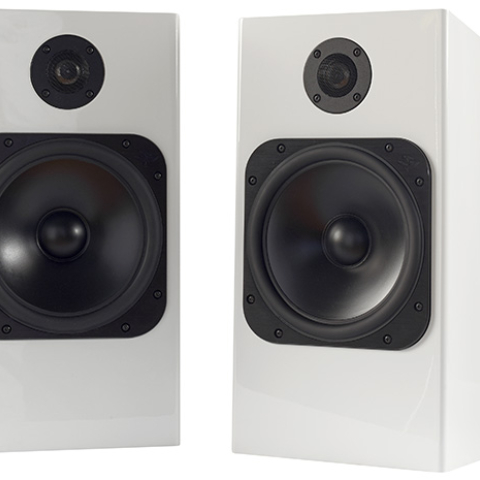
Mounted on the braced cabinet of 5/8"-thick particleboard is a bass driver with a 3.25" paper-pulp cone and a rather large magnet. The 1" silk-dome tweeter has a heatsink at the back of its magnet, designed to enhance the voice-coil's heat dissipation in an attempt to increase its power-handling capability. I found the Cherry vinyl finish quite attractive; a Dark Rosewood vinyl finish is also available.
I placed the Minuets on my trusty 24" Celestion Si stands, which are loaded with sand and lead shot. Although Alan Yun slightly prefers listening to the Minuets without their grilles, for greater degrees of detail and transparency, I thought the speakers sounded a bit more coherent with the grilles on, which is how I did most of my listening.
Listening
It was immediately apparent that one of the Minuet's greatest strengths was its midrange neutrality, transparency, and detail resolution, so I began to mine my collection for recordings of acoustic piano. I followed every nuance of Paul Bley's articulate style on "My Old Flame," from his Live at Sweet Basil (CD, Soul Note 121235-2), which sounded rich and natural. The Minuet's superb resolution of microdynamics made it very easy to follow Bley's unique phrasing.
Next I turned to vocal recordings. "Our Prayer," the opening, a cappella track of Brian Wilson's Smile (CD, Nonesuch 79846-2), was presented as an angelic and seamless blend of male voices, though I was easily able to follow each individual vocal line. Even Aimee Mann's highly processed vocals on her Bachelor No. 2 or The Last Remains of the Dodo (CD, Super Ego SE 002) sounded silky and holographic, and the overall instrumental picture was coherent, with a nice weight to the bass guitar.
Speaking of bass, the tiny Silverlines didn't seem the least bass-shy, even in my large main listening room, which usually presents a challenge to the smallest bookshelf speakers to reproduce a realistic bottom end. (I'm curious to see John Atkinson's measurements of the Minuet's bass talents.) And, yes, the most prominent instrument in the Silverline's reproduction of "Hejira," from Joni Mitchell's Misses (CD, Reprise 46358-2), was Jaco Pastorius's fretless Fender Jazz bass. From my notes: "Nothing bloooooms more than Jaco's bass on 'Hejira.'" While the speaker has no low-bass extension, every midbass instrument I cued up, whether acoustic or electric, was uncolored and forceful, its reproduction by the Minuets resembling the dynamic envelopes reproduced by much larger speakers.
At the opposite end of the frequency spectrum, the highs were clean, extended, and uncolored. The Minuet's natural highs, combined with its superb resolution of low-level dynamics and fast but unetched transients, made it an excellent match for percussion recordings. Is there a better jazz drum solo than the one on the title track of Art Blakey's A Night in Tunisia (LP, Viktor LX-1115)? Blakey's subtle, low-volume phrasing and melodic use of tom-toms are so captivating that I found it difficult to take notes while listening to this track. I then turned to one of my favorite drummers, Paul Motian, particularly his Garden of Eden (CD, ECM 1917). I've often said that I could listen to Motian play a single ride cymbal indefinitely and never get bored, and that's just about what I did. I'd never heard a small, affordable, bookshelf speaker render a ride cymbal more naturally than the Silverline Minuet did for each of this CD's 14 tracks. Although with certain recordings I've heard other speakers reveal more high-frequency inner detail, the Minuet's highs never once deviated from neutrality.
In his fairly large and acoustically favorable room, Silverline's Alan Yun was getting impressive sound from the diminutive Minuet bookshelf speakers ($600/pair). Alongside the Minuets stood a pair of Silverline's larger, floorstanding Preludes ($1200/pair, reviewed by Robert Deutsch in the March 2007 Stereophile). After hearing some bombastic orchestral music reproduced at loud levels, several listeners asked Yun which pair of speakers had been playing. Though it was obvious that a pair of speaker cables connected the amplifier to the Minuets and no speaker cables were connecting the Preludes to anything, the high levels of bombast and bass emanating from the system were so convincing that the listeners simply couldn't believe that it was all coming from the tiny Minuets.
I couldn't believe it either. Immediately, I decided I had to get a pair of Minuets to test out in my home reference system.
Design goals
The Minuet is the least expensive of Silverline's 12 two-channel loudspeaker models, which top out at the Grandeur Mk.II ($18,000/pair). The company also manufactures an amplifier, audio cables, and two center-channel speakers. The Minuet is a conventional, rear-ported, two-way minimonitor with a second-order crossover. According to Silverline, its stable 8 ohm impedance curve makes it easy to drive with a low-powered amplifier.
It was immediately apparent that one of the Minuet's greatest strengths was its midrange neutrality, transparency, and detail resolution, so I began to mine my collection for recordings of acoustic piano. I followed every nuance of Paul Bley's articulate style on "My Old Flame," from his Live at Sweet Basil (CD, Soul Note 121235-2), which sounded rich and natural. The Minuet's superb resolution of microdynamics made it very easy to follow Bley's unique phrasing.