The first reference I saw to the Count of Saint Germain was in Foucault's Pendulum, Umberto Eco's dense novel about a man whose paranoid delusions become so overpoweringly real that, by the end of the book, the reader is left wondering whether the protagonist's enemies actually exist. That their number should include Saint Germain was a nice touch: Part cabalist, part confidence man, the real-life Count was thought by some to be immortal (in Pendulum he's pushing 300), and while Casanova wrote vividly of meeting Saint Germain at a dinner party in 1757, so did the English writer and pederast C.W. Leadbetter—in 1926. Like Aleister Crowley, the Count of Saint Germain can be seen peering over the shoulders of countless parlor (but not parleur, or even haut-parleur) occultists: He keeps popping up all over the place.
 Still, imagine my shock at receiving from John Atkinson—editor, mentor, friend—a carton whose original return address read "Villeneuve Saint German, France."
Holy blue! If the carton's arrival signaled a curse of some sort—retaliation, perhaps, for the time I programmed vulgar phrases into the Simaudio Moon i-7's digital readout—it was too late to turn back: I had already accepted delivery (think: Jacques Tourneur's 1957 film Night of the Demon). I had no choice but to soldier on. So I did.
Description
Still, imagine my shock at receiving from John Atkinson—editor, mentor, friend—a carton whose original return address read "Villeneuve Saint German, France."
Holy blue! If the carton's arrival signaled a curse of some sort—retaliation, perhaps, for the time I programmed vulgar phrases into the Simaudio Moon i-7's digital readout—it was too late to turn back: I had already accepted delivery (think: Jacques Tourneur's 1957 film Night of the Demon). I had no choice but to soldier on. So I did.
Description
Life is full of thoughtless generalities, and here's another: Triangle Electroacoustique is France's version of Mission Audio. Both have been around for a few decades, both have enjoyed commercial and critical success, and both gained fame as makers of domestic loudspeakers that are moderately affordable and often remarkably good. The similarities continue, from the general to the specific: the slim profiles, the proprietary drivers, the generous investments in computer-driven measurement and construction technologies . . .
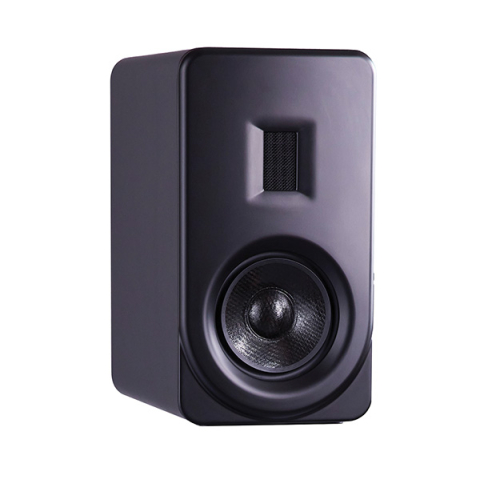
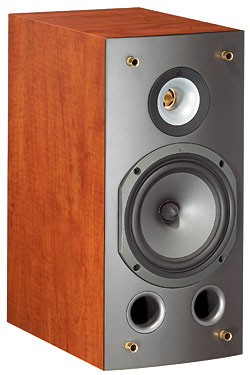
Here's at least one distinction, which I'm told has become a Triangle calling card: The Esprit Comete Ex ($1295/pair) has a horn-loaded tweeter, which flares from the 1" titanium dome at its throat to a mouth that measures some 2.5" in diameter. A longish phase plug, evidently made of brass and held in place with two radial strips, obscures much of the dark-gray dome. The tweeter's housing is molded from a smooth and apparently sturdy plastic; I at first took it to be sealed, but then noticed a tiny opening at the apex of its rear surface: a resistive load intended to increase output, perhaps, or a vent to equalize the pressure on the thin titanium diaphragm.
The 6.3" bass driver has a pulp cone with a smooth outer surface, and is shaped in a mild flare, as opposed to being straight-sided; its own phase plug is proportionately short, and made of hard rubber. Rubber of a much more pliant sort is used for the half-roll surround. The basket is a light cast alloy, with an integral frame for the textile spider.
Those drivers, which are both beautifully made, are held to the machined MDF baffle with hex-head wood screws, the ones for the tweeter being hidden behind a trim ring of hard rubber. The baffle is also home to a pair of molded reflex ports 1.5" in diameter and 2.75" long, mildly flared. Internal wiring is Triangle's own stranded copper cable, fastened with slip-on connectors. The crossover board, whose capacitors also carry Triangle's trademark, is fastened to the rear surface of the MDF cabinet, which is also home to a relatively thin cover of acoustic foam. The cabinet looks unremarkable except for a series of small braces that apparently serve the same purpose as the ribbon lining inside a stringed instrument: to provide additional gluing surfaces for the front and back.
Installation and setup
The Esprit Comete Ex is intended to be mounted on a stand, and because the center of its tweeter is just over 13" above its bottom surface, a stand 20–28" tall would suit the average seated listener. Triangle makes and sells an appropriate stand for the Comete Ex, but that wasn't supplied for the review; instead, I relied on an old pair of open-frame supports from Chicago Speaker Stand that measure a little over 22" tall. An hour or so of fiddling proved, to my satisfaction, that the Comete sounded best when coupled to the stand with tiny bits of Blu-Tak, and that the best (ie, least fussy-sounding) results were to be had when the stand's spiked feet were replaced with self-adhesive felt pads—green ones, in case you believe that makes a difference. A modest amount of bottom-end reinforcement could be had by placing the Cometes very close to the wall behind them. However, given that spatial depth and detail were among the speakers' greatest strengths, I took advantage of those qualities by bringing the Cometes well out into the room, farther from the walls and closer to the listening seat than is usual for me. Measured from a central point on the front baffle, each Comete ended up being 71" from the wall behind it and 27" from its respective sidewall. With my Audio Control SA3050 spectrum analyzer set at 4dB per step, and with its microphone set at ear height, the graphic readout was similar to what you'd see if you used a ruler and a red marker to draw a line between 63Hz and 12.5kHz: Apart from a small peak at 100Hz, the response was very flat, with usable response at 50Hz but nothing below, and a more gentle rolloff in that quaint European neighborhood, The Trebles.
Speaking of which, I preferred listening to the Triangle Cometes with their enclosures aimed straight ahead—under which circumstances the central listening area was off axis with respect to the Cometes' horn tweeters. Listening on the axis, with the enclosures toed-in, the treble range was exaggerated; vocal sibilants and plosives became fatiguing after an hour or so of listening. That may seem counterintuitive, given Triangle's use of a phase plug directly in front of the tweeter diaphragm, but it was nonetheless true.
Two pairs of gold-plated connectors on the rear of the cabinet allow biwiring, if desired, using spade connectors or 4mm banana plugs. I relied on the latter, and kept the Cometes' gold-plated metal links in place for use with my single-wire speaker cables.
Listening
The speakers' best places chosen and their positions all tweaked, I began auditioning the Esprit Comete Exes with Nick Drake's Pink Moon, from the newly re-reissued Fruit Tree boxed set (LP, Universal Island 006025 1745703 4). Notwithstanding its small size, the Comete didn't lose one bit of the richness in Drake's baritone: I was relieved to hear the sound of his voice reproduced with all the body I'd expected, the art of his singing with all its nuance.
Still, imagine my shock at receiving from John Atkinson—editor, mentor, friend—a carton whose original return address read "Villeneuve Saint German, France."
Holy blue! If the carton's arrival signaled a curse of some sort—retaliation, perhaps, for the time I programmed vulgar phrases into the Simaudio Moon i-7's digital readout—it was too late to turn back: I had already accepted delivery (think: Jacques Tourneur's 1957 film Night of the Demon). I had no choice but to soldier on. So I did.
Description
Life is full of thoughtless generalities, and here's another: Triangle Electroacoustique is France's version of Mission Audio. Both have been around for a few decades, both have enjoyed commercial and critical success, and both gained fame as makers of domestic loudspeakers that are moderately affordable and often remarkably good. The similarities continue, from the general to the specific: the slim profiles, the proprietary drivers, the generous investments in computer-driven measurement and construction technologies . . .
The Esprit Comete Ex is intended to be mounted on a stand, and because the center of its tweeter is just over 13" above its bottom surface, a stand 20–28" tall would suit the average seated listener. Triangle makes and sells an appropriate stand for the Comete Ex, but that wasn't supplied for the review; instead, I relied on an old pair of open-frame supports from Chicago Speaker Stand that measure a little over 22" tall. An hour or so of fiddling proved, to my satisfaction, that the Comete sounded best when coupled to the stand with tiny bits of Blu-Tak, and that the best (ie, least fussy-sounding) results were to be had when the stand's spiked feet were replaced with self-adhesive felt pads—green ones, in case you believe that makes a difference. A modest amount of bottom-end reinforcement could be had by placing the Cometes very close to the wall behind them. However, given that spatial depth and detail were among the speakers' greatest strengths, I took advantage of those qualities by bringing the Cometes well out into the room, farther from the walls and closer to the listening seat than is usual for me. Measured from a central point on the front baffle, each Comete ended up being 71" from the wall behind it and 27" from its respective sidewall. With my Audio Control SA3050 spectrum analyzer set at 4dB per step, and with its microphone set at ear height, the graphic readout was similar to what you'd see if you used a ruler and a red marker to draw a line between 63Hz and 12.5kHz: Apart from a small peak at 100Hz, the response was very flat, with usable response at 50Hz but nothing below, and a more gentle rolloff in that quaint European neighborhood, The Trebles.
The speakers' best places chosen and their positions all tweaked, I began auditioning the Esprit Comete Exes with Nick Drake's Pink Moon, from the newly re-reissued Fruit Tree boxed set (LP, Universal Island 006025 1745703 4). Notwithstanding its small size, the Comete didn't lose one bit of the richness in Drake's baritone: I was relieved to hear the sound of his voice reproduced with all the body I'd expected, the art of his singing with all its nuance.