Every engineer has known for years that, while beryllium has excellent physical qualities for use as a speaker radiator—light weight, rigidity, and a remarkable degree of internal damping—it is not usable as such because it cannot be stamped out like most other materials. It will not stretch, and any attempt to shape it simply causes it to split.
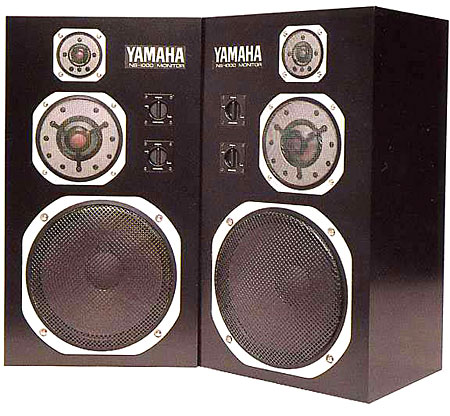 The Japanese Yamaha firm, better known for its successes in motorcycle design than in audio design, has managed to score a First in audio by devising a way of producing speaker domes of beryllium, by depositing the metal on a suitably shaped form and building it up to the requisite thickness by a process similar to that used for laying down the surface of a disc stamper on an acetate (poly-vinyl chloride, actually) master disc.
It appears, though, that Yamaha may have a tough job of selling their 1000 speakers to buyers, for everyone knows that metal cones sound metallic, and since the speakers are sold without grille cloth covers—the drivers are visible through wire-mesh covers—there is no concealing the fact that the mid- and upper-range drivers on the 1000 are metal. Thus, most audiophiles who have listened to our review pairs of NS-1000s have claimed to hear the metallic quality of those speakers. Interestingly, though, when some of them heard the same speakers, after having been told that other speakers standing next to them were operating, they no longer heard the metallic sound and were quite enthusiastic about what they heard. Strange, what a prejudice can do...
Our evaluation, after quite a number of hours of listening to a variety of program sources: Excellent overall sound, slightly forward, somewhat brassy but not at all shrill or metallic, very smooth and extended at the top, rather like electrostatics, with excellent blending and homogeneity between the midrange driver and the tweeter.
As is often the case, though, when an unusually good upper range is matched to a good but not phenomenal woofer, there is an audible discontinuity there. The low end was a hair up at its upper end and gradually tapering down below that, and although the speakers were shaking the room at 35Hz, the output there was substantially below that at 100Hz, and the upper end tended to make the lower range sound weaker on musical material than it actually is. Bass detail, however, was very good.
Stereo imaging was phenomenal—as good as from any system we have heard. We could stand to the left of the left-hand speaker and still hear the full stereo spread between the two speakers. They are also remarkable in that they reproduce depth and perspective about as well as any speakers we have heard. Only the IMFs and the Magneplanars are better in these respects, and not by much. Contributing to the broad stereo spread and outstanding imaging of the NS-1000s is the mirror-image configuratiqn of their drivers.
A caveat
The Japanese Yamaha firm, better known for its successes in motorcycle design than in audio design, has managed to score a First in audio by devising a way of producing speaker domes of beryllium, by depositing the metal on a suitably shaped form and building it up to the requisite thickness by a process similar to that used for laying down the surface of a disc stamper on an acetate (poly-vinyl chloride, actually) master disc.
It appears, though, that Yamaha may have a tough job of selling their 1000 speakers to buyers, for everyone knows that metal cones sound metallic, and since the speakers are sold without grille cloth covers—the drivers are visible through wire-mesh covers—there is no concealing the fact that the mid- and upper-range drivers on the 1000 are metal. Thus, most audiophiles who have listened to our review pairs of NS-1000s have claimed to hear the metallic quality of those speakers. Interestingly, though, when some of them heard the same speakers, after having been told that other speakers standing next to them were operating, they no longer heard the metallic sound and were quite enthusiastic about what they heard. Strange, what a prejudice can do...
Our evaluation, after quite a number of hours of listening to a variety of program sources: Excellent overall sound, slightly forward, somewhat brassy but not at all shrill or metallic, very smooth and extended at the top, rather like electrostatics, with excellent blending and homogeneity between the midrange driver and the tweeter.
As is often the case, though, when an unusually good upper range is matched to a good but not phenomenal woofer, there is an audible discontinuity there. The low end was a hair up at its upper end and gradually tapering down below that, and although the speakers were shaking the room at 35Hz, the output there was substantially below that at 100Hz, and the upper end tended to make the lower range sound weaker on musical material than it actually is. Bass detail, however, was very good.
Stereo imaging was phenomenal—as good as from any system we have heard. We could stand to the left of the left-hand speaker and still hear the full stereo spread between the two speakers. They are also remarkable in that they reproduce depth and perspective about as well as any speakers we have heard. Only the IMFs and the Magneplanars are better in these respects, and not by much. Contributing to the broad stereo spread and outstanding imaging of the NS-1000s is the mirror-image configuratiqn of their drivers.
A caveat
The NS-1000s are like the class-A speakers in that they are almost embarrassingly revealing of the electronics feeding them. They sound best with the best tube-type electronics but excessively biting with most solid-state amplifiers. They also resemble the Infinity SS-1A in that they can become irritatingly strident if used in an acoustically bright listening room. Perhaps they are not everyone's cup of tea even in an average room, but they can produce some of the most golden, blatcy sound from trombones of any speakers we have heard, and it must be remembered that trombones are the instruments that give an orchestra its power and drama. Summing Up
The Yamaha NS-1000 is described as a "bookshelf" system, which is nonsense! Not only is it too large for any bookshelf we ever saw, it also weighs in at over 68 lbs, which few bookshelves are likely to withstand. The weight is due to a great extent to extraordinary internal bracing, which is so effective that pounding the back of the cabinet produces nothing more than a hand-bruising "puk." At around $1000/pair, the model NS-1000's closest price competition is the Dahlquist DQ-l0, which sounds entirely different—more distant, softer, and not quite as good in the stereo imaging department. We suspect the Dahlquist would do better in a bright room, the Yamaha in a deader or duller one. In a neutral one, we think we prefer the Yamahas, but you'd best make your own choice for yourself.
The Japanese Yamaha firm, better known for its successes in motorcycle design than in audio design, has managed to score a First in audio by devising a way of producing speaker domes of beryllium, by depositing the metal on a suitably shaped form and building it up to the requisite thickness by a process similar to that used for laying down the surface of a disc stamper on an acetate (poly-vinyl chloride, actually) master disc.
It appears, though, that Yamaha may have a tough job of selling their 1000 speakers to buyers, for everyone knows that metal cones sound metallic, and since the speakers are sold without grille cloth covers—the drivers are visible through wire-mesh covers—there is no concealing the fact that the mid- and upper-range drivers on the 1000 are metal. Thus, most audiophiles who have listened to our review pairs of NS-1000s have claimed to hear the metallic quality of those speakers. Interestingly, though, when some of them heard the same speakers, after having been told that other speakers standing next to them were operating, they no longer heard the metallic sound and were quite enthusiastic about what they heard. Strange, what a prejudice can do...
The NS-1000s are like the class-A speakers in that they are almost embarrassingly revealing of the electronics feeding them. They sound best with the best tube-type electronics but excessively biting with most solid-state amplifiers. They also resemble the Infinity SS-1A in that they can become irritatingly strident if used in an acoustically bright listening room. Perhaps they are not everyone's cup of tea even in an average room, but they can produce some of the most golden, blatcy sound from trombones of any speakers we have heard, and it must be remembered that trombones are the instruments that give an orchestra its power and drama. Summing Up
The Yamaha NS-1000 is described as a "bookshelf" system, which is nonsense! Not only is it too large for any bookshelf we ever saw, it also weighs in at over 68 lbs, which few bookshelves are likely to withstand. The weight is due to a great extent to extraordinary internal bracing, which is so effective that pounding the back of the cabinet produces nothing more than a hand-bruising "puk." At around $1000/pair, the model NS-1000's closest price competition is the Dahlquist DQ-l0, which sounds entirely different—more distant, softer, and not quite as good in the stereo imaging department. We suspect the Dahlquist would do better in a bright room, the Yamaha in a deader or duller one. In a neutral one, we think we prefer the Yamahas, but you'd best make your own choice for yourself.