

AkitikA GT-102 power amplifier

An e-mail from an old audiophile pal: "Herb, my buddy owns a recording studio, and he told me one of his $10k reference amplifiers stopped working and the manufacturer said it would take months to be repaired. So he went online and bought this 60W AkitikA solid-state amplifier to use while his big amp was being repaired. The trouble is, the kit cost only $314. (The studio guy bought his assembled and tested for $488.) Now, he likes the AkitikA more than his broke-down reference amp."
Anthem Statement M1 monoblock power amplifier

When I first saw Anthem Statement's M1 at the 2011 CEDIA Expo, it was a bolt from the blue. Happening on this flat, black slab of an amplifier lying on a display table or bolted to a wall, reminded me of the appearance of the iconic monolith in Stanley Kubrick and Arthur C. Clarke's 2001: A Space Odyssey. The M1's dimensional ratios are not 12:22:32, and there are many other one-rack-unit ampsyet, like the monolith on the moon, the M1 was in such striking contrast to everything else in its environment that it demanded attention and reflection.
Aragon 8008 power amplifier

Like most audiophiles, I salivate over the latest Jurassic, second-mortgage-inducing power amplifier. Whether it's about the music itself, or simply "my amp is bigger than your amp" one-upmanship, we all know that those who risk a hernia in pursuit of the ultimate in sound invariably come out winners.
Arcam FMJ P49 power amplifier

I first met electronics engineer John Dawson in 1979, at a British audio show. The company he'd co-founded, A&R Cambridge, had just launched the A60, a slim, elegant-looking, 40Wpc integrated amplifier costing only £99 (then equivalent to $217).
By the time I reviewed the Mk.2 version, in the October 1984 issue of Hi-Fi News & Record Review, the A60's price had risen to £199 ($248), the company was now called Arcam, and more than 22,000 A60s had been sold, making it one of the best-selling amplifiers in England. While preparing that review I had visited Arcam's factory, near the English town of Ely, where Dawson had shown me filing cabinets containing a separate manufacturing report for each and every one of those A60s.
Audio Alchemy DPA-1M monoblock power amplifier
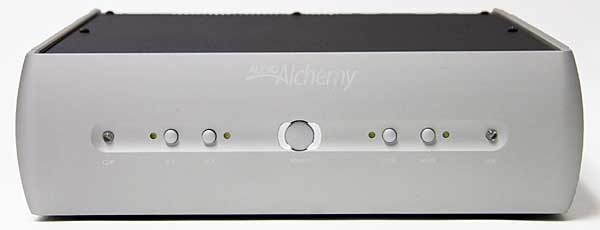
To those who were into audio in the late 1980s and early '90s, the name Audio Alchemy is a familiar one. I've owned DACs and jitter-reducing devices made by Audio Alchemy and Perpetual Technologies (the first successor to the original AA) and found them to provide excellent performance at modest prices. Indeed, at the time, many in the industry felt that the Audio Alchemy products were underpriced, leaving too little room for profit, and that this led to the company's demise. The new Audio Alchemyled by its original designer, Peter Madnick, and having on staff other employees from the old AAis what Madnick describes as a "grown-up" version of the original company, maintaining "the brand's original ethos of superior technology and value." And the prices, while quite reasonable for the performance they seem to offer, appear high enough to allow the new AA to survive.
Audio Research D-100 power amplifier
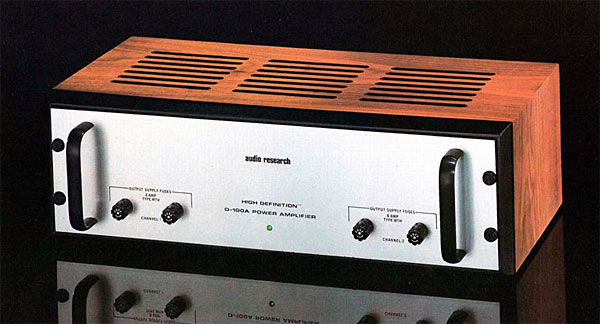
We cannot recall when any new products have generated as much of a stir among perfectionists as the new solid-state equipment from Audio Research. Preceded by rumors of "a new kind of amplifying devicea cross between a tube and a transistor"the announcement of ARC's new power amp and SP-4 preamplifier elicited very mixed reactions from loyal ARC customers, some of whom gleefully anticipated a virtual revolution in audio electronics, others of whom felt betrayed by the company which, having originally convinced them that "Tubes Are Better," suddenly seemed to be doing an about-face and espousing the views of the Enemythe "Soiled-State"forces.
Audionet Max monoblock power amplifier
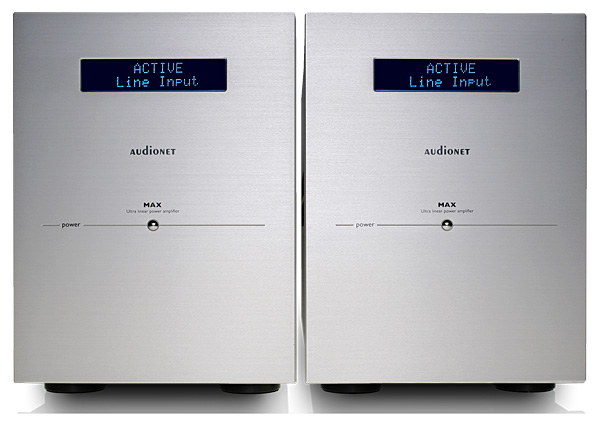
Three years ago, when I first heard Audionet's Max monoblock power amplifiers, I described their pairing with YG Acoustics Hailey loudspeakers "an absolute winner" and "definitely one of the finer systems at T.H.E. Show Newport Beach." At subsequent audio shows, no fewer than four other Stereophile Contributing Editors enthused about different pairings of YG loudspeakers with Audionet amplification. Herb Reichert, at the 2014 Rocky Mountain Audio Fest: "Everything had a kind of just right quality. Totally impressive!" Sasha Matson, at RMAF 2015: "Marvelous" on vocals, "rockin' and tight" on bass and drums. John Atkinson, at T.H.E. Show 2016: "Duke Ellington's classic Jazz Party in Stereo . . . was reproduced with terrific dynamics." Larry Greenhill at the 2017 Consumer Electronics Show on the sound in the YG Acoustics room, which included Audionet's Max monoblocks: "the sound on playback of Jake Shimabukuro's ukulele wizardry came closer to matching his live performance than in most rooms."
AVM Ovation MA8.2 monoblock power amplifier

I've known Peder Bäckman, international sales director for the German firm Audio Video Manufaktur GmbH (AVM), for many years, ever since he worked with Electrocompaniet. When I told him that I was looking for products to review in the reference system in my new 20' by 16' by 9' music room, he invited me to browse AVM's large catalog and see what tickled my fancy. In consultation with John Atkinson, it became clear that AVM's largest, most powerful monoblock amplifier, the Ovation MA8.2 ($29,990/pair), seemed a good fit.
Ayre Acoustics MX-R Twenty monoblock power amplifier
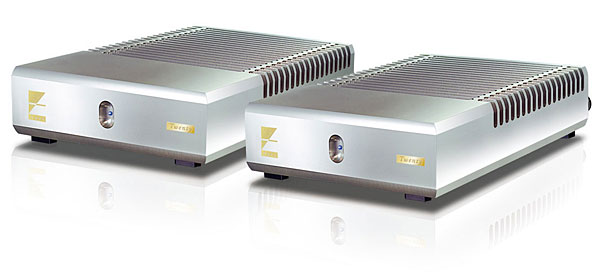
Of the hundreds of product reviews I have written over the years, it is perhaps those of power amplifiers that present the hardest task in defining their worth. This is not because power amps are unimportant. As I wrote in my review of the MBL Corona C15 monoblock, in June 2014, "it is the power amplifier that is responsible for determining the character of the system's sound, because it is the amplifier that must directly interface with the loudspeakers. The relationship between amplifier and loudspeaker is complex, and the nature of that relationship literally sets the tone of the sound quality." But because the amplifier's role is so fundamental, it can at first be difficult to determine a given amp's balance of virtues and failings. A paradox.
Ayre Acoustics V-3 power amplifier
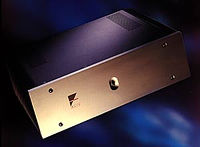
"Why no review of the Ayre V-3?" queried Stephen Slaughter in July's "Letters" column, echoing several urgent posts to my e-mail address. Word of mouth on this remarkable 100Wpc amplifier was reaching fever pitch. Show reports over the last several years had sounded a consistent note—rooms that demoed with V-3s kept getting mentioned in "Best of Show" overviews. Naturally, this also meant that the pendulum had started its backward swing. "It's not really as good as people are saying," one WCES attendee confided in me. "That's why they won't give it to critics."