

Ayre Acoustics VX-8 power amplifier

Can an audio brand maintain a "house sound" if the original creator of that sound is no longer among the living? If the brand in question is Ayre Acoustics, the answer is a resounding Yes.
When Ayre founder Charley Hansen passed in late 2017, Ariel Brown, who is now Ayre's vice president and chief technology officer, was ready, waiting in the wings. Brown has worked for Ayre since he was a sophomore in college. As John Atkinson wrote in his February 2019 review of Ayre's EX-8 Integrated Hub, "Brown says that for better or worse, he was indoctrinated in Hansen's way of thinking and design. 'I only know the Charley way! Charley never wanted to introduce a product unless we had something new to offer with that product. 'NewBetterDifferent' was his philosophy; every product had to be a step up from before.'"
Ayre MX-R monoblock power amplifier

Recently, on the Stereophile Web">http://forum.stereophile.com/forum/ubbthreads.php">Web forum, reader Natal commented on Robert J. Reina's review of the Creek">http://www.stereophile.com/integratedamps/107creek">Creek Audio Destiny integrated amplifier in the January 2007 issue: "Maybe it's just me but I've never found any piece of electronic equipment sexy."
Ayre V-1 power amplifier
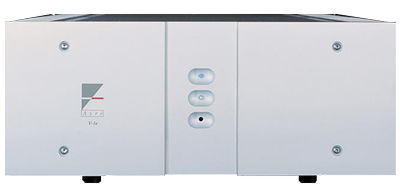
I've heard my share of Krells, Levinsons, Rowlands, and the like in other people's systems—expensive solid-state amplifiers are not my usual beat. With the exception of an inexpensive Adcom a few years back, for more than a decade I've owned and reviewed only tube amps. In fact, until the $7500 Ayre Acoustics V-1 showed up, I'd not had one in my system. Similarly, I'd had only tube preamps until I reviewed the Ayre K-3, which so impressed me that I asked to hear the more">http://www.stereophile.com//amplificationreviews/609/">more expensive K-1—and ended up buying it.
B&K ST-140 power amplifier
I must admit that even before I connected up this amplifier I was put off by the accompanying literature. B&K makes some persuasive points about the validity (or rather the lack thereof) of some traditional amplifier tests, but the literature was so loaded with flagrant grammaticides, syntactical ineptitudes, and outright errors that I could not help but wonder if the same lack of concern had gone into the product itself (eg, the term "infrasonic" is used throughout to mean "ultrasonic"). Good copy editors aren't that hard to find; B&K should have found one.
Balanced Audio Technology REX 500 power amplifier

There was a period in the 1970s when many pop ballads that should have had understated arrangements instead turned grandiose and even maudlin. Take Gilbert O'Sullivan's sensational single "Nothing Rhymed" (a track that went deep for a pop hit, referencing famine, duty, and morality). Soon after the start, O'Sullivan's piano is overshadowed by a loud, saccharine string section.
Another example is "Lotte," German singer Stephan Sulke's portrayal of a dying love affair. The devastatingly wistful chanson is burdened by a mawkish orchestral trackthe equivalent of glitterbombing an Edward Hopper painting.
Contrast this with Roberta Flack's definitive version of Ewan MacColl's "The First Time Ever I Saw Your Face." Apart from Flack's voice and her emotional delivery, the gently strummed guitar and quiet piano do all the heavy lifting. An unhurried double bass and a couple of minimally bowed string instruments leave swaths of negative space, helping to give her interpretation its hushed, reverent character.
I reflected on all this after spending several months with Balanced Audio Technology's REX 500 solid state power amplifier ($25,000), which has more in common with the Roberta Flack track than with the bombast of "Nothing Rhymed."
Bel Canto Design Black ACI 600 integrated amplifier

When Michael McCormick, president of Bel Canto Design, suggested that I review their Black ACI 600 integrated amplifier, I accepted without hesitation. As wonderful as my reference system may sound, its dCS digital front end alone comprises four boxes and a web of cables complex enough to send many a spider spinning. Given the choice between connecting that front end to a pair of expensive, enormous monoblockswith their similarly expensive AC cords and equipment racks/isolation platformsor to a single, visually elegant, 45-lb box that costs $25,000, produces 300Wpc into 8 ohms, and requires only a single power cord and shelf, I think many an audiophile, even those with lots of money, might gravitate toward the latter.
Bel Canto Design Black amplification system

Stereophile normally doesn't review audio systems. We review individual components. We've made an exception for the Bel Canto Black system because it deserves to be evaluated as such. It consists of three dense, almost identically sized cases of black-anodized aluminum. One, the ASC1 Asynchronous Stream Controller, is what in a conventional system would be called a "preamplifier." The other two, a pair of MPS1 Mono PowerStreams, would in a conventional system be called "monoblock power amplifiers."
Bel Canto e.One Ref600M power amplifier
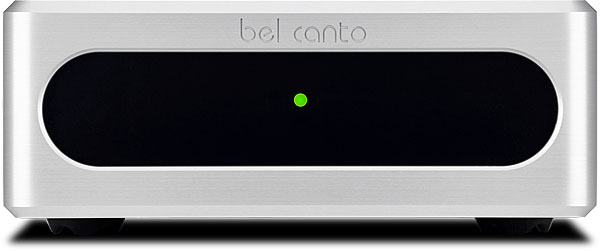
Has it really been more than seven years since I reviewed Bel Canto's REF1000M monoblock? According to the Bel Canto website, that model, based on Bang & Olufsen's ICEpower class-D modules, is no longer available. But now, like so many manufacturers, Bel Canto has adopted for its new models the NCore class-D module from Hypexalthough the REF600M monoblock ($4990/pair) is not Bel Canto's first product to use it . . .
Bel Canto e1X power amplifier
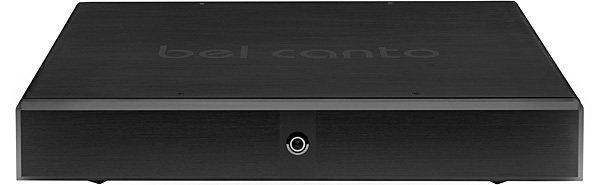
I own and enjoy loudspeakers from seemingly opposite ends of the audiophile spectrum: I'm a huge fan of minimally efficient yet otherwise overachieving flat-panel designs, such as my Magnepan LRS speakers. Yet I'm just as smitten with another, equally outside-the-norm alternative: high-sensitivity full-range loudspeakers, such as my Zu Omensespecially when driven by tube electronics. It's an ongoing yin and yang that keeps my home system in a constant state of flux: Alternating between loudspeakers that use such different technologies, while maintaining relatively optimal positioning for each, is a bit daunting.
Bel Canto eVo 200.2 power amplifier

The word on Bel Canto's upsampling DAC was already out when I visited their room at the 2000 Consumer Electronics Show looking to get one of the first samples. But despite my protestations, all Bel Canto's Mike McCormick wanted to talk about was their company's new digital amp, the eVo 200.2. Sure, there's a future out there in which all sources will be digital and D/A conversion will occur in the speaker (or later?). But today, I see no practical advantage in a digital amplifier with only an analog input. It may be more efficient and it may be new technology, but the amplifier has got to stand on the same footing as any analog design and justify its existence by the way it sounds. The eVo did make a good case for itself at the demo, so I signed up to get one for review.