

Bricasti Design M15 power amplifier

On the second morning of a recent audio show, I walked into the exhibit room of Bricasti Design.
"How about some Mahler?" asked cofounder and designer Brian Zolner.
"Oh God. Not at 10am!"
Bricasti Design M28 monoblock power amplifier

Google Bricasti and all that comes up are sites relating to Bricasti Design products. The name must be fancifulit sounds Italian, but cofounders Brian Zolner and Casey Dowdell most likely are not, and the company's headquarters are not in Milan or Turin but in Massachusetts.
While its name might be whimsical, nothing else about Bricasti is. As John Marks reported in his review of Bricasti's M1 DAC in the August 2011 issue, both founders previously worked at Lexicon: Dowdell as a DSP-software engineer, Zolner as international sales manager. Bricasti develops its products in conjunction with Aeyee Labs, formed by a group of ex-employees of Madrigal Audio Laboratories and based in New Haven, Connecticut.
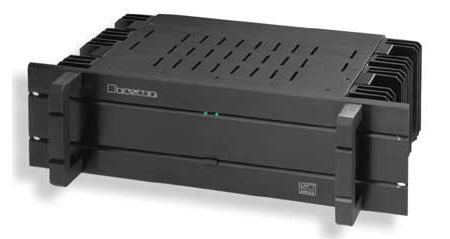
Bryston 14B-SST power amplifier
Talking to fellow audiophiles, I sometimes hear generalizations about power-amplifier design: "High-power amplifiers don't sound as good as low-power amplifiers." "Tube amps are more musical than solid-state amps." "Class-A circuit designs always sound better than class-AB." "Bridged amplifiers don't image precisely, throw deep soundstages, or have the transparency of non-bridged output stages." Etc.
Bryston 28B-SST monoblock power amplifier

It was a hot, humid, New York City evening in early August, and I was thankful to be sitting in the air-conditioned dark of Avery Fisher Hall, up in the Second Tier, for a Mostly Mozart concert. Listening to cello soloist Alisa Weilerstein in Osvaldo Golijov's hypnotic Azul, I was suddenly jolted by an explosive mix of primitive cello sonorities, accordion, and staccato riffs on ethnic percussion instruments. My thoughts turned to the importance in music of both power and delicacy, and of how Bryston Ltd.'s 28B-SST, a 1000W monoblock power amplifier, was designed to address both.
Bryston 3B-ST power amplifier
Canadian electronics manufacturer Bryston Limited has been producing consumer and professional amplifiers since 1974 [see Robert Deutsch's interview elsewhere in this issue—Ed.]. Bryston amps are engineered to be physically and electrically rugged, to meet the stringent demands of professionals, many of whom leave their studio amplifiers turned on for years. While chassis had to be light instead of the audiophile massiveness found in some high-end consumer amplifiers, studio engineers and concert pros continued to favor Bryston amps, which easily passed the "steel toe" test. The 4B, for example, became a standard amplifier for recording engineers and touring musicians.
Bryston 4B power amplifier

On January 1, 1990, Canadian electronics manufacturer Bryston instituted a remarkable warranty program that covered each of their products for a full 20 years. This warranty includes all audio products ever manufactured and sold under the Bryston name. Besides covering parts and labor costs, the company will also pay shipping costs one way. This is all the more significant for their 4B NRB amplifier, which has been in production since 1976. The amp's $2k price, while not cheap, is at the lower end of what well-heeled audiophiles typically pay for amplifiers.
Bryston 7B NRB-THX, ST, & SST monoblock power amplifier

The Canadian audio industry has been mounting a challenge to other high-end manufacturers over the past few years. Ask any audiophile about Canadian audio manufacturers and chances are that he or she will have no trouble rattling off a string of respected names—Classé, Museatex, Sonic Frontiers, Mirage, PSB, Paradigm, Energy. And Bryston.
Bryston 7B SST2 monoblock power amplifier

Hang around long enough, and your reward is often to be taken for granted or ignored. Canadian electronics manufacturer Bryston Ltd. has been around since the mid-1970s, and whileif coverage by Stereophile is any indicationthe company has hardly been ignored, it's often taken for granted.
Bryston 9B-THX five-channel power amplifier

Bright April Sunday sunshine beams through the bay window of my listening room. The light catches four loudspeakers on stands, two stacks of electronic equipment, a small video monitor, black cables strung behind furniture, and a pile of freshly opened DVDs. I sit in the center in a large, overstuffed chair covered in blue velvet, listening to an array of six loudspeakers and a TV monitor playing The Haunting's DTS soundtrack. The floor rumbles as the sounds of creaking timbers come up from below.
Buckeye Purifi Eigentakt 1ET9040BA monoblock power amplifier

Back in 2016, I documented the rise of class-D amps using the early TriPath technology. Used in the Bel Canto eVo 200.2, TriPath cracked open the door to the High End but was never admitted due to a dim and opaque treble. The second wave was based on B&O's ICEpower technology, again via a Bel Canto amplifier, the Ref1000M monoblock. ICEpower had more credibility and was accepted by many but, often, only with, ahem, due consideration for size and efficiency. There was an explosion of new class-D amps in 2016 when Stereophile featured glowing reviews of Bel Canto's e.One Ref600M monoblock, Theta's Prometheus monoblock, and NAD's Masters Series M22 stereo amp, all based on Bruno Putzeys's Hypex NCore technology modules. Finally, it seemed that class-D was "in the room," though, even to this day, there remain critics and quibblers who continue to deny them as true high-fidelity products.
Well, time does not stand still and neither did Bruno Putzeys. He, along with Lars Risbo and Peter Lyngdorf, had founded Purifi in 2015, and in 2019 he unveiled the Purifi Eigentakt power amplifier modules.