

Burmester 216 power amplifier
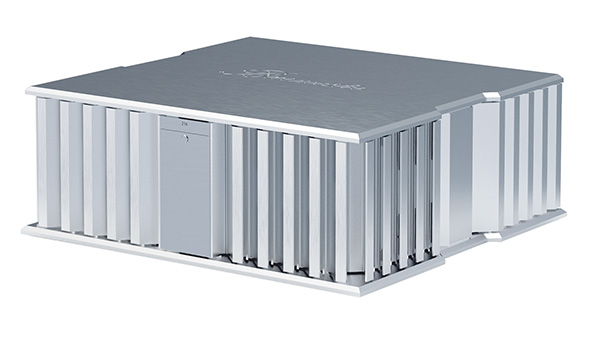
When I was offered the opportunity to review a Burmester productthe 216 stereo power amplifierI accepted immediately, mainly out of curiosity. Berlin-based Burmester is an important hi-fi brand, but I knew very little about the company and their products. What better way to learn more than to review one of their products?
Burmester 218 power amplifier

As much as I tinkered with a little crystal radio as a child and started reading stereo magazines in high school, it wasn't until my early 30s that I half-stumbled into the higher end of the hi-fi sphere. As I progressed from used Advents to used Spicas and began to experiment with speaker cables, more and more names of high-end brands entered my consciousness. Burmester (founded in 1977), and some of the other higher-priced components from overseas whose looks seemed commensurate with their prices, held an outsized fascination for me. What about them, other than their visual appearance, accounted for their vaunted reputations and cost?
Carver Research Lightstar Reference power amplifier
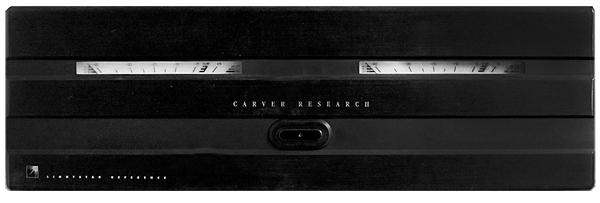
When it comes to amplifiers, ya gotcher tubes, yer solid-states, and yer hybrids. Although amplifier manufacturers would have you believe otherwise, the majority of designs within each category are variations on a few fairly-well-known themes. Everyone agrees that the power supply is extremely important. Most designers try to obtain the amplifier's desired frequency response and distortion characteristics with a minimum of negative feedback. It's also agreedat least among designers of solid-state ampsthat the ability to drive a variety of speakers, including those that present a low-impedance and/or reactive load, is an important priority.
Carver Silver Seven-t monoblock power amplifier

In 1988, Bob Carver set out to design the best amplifier he possibly could, without regard for cost. It was more of an ego exercise than an attempt to build a product with wide commercial appeal. The result was the four-chassis, $17,500 Silver Seven.
Interestingly, Bob Carver chose vacuum tubes to realize his dream of building the ultimate power amplifier. The Silver Seven uses fourteen KT88 output tubes per channel, and puts out 375W into 8 ohms. Bob built three pairs of Silver Sevens, not expecting to sell many at the $17,500 asking price. When those sold quickly, another 10 pairs were manufactured. Now, demand is so great that Silver Sevens are built in groups of 30 pairs.
CH Precision M1.1 power amplifier

CH Precision's massive, versatile, technologically sophisticated, 165 lb M1.1 power amplifier ($54,000 configured for stereo) can easily crush your foot if you're not careful when installing it. But the more important consideration is this: Can this cool gray techno-square sing and dance without stepping on its own feet?
CH Precision M10 monoblock power amplifier

A mono pair of CH Precision M10s ($210,000/pair as reviewed) declares its presence in capital letters. Each channel consists of two large units, each almost 2' high, linked by a total of four umbilical cords. While the "lighter" amplifier unit weighs almost 117lb, the toroidal transformer–based power supply unit tops out at nearly 172lb. That's a lot of metal.
Channel Islands Audio D-100 monoblock power amplifier

"You're reviewing a class-D amplifier?" whined John Atkinson. "I hate measuring those."
Chord SPM 14000 Ultimate monoblock power amplifier

Lord Acton said, famously, that power corrupts and absolute power corrupts absolutely. If there ever were an amplifier to test that maxim's applicability to audiophiles, it is surely the Chord SPM 14000 Ultimate Monoblock. Priced no less than $75,000/pair, the SPM 14000 is rated to produce power as do very few other amplifiers on the planet: it is very conservatively rated at 1kW into an 8 ohm load, 2kW into 4 ohms, and "will easily exceed" 2800W (give or take a few watts) into 2 ohms.
Chord SPM 650 power amplifier

High-tech, compact, and lightweight, Chord's entry-level SPM 650 power amplifier ($4995) promises robust power output, low distortion and noise, flat and ultra-wideband frequency response, and bulletproof reliability—all in what seems an impossibly small package measuring 16.4" wide by 3.4" high by 13.8" deep and weighing only 22 lbs.
Classé Audio DR-3 power amplifier

Classé Audio's DR-3 once again brings to the fore the issues of class-A vs class-AB, weighty vs small and efficient, and brute-force expensive vs clever and inexpensive.
A well-worn, if unproven, audiophile rule of thumb says that a small, quick amplifier will sound better than a very powerful one. Among low-powered amps, those that operate in "pure" class-A are thought to be sonically superior. Pure class-A means the amplifier must run a constant high bias (more than one ampere), so the output devices never turn off.