

Hot Stuff: Loudspeaker Voice-Coil Temperatures
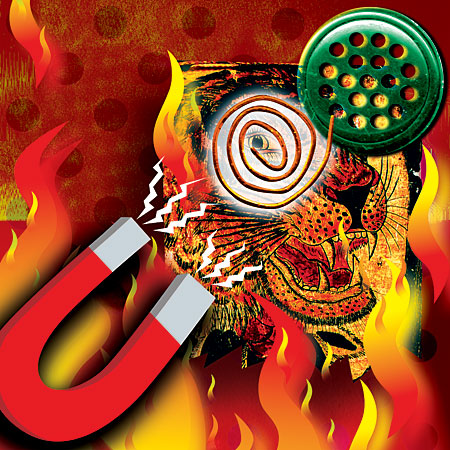
As Hans Christian Oersted, the Danish physicist and founder of electrodynamics, discovered in 1819, an electric current passed through a wire generates a magnetic field. Place that wire close to a permanent magnet and the interaction of the two fields will generate a force. That, in two sentences, summarizes the operating principle of the motor that energizes every moving-coil drive-unit in millions of loudspeakers worldwide. It sounds simple, but—like everything in audio—it isn't.
Humidity, Concert Hall Sound & Spectral Tilt

I want to talk about the acoustics of live music and recordings. As I write this I'm back in Boston for a week, re-calibrating my ears with (excuse the expression) the "absolute sound" of live music in various concert halls. On Friday the Boston Symphony played symphonies by Mozart and Shostakovich, producing (as always) magnificent sound with the aid of Symphony Hall's near-legendary acoustics.
In Search Of The Audio Abode---The Hi-fi House
When sociologists tell us America is a highly mobile society, they don't just mean we do lot of driving. What they mean is, we do a lot of moving. The good old three-generation family homestead, immortalized in nostalgia TV and literature, is a thing of the past. According to census information, almost 20% of America's population changes its address every year. Of course, it's usually a different 20% every year, but pulling up roots and moving---to a bigger house, a better neighborhood or a nicer city, not to mention a place where your employer decides to transfer you---is almost as commonplace across the US of A as marriage, divorce, and unbridled greed.
Inside MQA

Jim Austin briefly discusses MQA in his review of the Explorer2 in this issue, but a more complete description of MQA can be found in an article posted on Stereophile's website at the end of 2014.
MQA involves two fundamental concepts, discussed in a paper presented to the Audio Engineering Society in October 2014, the first responsible for a potential improvement in sound quality, the second responsible for a large reduction in the bandwidth required for storage and streaming of high-resolution files...
JA on Loudspeaker Measurements
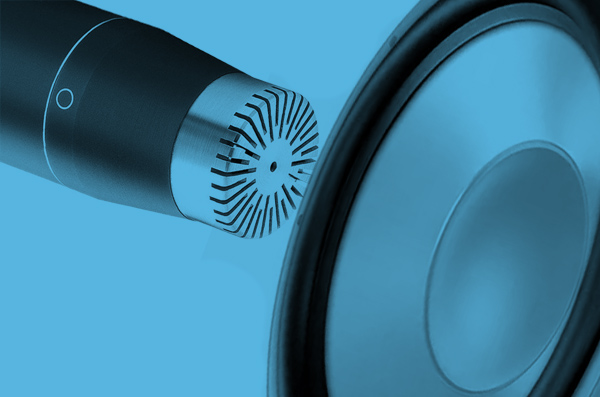
Author's Note: Although I started accompanying Stereophile's loudspeaker reviews with measurements soon after I joined the magazine in 1986, it wasn't until 1989, when we acquired an Audio Precision System One electronics analyzer and the then-new MLSSA speaker measurement system from DRA Labs, that I developed the standardized data presentation that is still featured in our reviews more than three decades later. In this article from October 1991, I summarize the results from the first two years of using MLSSA to test 69 loudspeakers.John Atkinson
Jitter & the Digital Interface
Until recently, all problems in digital audio systems were blamed on either the analog/digital converters (ADCs) used in mastering or the digital/analog converters (DACs) needed for playback (footnote 1). As the performance of both ADCs and DACs improved, however, a previously unrecognized mechanism for distortion was unmasked: jitter. As we shall see, jitter—or, more correctly, word-clock jitter—can be a significant limitation in the technical and sonic performance of digital audio systems (footnote 2).
Jitter, Bits, & Sound Quality
Jitter is not what digital sound quality induces in the listener; rather it is the instability in the clock signal that controls exactly when the analog waveform is sampled in the original A/D conversion, or when the digital word input into a DAC results in an analog voltage being produced at the chip's output. "So what?" is the response of digital advocates, "As long as a digital one is recognized as a one and a digital zero as a zero, then how can there be any difference in sound?" goes their argument, normally culminating in a fervently expressed "Bits is bits!"
Jitterbuggin'
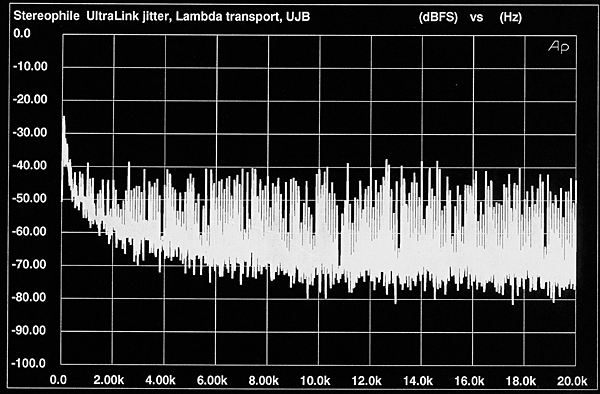
If there's one buzzword in high-end audio for the 1990s, it's undoubtedly jitter. "Jitter" describes timing variations in the clock controlling the ones and zeros that represent the analog audio signal. If that clock isn't stable to an extraordinarily precise degree, the sound quality of the digital processor will be degraded.
A CD transport/digital processor combination introduces jitter in three ways: 1) the transport puts out a jittered signal; 2) the S/PDIF or AES/EBU interface between the transport and processor creates jitter; and 3) the digital processor adds its own jitter to the clock. These additive factors are largely responsible for the great range in sound quality we hear from different transports and interfaces.
Lindsay-Geyer Highly Magnetic Cables

Why cable again?
Well, the obvious reason is that it has been a while since my last foray into Cableland (July 1988). Many new products have been introduced in the interim, so it appeared appropriate to once again open Pandora's Box. Those of you who still remember my speaker cable article of 2½ years ago will recollect the considerable controversy that evolved from that project.
Some of the response was quite predictable, though the venom with which it was laced was not. The manufacturers of those outrageously priced "garden-hose"type cables that I failed to rave about were more than just perturbed.
Listening Tests and Absolute Phase

The problem confronting the magazine reviewer when organising the necessary listening tests to accompany/reinforce the measured behavior of a device under test is complex. There has never been a problem with the measurement aspect; as long as someone has access to the same test gearand full knowledge of the test conditionsthen he should be able to replicate the critic's findings exactly (assuming an infinitely narrow spread of behaviour from sample to samplea rasher assumption with some manufacturers' equipment than of others). However, when it comes to determining reliably the audible (or inaudible?) effects on music program by an amplifier/cartridge/loudspeaker etc. then the going gets tough.